de Truchis Pierre, de Truchis Anne
Département de Médecine et Maladies Infectieuses, Hôpital Raymond Poincaré, APHP, Garches.
Presse Med. 2007 Apr;36(4 Pt 2):695-705. doi: 10.1016/j.lpm.2006.11.023. Epub 2007 Feb 27.
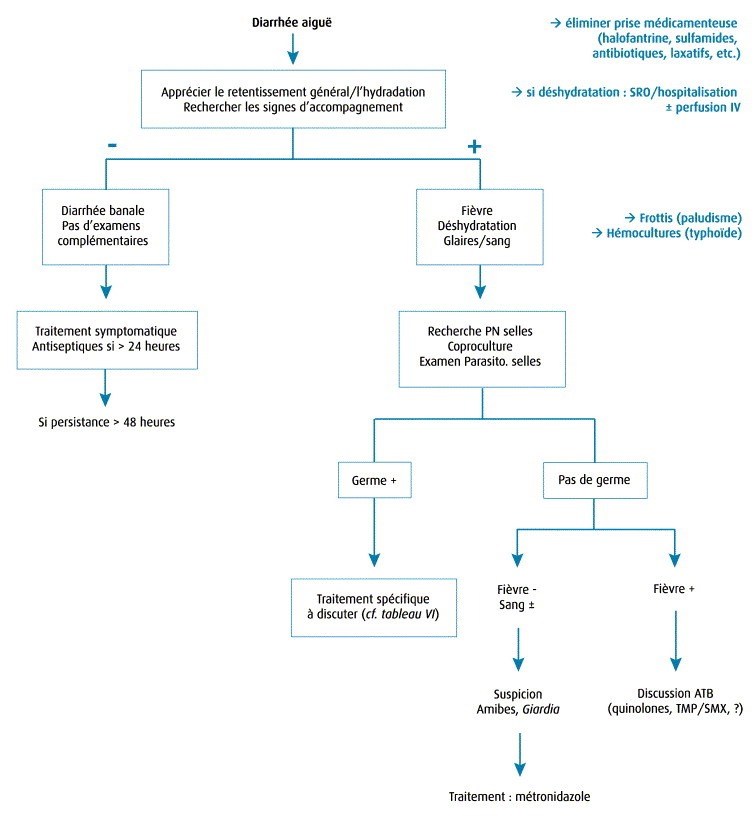
Acute infectious diarrhea has various causes: bacterial diarrhea with invasive or toxigenic mechanisms, especially frequent in hot regions and in travelers; viral diarrheas, frequent and cosmopolitan in children but also adults; and parasitic diarrhea, less frequent, and generally in subtropical areas. The major concerns involve the risk of complications, essentially dehydration and malnutrition, especially in vulnerable patients: young children, the elderly, and patients with immunosuppression, for whom rehydration is urgent. Diagnosis of diarrhea requires clinical assessment and history: underlying illnesses, severity of symptoms, presence and extent of dehydration and other clinical symptoms, travel history, known outbreaks, and pathogenic mechanism (invasive or toxigenic). Initial therapy should always include oral or parenteral rehydration; antimotility agents are generally not indicated; specific antibiotic treatment is not systematically indicated, except for invasive or dysenteric diarrhea and in immunosuppressed patients.
有侵袭性或产毒性机制的细菌性腹泻,在炎热地区及旅行者中尤为常见;病毒性腹泻,在儿童及成人中均常见且分布广泛;还有寄生虫性腹泻,相对少见,一般发生在亚热带地区。主要关注点在于并发症风险,尤其是脱水和营养不良,在脆弱患者中更是如此,如幼儿、老年人以及免疫抑制患者,对他们而言,补液刻不容缓。腹泻的诊断需要进行临床评估和病史询问:基础疾病、症状严重程度、脱水及其他临床症状的存在与程度、旅行史、已知疫情以及致病机制(侵袭性或产毒性)。初始治疗应始终包括口服或肠外补液;一般不使用止泻剂;除侵袭性或痢疾性腹泻以及免疫抑制患者外,通常不常规使用特异性抗生素治疗。