Solomon Daniel H, Polinski Jennifer M, Stedman Margaret, Truppo Colleen, Breiner Laura, Egan Catherine, Jan Saira, Patel Minal, Weiss Thomas W, Chen Ya-ting, Brookhart M Alan
Division of Pharmacepidemiology, Brigham and Women's Hospital, Boston, MA 02120, USA.
J Gen Intern Med. 2007 Mar;22(3):362-7. doi: 10.1007/s11606-006-0099-7.
Despite accurate diagnostic tests and effective therapies, the management of osteoporosis has been observed to be suboptimal in many settings. We tested the effectiveness of an intervention to improve care in patients at-risk of osteoporosis.
Randomized controlled trial.
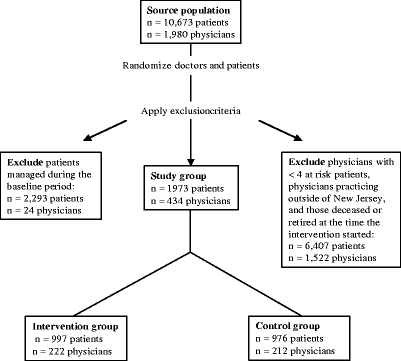
Primary care physicians and their patients at-risk of osteoporosis, including women 65 years and over, men and women 45 and over with a prior fracture, and men and women 45 and over who recently used > or =90 days of oral glucocorticoids.
A multifaceted program of education and reminders delivered to primary care physicians as well as mailings and automated telephone calls to patients.
Either undergoing a bone mineral density (BMD) testing or filling a prescription for a bone-active medication during the 10 months of follow-up.
After the intervention, 144 (14%) patients in the intervention group and 97 (10%) patients in the control group received either a BMD test or filled a prescription for an osteoporosis medication. This represents a 4% absolute increase and a 45% relative increase (95% confidence interval 9-93%, p = 0.01) in osteoporosis management between the intervention and control groups. No differences between groups were observed in the incidence of fracture.
An intervention targeting primary care physicians and their at-risk patients increased the frequency of BMD testing and/or filling prescriptions for osteoporosis medications. However, the absolute percentage of at-risk patients receiving osteoporosis management remained low.
尽管有准确的诊断测试和有效的治疗方法,但在许多情况下,骨质疏松症的管理仍未达到最佳状态。我们测试了一项干预措施对改善骨质疏松症高危患者护理的有效性。
随机对照试验。
初级保健医生及其骨质疏松症高危患者,包括65岁及以上的女性、有过骨折史的45岁及以上的男性和女性,以及最近使用过≥90天口服糖皮质激素的45岁及以上的男性和女性。
向初级保健医生提供多方面的教育和提醒,并向患者邮寄资料和进行自动电话提醒。
在随访的10个月内,干预组有144名(14%)患者接受了骨密度(BMD)测试或开具了骨活性药物处方,对照组有97名(10%)患者接受了上述检查或治疗。这表明干预组与对照组在骨质疏松症管理方面的绝对增加率为4%,相对增加率为45%(95%置信区间9 - 93%,p = 0.01)。两组之间在骨折发生率方面未观察到差异。
针对初级保健医生及其高危患者的干预措施增加了骨密度测试的频率和/或骨质疏松症药物处方的开具。然而,接受骨质疏松症管理的高危患者的绝对百分比仍然较低。