Rose Rajiv, Karthikeyan Muthusamy, Anandan Balakrishnan, Jayaraman Gopalswamy
Department of Genetics, Dr. ALM PGIBMS, University of Madras, Taramani Campus, Chennai, Tamil Nadu, India.
Mol Vis. 2007 Apr 2;13:497-503.
Glaucoma can be defined as optic neuropathy leading to irreversible blindness if not treated in time. Primary open angle glaucoma (POAG) is the most common form of glaucoma. The myocilin (MYOC) gene has been found to mutate in both sporadic and familial cases of POAG worldwide. About 90% of these mutations have been seen to cluster at exon III of the gene. There are documented reports of mutations in the MYOC gene among POAG patients from different parts of India. The southernmost tip of the Indian subcontinent (Kanyakumari district) has remained isolated from all these studies. The aim of this study was to indicate or rule out the disease causative role of the MYOC gene mutations in these patients by screening the MYOC gene for mutations among POAG patients of the Kanyakumari district.
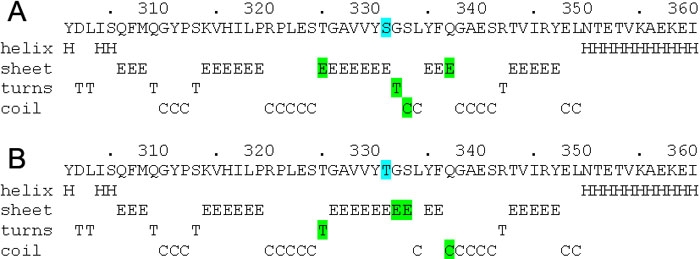
One hundred POAG patients from the Kanyakumari District of South India were recruited for the study. The MYOC gene was screened using the PCR-SSCP methodology followed by DNA sequencing. The sequences were analyzed using BLAST. Secondary structures of the amino acid sequences with a variation were predicted.
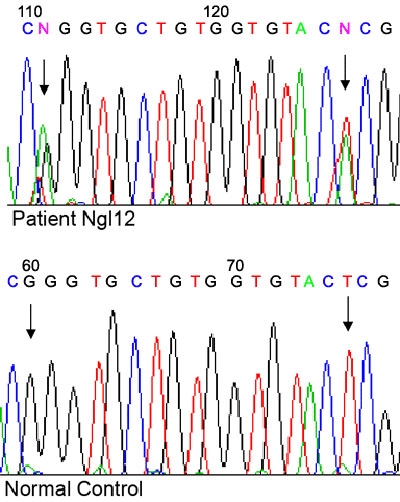
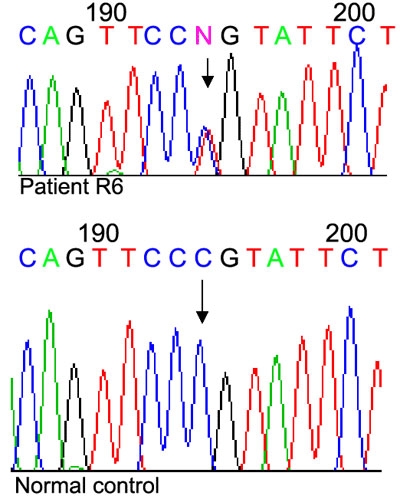
Two probable disease-causing variations (mutations), Ser331Thr and Pro370Leu, were each observed in one patient apiece. Two polymorphisms, (Tyr347Tyr and Thr325Thr) were also observed in the patients. Ser331Thr is a novel conservative change while Pro370Leu is a widely reported mutation with an associated severe disease phenotype.
The presence of the mutations in the patients suggests the causative role of the MYOC gene among POAG patients in the Kanyakumari district of India. The mutation frequency of 2% corresponds well with the other reports from India and other countries. However, the mutation rate reported from a population in the eastern part of India was much higher. Screening of patients from different parts of India is essential to estimate the overall mutation frequency. More functional studies on the MYOC gene are required to elucidate the pathophysiology of POAG.
青光眼可定义为一种视神经病变,若不及时治疗会导致不可逆性失明。原发性开角型青光眼(POAG)是最常见的青光眼类型。已发现在全球范围内散发性和家族性POAG病例中,肌纤蛋白(MYOC)基因均会发生突变。这些突变中约90%集中在该基因的外显子III。有文献报道印度不同地区的POAG患者中存在MYOC基因突变。印度次大陆最南端(坎亚库马里地区)未纳入所有这些研究。本研究的目的是通过筛查坎亚库马里地区POAG患者的MYOC基因以检测突变,从而明确或排除这些患者中MYOC基因突变在致病方面的作用。
招募了来自印度南部坎亚库马里地区的100例POAG患者进行研究。采用聚合酶链反应-单链构象多态性(PCR-SSCP)方法筛查MYOC基因,随后进行DNA测序。使用BLAST对序列进行分析。对有变异的氨基酸序列的二级结构进行预测。
分别在1例患者中观察到两个可能致病的变异(突变),即Ser331Thr和Pro370Leu。在患者中还观察到两个多态性位点(Tyr347Tyr和Thr325Thr)。Ser331Thr是一种新的保守性改变,而Pro370Leu是一种有相关严重疾病表型且被广泛报道的突变。
患者中存在这些突变提示MYOC基因在印度坎亚库马里地区POAG患者中具有致病作用。2%的突变频率与印度其他地区及其他国家的报道相符。然而,印度东部一个人群报道的突变率要高得多。对印度不同地区的患者进行筛查对于估计总体突变频率至关重要。需要对MYOC基因开展更多功能研究以阐明POAG的病理生理学机制。