Nomura Masaharu, Shigematsu Hisayuki, Li Lin, Suzuki Makoto, Takahashi Takao, Estess Pila, Siegelman Mark, Feng Ziding, Kato Harubumi, Marchetti Antonio, Shay Jerry W, Spitz Margaret R, Wistuba Ignacio I, Minna John D, Gazdar Adi F
Hamon Center for Therapeutic Oncology Research, University of Texas Southwestern Medical Center, Dallas, Texas, United States of America.
PLoS Med. 2007 Apr;4(4):e125. doi: 10.1371/journal.pmed.0040125.
The epidermal growth factor receptor (EGFR) gene is the prototype member of the type I receptor tyrosine kinase (TK) family and plays a pivotal role in cell proliferation and differentiation. There are three well described polymorphisms that are associated with increased protein production in experimental systems: a polymorphic dinucleotide repeat (CA simple sequence repeat 1 [CA-SSR1]) in intron one (lower number of repeats) and two single nucleotide polymorphisms (SNPs) in the promoter region, -216 (G/T or T/T) and -191 (C/A or A/A). The objective of this study was to examine distributions of these three polymorphisms and their relationships to each other and to EGFR gene mutations and allelic imbalance (AI) in non-small cell lung cancers.
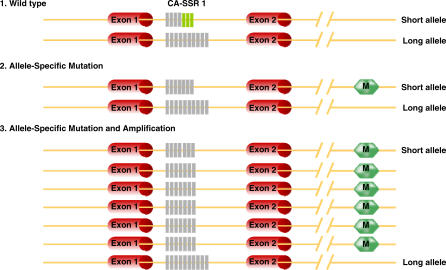
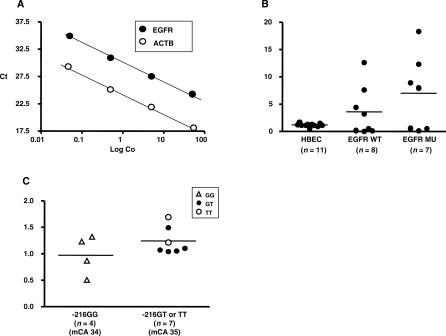
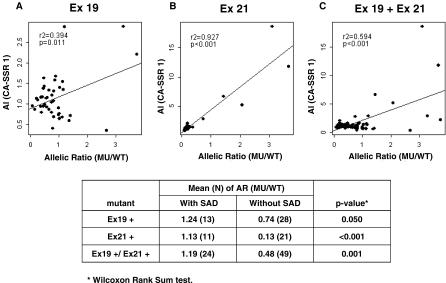
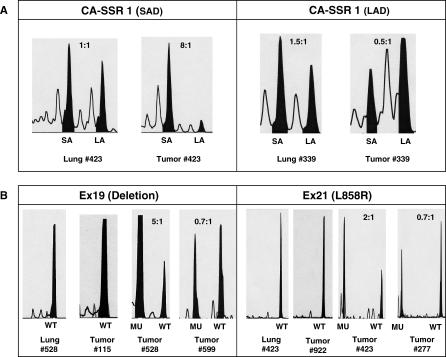
We examined the frequencies of the three polymorphisms of EGFR in 556 resected lung cancers and corresponding non-malignant lung tissues from 336 East Asians, 213 individuals of Northern European descent, and seven of other ethnicities. We also studied the EGFR gene in 93 corresponding non-malignant lung tissue samples from European-descent patients from Italy and in peripheral blood mononuclear cells from 250 normal healthy US individuals enrolled in epidemiological studies including individuals of European descent, African-Americans, and Mexican-Americans. We sequenced the four exons (18-21) of the TK domain known to harbor activating mutations in tumors and examined the status of the CA-SSR1 alleles (presence of heterozygosity, repeat number of the alleles, and relative amplification of one allele) and allele-specific amplification of mutant tumors as determined by a standardized semiautomated method of microsatellite analysis. Variant forms of SNP -216 (G/T or T/T) and SNP -191 (C/A or A/A) (associated with higher protein production in experimental systems) were less frequent in East Asians than in individuals of other ethnicities (p < 0.001). Both alleles of CA-SSR1 were significantly longer in East Asians than in individuals of other ethnicities (p < 0.001). Expression studies using bronchial epithelial cultures demonstrated a trend towards increased mRNA expression in cultures having the variant SNP -216 G/T or T/T genotypes. Monoallelic amplification of the CA-SSR1 locus was present in 30.6% of the informative cases and occurred more often in individuals of East Asian ethnicity. AI was present in 44.4% (95% confidence interval: 34.1%-54.7%) of mutant tumors compared with 25.9% (20.6%-31.2%) of wild-type tumors (p = 0.002). The shorter allele in tumors with AI in East Asian individuals was selectively amplified (shorter allele dominant) more often in mutant tumors (75.0%, 61.6%-88.4%) than in wild-type tumors (43.5%, 31.8%-55.2%, p = 0.003). In addition, there was a strong positive association between AI ratios of CA-SSR1 alleles and AI of mutant alleles.
The three polymorphisms associated with increased EGFR protein production (shorter CA-SSR1 length and variant forms of SNPs -216 and -191) were found to be rare in East Asians as compared to other ethnicities, suggesting that the cells of East Asians may make relatively less intrinsic EGFR protein. Interestingly, especially in tumors from patients of East Asian ethnicity, EGFR mutations were found to favor the shorter allele of CA-SSR1, and selective amplification of the shorter allele of CA-SSR1 occurred frequently in tumors harboring a mutation. These distinct molecular events targeting the same allele would both be predicted to result in greater EGFR protein production and/or activity. Our findings may help explain to some of the ethnic differences observed in mutational frequencies and responses to TK inhibitors.
表皮生长因子受体(EGFR)基因是I型受体酪氨酸激酶(TK)家族的原型成员,在细胞增殖和分化中起关键作用。有三种已被充分描述的多态性,在实验系统中与蛋白质产量增加相关:内含子一中的多态性二核苷酸重复序列(CA简单序列重复1 [CA-SSR1],重复次数较少)以及启动子区域的两个单核苷酸多态性(SNP),-216(G/T或T/T)和-191(C/A或A/A)。本研究的目的是检测这三种多态性在非小细胞肺癌中的分布情况,以及它们彼此之间的关系,及其与EGFR基因突变和等位基因失衡(AI)的关系。
我们检测了556例切除的肺癌以及来自336名东亚人、213名北欧血统个体和7名其他种族个体的相应非恶性肺组织中EGFR三种多态性的频率。我们还研究了来自意大利的欧洲血统患者的93份相应非恶性肺组织样本中的EGFR基因,以及来自参与流行病学研究的250名正常健康美国个体(包括欧洲血统、非裔美国人和墨西哥裔美国人)的外周血单核细胞中的EGFR基因。我们对已知在肿瘤中携带激活突变的TK结构域的四个外显子(18-21)进行了测序,并通过标准化的半自动微卫星分析方法检测了CA-SSR1等位基因的状态(杂合性的存在、等位基因的重复次数以及一个等位基因的相对扩增)和突变肿瘤的等位基因特异性扩增。在东亚人中,与实验系统中较高蛋白质产量相关的SNP -216(G/T或T/T)和SNP -191(C/A或A/A)的变异形式比其他种族个体中更为少见(p < 0.001)。东亚人中CA-SSR1的两个等位基因均明显长于其他种族个体(p < 0.001)。使用支气管上皮培养物进行的表达研究表明,具有变异SNP -216 G/T或T/T基因型的培养物中mRNA表达有增加的趋势。在30.6%的信息性病例中存在CA-SSR1位点的单等位基因扩增,且在东亚种族个体中更常出现。与25.9%(20.6%-31.2%)的野生型肿瘤相比,44.4%(95%置信区间:34.1%-54.