Psychosomatic Medicine Division, Department of Neurology, University of Occupational and Environmental Health, Japan Iseigaoka 1-1, Yahatanishi-ku, Kitakyushu, 807-8555, Japan.
Biopsychosoc Med. 2007 May 19;1:11. doi: 10.1186/1751-0759-1-11.
Psychogenic fever is one of the most common psychosomatic diseases. Patients with psychogenic fever have acute or persistent body temperature above normal range in psychologically stressful situations. In spite of numerous case reports on psychogenic fever, there are few epidemiological studies. Therefore, our goal was to investigate the age distribution and gender differences of psychogenic fever in Japan.
To achieve this goal, we searched Medline and Ichushi WEB, a Japanese medical database, and added other publications that were not included in these databases. Thus, we reviewed 195 Japanese cases of psychogenic fever published in 62 papers.
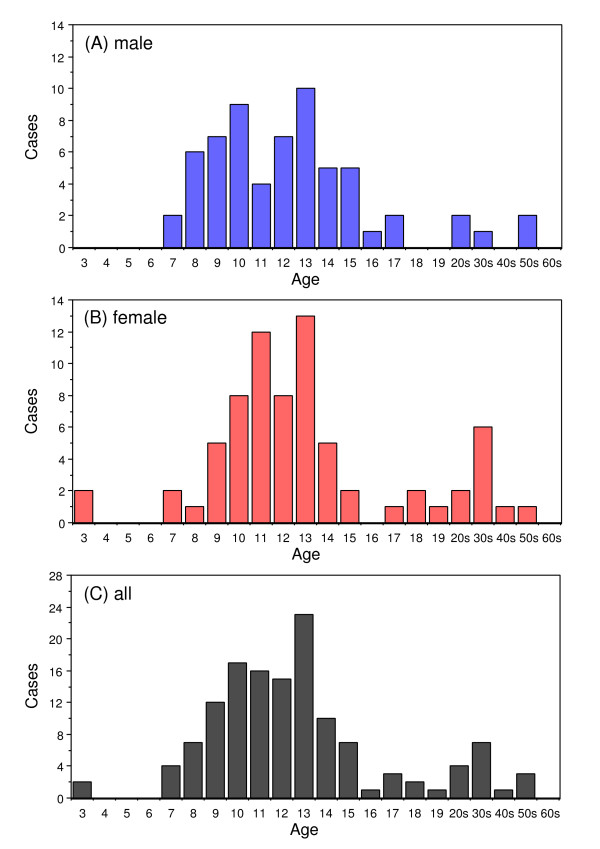
Psychogenic fever patients ranged from 3 to 56 years old, with the highest number of cases occurring in 13 year-olds in both sexes. The male: female ratio of 1: 1.19 suggested a slight predominance of female cases. Psychogenic fever accounted for 18% of fever cases of unknown origin in children and 2-6% of the psychosomatic diseases of pediatric patients. Patients with psychogenic fever were not only found in pediatrics departments, but also in psychosomatic medicine, psychiatry, internal medicine, anesthesiology, dentistry, and obstetrics/gynecology departments.
The age of psychogenic fever patients ranged from 3 to 56 years old and the male: female ratio was 1:1.19. Psychogenic fever is seen especially in adolescence in Japan.
心因性发热是最常见的心身疾病之一。心因性发热患者在心理应激状态下会出现急性或持续性体温高于正常范围。尽管有大量关于心因性发热的病例报告,但很少有流行病学研究。因此,我们的目标是调查日本心因性发热的年龄分布和性别差异。
为了实现这一目标,我们检索了 Medline 和 Ichushi WEB,一个日本医学数据库,并添加了其他未包含在这些数据库中的出版物。因此,我们回顾了 62 篇论文中发表的 195 例日本心因性发热病例。
心因性发热患者年龄从 3 岁到 56 岁不等,男女患者中最多的是 13 岁。男女比例为 1:1.19,表明女性病例略占优势。心因性发热占儿童不明原因发热病例的 18%,占儿科患者心身疾病的 2-6%。心因性发热患者不仅出现在儿科,还出现在身心医学、精神病学、内科、麻醉学、牙科和妇产科。
心因性发热患者的年龄从 3 岁到 56 岁不等,男女比例为 1:1.19。心因性发热在日本尤其见于青春期。