Kreth Jens, Hung David C I, Merritt Justin, Perry Julie, Zhu Lin, Goodman Steven D, Cvitkovitch Dennis G, Shi Wenyuan, Qi Fengxia
UCLA School of Dentistry, Los Angeles, CA 90095, USA.
Division of Diagnostic Science, University of Southern California School of Dentistry, Los Angeles, CA.
Microbiology (Reading). 2007 Jun;153(Pt 6):1799-1807. doi: 10.1099/mic.0.2007/005975-0.
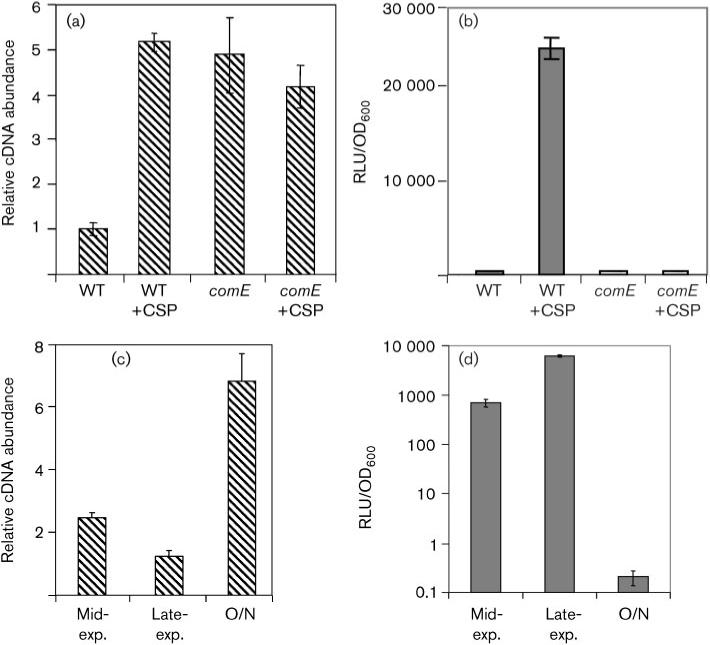
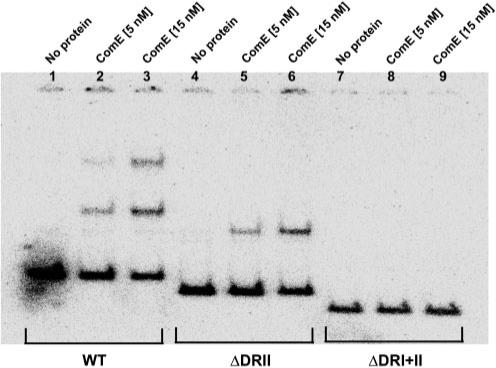
In Streptococcus pneumoniae, competence and bacteriocin genes are controlled by two two-component systems, ComED and BlpRH, respectively. In Streptococcus mutans, both functions are controlled by the ComED system. Recent studies in S. mutans revealed a potential ComE binding site characterized by two 11 bp direct repeats shared by each of the bacteriocin genes responsive to the competence-stimulating peptide (CSP). Interestingly, this sequence was not found in the upstream region of the CSP structural gene comC. Since comC is suggested to be part of a CSP-responsive and ComE-dependent autoregulatory loop, it was of interest to determine how it was possible that the ComED system could simultaneously regulate bacteriocin expression and natural competence. Using the intergenic region IGS1499, shared by the CSP-responsive bacteriocin nlmC and comC, it was demonstrated that both genes are likely to be regulated by a bifunctional ComE. In a comE null mutant, comC gene expression was increased similarly to a fully induced wild-type. In contrast, nlmC gene expression was nearly abolished. Deletion of ComD exerted a similar effect on both genes to that observed with the comE null mutation. Electrophoretic mobility shift assays (EMSAs) with purified ComE revealed specific shift patterns dependent on the presence of one or both direct repeats in the nlmC-comC promoter region. The two direct repeats were also required for the promoter activity of both nlmC and comC. These results suggest that gene regulation of comC in S. mutans is fundamentally different from that reported for S. pneumoniae, which implicates a unique regulatory mechanism that allows the coordination of bacteriocin production with competence development.
在肺炎链球菌中,感受态和细菌素基因分别由两个双组分系统ComED和BlpRH控制。在变形链球菌中,这两种功能均由ComED系统控制。最近对变形链球菌的研究揭示了一个潜在的ComE结合位点,其特征是每个对感受态刺激肽(CSP)有反应的细菌素基因都有两个11 bp的直接重复序列。有趣的是,在CSP结构基因comC的上游区域未发现该序列。由于comC被认为是CSP反应性和ComE依赖性自调节环的一部分,因此确定ComED系统如何能够同时调节细菌素表达和自然感受态就变得很有意义。利用CSP反应性细菌素nlmC和comC共有的基因间区域IGS1499,证明这两个基因可能受双功能ComE调控。在comE缺失突变体中,comC基因表达的增加与完全诱导的野生型相似。相反,nlmC基因表达几乎被消除。ComD的缺失对这两个基因的影响与comE缺失突变所观察到的相似。用纯化的ComE进行的电泳迁移率变动分析(EMSA)显示,特定的迁移模式取决于nlmC-comC启动子区域中一个或两个直接重复序列的存在。这两个直接重复序列也是nlmC和comC启动子活性所必需的。这些结果表明,变形链球菌中comC的基因调控与肺炎链球菌所报道的有根本不同,这暗示了一种独特的调控机制,该机制允许细菌素产生与感受态发育相互协调。