Stamm Thomas, Meyer Ulrich, Wiesmann Hans-Peter, Kleinheinz Johannes, Cehreli Murat, Cehreli Zafer C
Poliklinik für Kieferorthopädie, Universitätsklinikum, Westfälische Wilhelms-Universität, Münster, Germany.
Head Face Med. 2007 Jun 11;3:27. doi: 10.1186/1746-160X-3-27.
Head & Face Medicine (HFM) was launched in August 2005 to provide multidisciplinary science in the field of head and face disorders with an open access and open peer review publication platform. The objective of this study is to evaluate the characteristics of submissions, the effectiveness of open peer reviewing, and factors biasing the acceptance or rejection of submitted manuscripts.
A 1-year period of submissions and all concomitant journal operations were retrospectively analyzed. The analysis included submission rate, reviewer rate, acceptance rate, article type, and differences in duration for peer reviewing, final decision, publishing, and PubMed inclusion. Statistical analysis included Mann-Whitney U test, Chi-square test, regression analysis, and binary logistic regression.
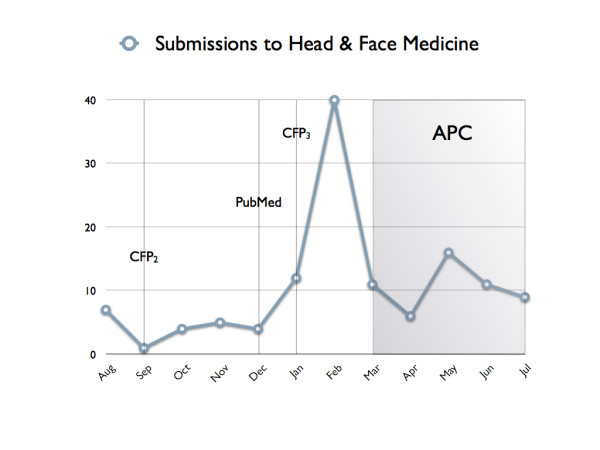
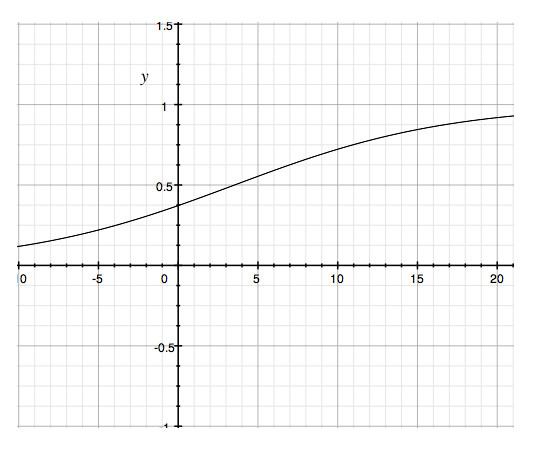
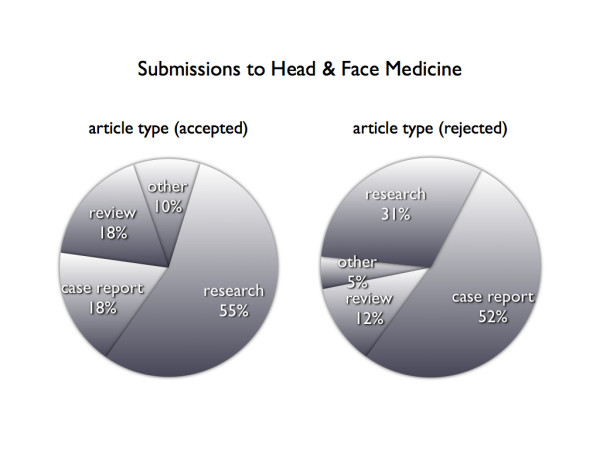
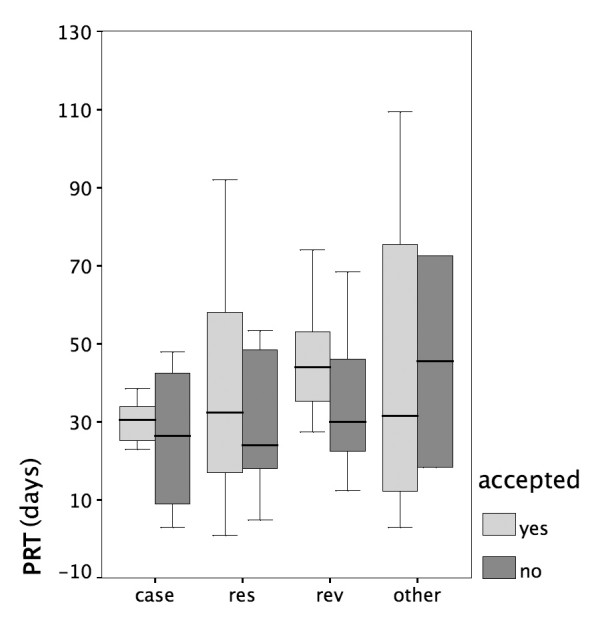
HFM received 126 articles (10.5 articles/month) for consideration in the first year. Submissions have been increasing, but not significantly over time. Peer reviewing was completed for 82 articles and resulted in an acceptance rate of 48.8%. In total, 431 peer reviewers were invited (5.3/manuscript), of which 40.4% agreed to review. The mean peer review time was 37.8 days. The mean time between submission and acceptance (including time for revision) was 95.9 days. Accepted papers were published on average 99.3 days after submission. The mean time between manuscript submission and PubMed inclusion was 101.3 days. The main article types submitted to HFM were original research, reviews, and case reports. The article type had no influence on rejection or acceptance. The variable 'number of invited reviewers' was the only significant (p < 0.05) predictor for rejection of manuscripts.
The positive trend in submissions confirms the need for publication platforms for multidisciplinary science. HFM's peer review time comes in shorter than the 6-weeks turnaround time the Editors set themselves as the maximum. Rejection of manuscripts was associated with the number of invited reviewers. None of the other parameters tested had any effect on the final decision. Thus, HFM's ethical policy, which is based on Open Access, Open Peer, and transparency of journal operations, is free of 'editorial bias' in accepting manuscripts. ORIGINAL DATA: Provided as a downloadable tab-delimited text file (URL and variable code available under section 'additional files').
《头面部医学》(HFM)于2005年8月创刊,旨在通过一个开放获取和开放同行评议的出版平台,提供头面部疾病领域的多学科科学内容。本研究的目的是评估投稿的特点、开放同行评议的有效性,以及影响投稿稿件接受或拒绝的因素。
对为期1年的投稿情况及所有相关的期刊运营情况进行回顾性分析。分析内容包括投稿率、审稿人率、接受率、文章类型,以及同行评议、最终决定、发表和被PubMed收录的时长差异。统计分析包括曼-惠特尼U检验、卡方检验、回归分析和二元逻辑回归。
HFM在第一年收到126篇文章供审议(每月10.5篇)。投稿数量一直在增加,但随着时间推移增幅并不显著。82篇文章完成了同行评议,接受率为48.8%。总共邀请了431位同行评审员(每篇稿件5.3位),其中40.4%同意评审。同行评议的平均时间为37.8天。投稿至接受(包括修订时间)的平均时间为95.9天。被接受的论文在投稿后平均99.3天发表。稿件提交至被PubMed收录的平均时间为101.3天。提交给HFM的主要文章类型为原创研究、综述和病例报告。文章类型对稿件的接受或拒绝没有影响。“受邀评审员数量”这一变量是稿件被拒的唯一显著(p<0.05)预测因素。
投稿数量的积极趋势证实了多学科科学出版平台的必要性。HFM的同行评议时间短于编辑们给自己设定的6周最长周转时间。稿件被拒与受邀评审员数量有关。所测试的其他参数均未对最终决定产生任何影响。因此,基于开放获取、开放同行评议和期刊运营透明度的HFM伦理政策,在接受稿件时不存在“编辑偏见”。原始数据:以可下载的制表符分隔文本文件形式提供(“附加文件”部分提供了URL和变量代码)。