Lin Blossom Yen-Ju
Institute of Health Service Administration, China Medical University, Taiwan.
BMC Health Serv Res. 2007 Jun 19;7:90. doi: 10.1186/1472-6963-7-90.
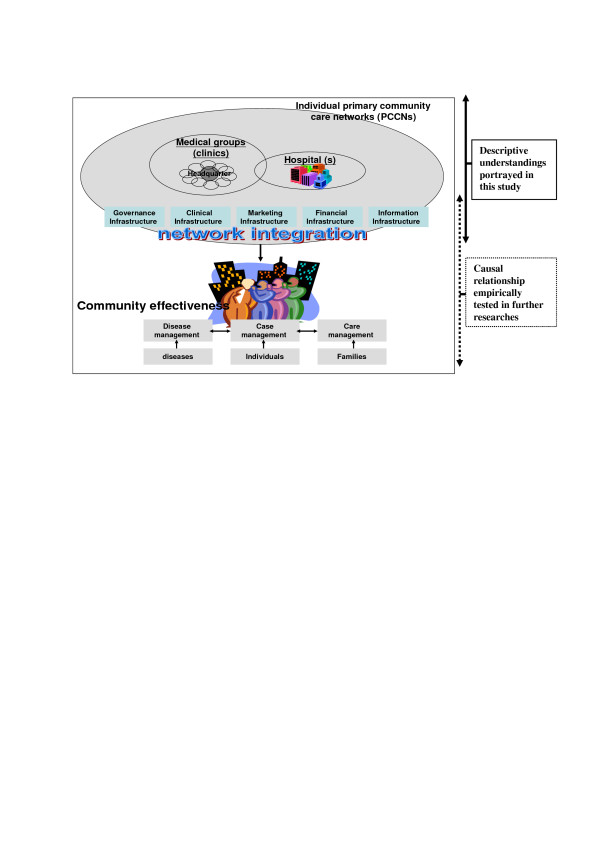
Taiwan's primary community care network (PCCN) demonstration project, funded by the Bureau of National Health Insurance on March 2003, was established to discourage hospital shopping behavior of people and drive the traditional fragmented health care providers into cooperate care models. Between 2003 and 2005, 268 PCCNs were established. This study profiled the individual members in the PCCNs to study the nature and extent to which their network infrastructures have been integrated among the members (clinics and hospitals) within individual PCCNs.
The thorough questionnaire items, covering the network working infrastructures--governance, clinical, marketing, financial, and information integration in PCCNs, were developed with validity and reliability confirmed. One thousand five hundred and fifty-seven clinics that had belonged to PCCNs for more than one year, based on the 2003-2005 Taiwan Primary Community Care Network List, were surveyed by mail. Nine hundred and twenty-eight clinic members responded to the surveys giving a 59.6 % response rate.
Overall, the PCCNs' members had higher involvement in the governance infrastructure, which was usually viewed as the most important for establishment of core values in PCCNs' organization design and management at the early integration stage. In addition, it found that there existed a higher extent of integration of clinical, marketing, and information infrastructures among the hospital-clinic member relationship than those among clinic members within individual PCCNs. The financial infrastructure was shown the least integrated relative to other functional infrastructures at the early stage of PCCN formation.
There was still room for better integrated partnerships, as evidenced by the great variety of relationships and differences in extent of integration in this study. In addition to provide how the network members have done for their initial work at the early stage of network forming in this study, the detailed surveyed items, the concepts proposed by the managerial and theoretical professionals, could be a guide for those health care providers who have willingness to turn their business into multi-organizations.
2003年3月由国民健康保险局资助的台湾基层医疗照护网络(PCCN)示范项目,旨在抑制民众的就医选择行为,并推动传统分散的医疗服务提供者转向合作照护模式。2003年至2005年期间,建立了268个基层医疗照护网络。本研究对基层医疗照护网络中的个体成员进行了剖析,以研究其网络基础设施在各个基层医疗照护网络内的成员(诊所和医院)之间整合的性质和程度。
编制了涵盖网络工作基础设施——基层医疗照护网络中的治理、临床、营销、财务和信息整合的详尽问卷项目,并确认了其有效性和可靠性。根据2003 - 2005年台湾基层医疗照护网络名单,对1557个加入基层医疗照护网络一年以上的诊所进行了邮件调查。928个诊所成员回复了调查,回复率为59.6%。
总体而言,基层医疗照护网络的成员在治理基础设施方面的参与度较高,在早期整合阶段,治理基础设施通常被视为基层医疗照护网络组织设计和管理中确立核心价值观最为重要的方面。此外,研究发现,医院与诊所成员关系之间的临床、营销和信息基础设施整合程度高于各个基层医疗照护网络内诊所成员之间的整合程度。在基层医疗照护网络形成的早期阶段,相对于其他功能基础设施,财务基础设施的整合程度最低。
本研究中关系的多样性和整合程度的差异表明,仍有提升整合伙伴关系的空间。除了在本研究中说明网络成员在网络形成初期所做的初步工作外,详细的调查项目以及管理和理论专业人员提出的概念,可为那些有意将业务转变为多组织形式的医疗服务提供者提供指导。