Aartsma-Rus Annemieke, Janson Anneke A M, van Ommen Gert-Jan B, van Deutekom Judith C T
Department of Human Genetics, Leiden University Medical Center, Leiden, The Netherlands.
BMC Med Genet. 2007 Jul 5;8:43. doi: 10.1186/1471-2350-8-43.
Antisense-mediated exon skipping is currently one of the most promising therapeutic approaches for Duchenne muscular dystrophy (DMD). Using antisense oligonucleotides (AONs) targeting specific exons the DMD reading frame is restored and partially functional dystrophins are produced. Following proof of concept in cultured muscle cells from patients with various deletions and point mutations, we now focus on single and multiple exon duplications. These mutations are in principle ideal targets for this approach since the specific skipping of duplicated exons would generate original, full-length transcripts.
Cultured muscle cells from DMD patients carrying duplications were transfected with AONs targeting the duplicated exons, and the dystrophin RNA and protein were analyzed.
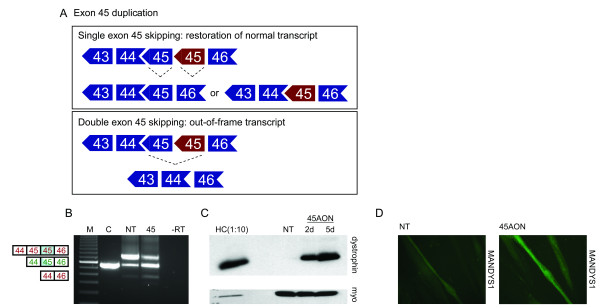
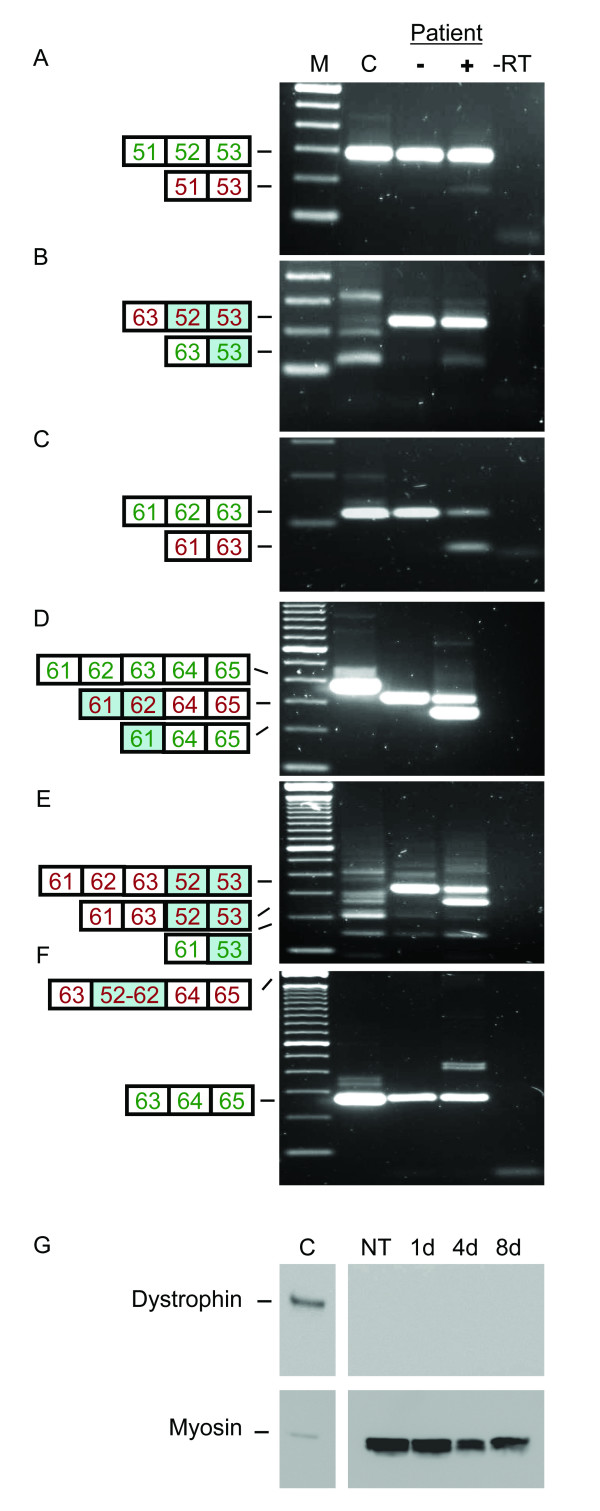
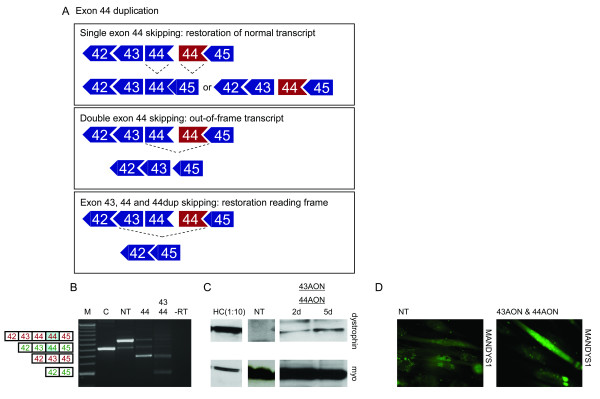
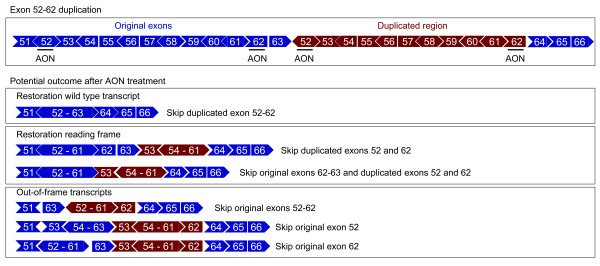
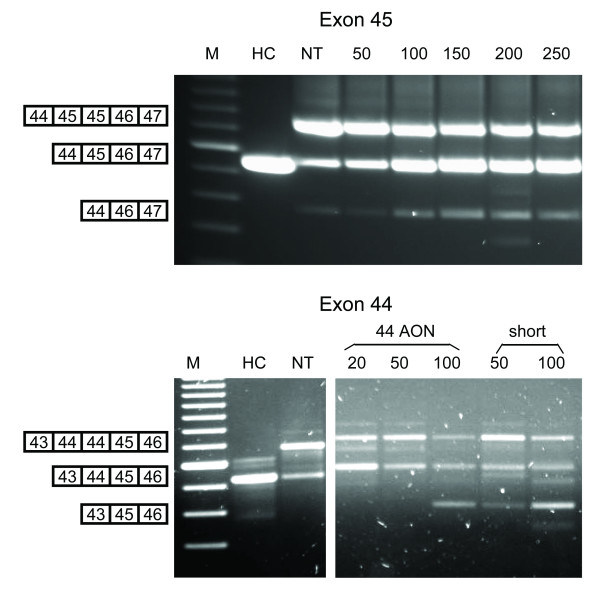
For two brothers with an exon 44 duplication, skipping was, even at suboptimal transfection conditions, so efficient that both exons 44 were skipped, thus generating, once more, an out-of-frame transcript. In such cases, one may resort to multi-exon skipping to restore the reading frame, as is shown here by inducing skipping of exon 43 and both exons 44. By contrast, in cells from a patient with an exon 45 duplication we were able to induce single exon 45 skipping, which allowed restoration of wild type dystrophin. The correction of a larger duplication (involving exons 52 to 62), by combinations of AONs targeting the outer exons, appeared problematic due to inefficient skipping and mistargeting of original instead of duplicated exons.
The correction of DMD duplications by exon skipping depends on the specific exons targeted. Its options vary from the ideal one, restoring for the first time the true, wild type dystrophin, to requiring more 'classical' skipping strategies, while the correction of multi-exon deletions may need the design of tailored approaches.
反义介导的外显子跳跃目前是杜氏肌营养不良症(DMD)最有前景的治疗方法之一。通过使用靶向特定外显子的反义寡核苷酸(AON),可恢复DMD的阅读框并产生部分功能性的抗肌萎缩蛋白。在对患有各种缺失和点突变的患者的培养肌肉细胞进行概念验证后,我们现在将重点放在单外显子和多外显子重复上。这些突变原则上是这种方法的理想靶点,因为重复外显子的特异性跳跃会产生原始的全长转录本。
用靶向重复外显子的AON转染携带重复的DMD患者的培养肌肉细胞,并分析抗肌萎缩蛋白RNA和蛋白质。
对于两名患有44号外显子重复的兄弟,即使在次优转染条件下,跳跃也非常有效,以至于两个44号外显子都被跳过,从而再次产生移码转录本。在这种情况下,可以采用多外显子跳跃来恢复阅读框,如此处所示,通过诱导43号外显子和两个44号外显子的跳跃。相比之下,在一名患有45号外显子重复的患者的细胞中,我们能够诱导单个45号外显子跳跃,从而恢复野生型抗肌萎缩蛋白。由于跳跃效率低下以及靶向原始而非重复外显子的错误靶向,通过靶向外部外显子的AON组合来纠正更大的重复(涉及52号至62号外显子)似乎存在问题。
通过外显子跳跃纠正DMD重复取决于靶向的特定外显子。其选择范围从理想的情况,即首次恢复真正的野生型抗肌萎缩蛋白,到需要更多“经典”的跳跃策略,而多外显子缺失的纠正可能需要设计量身定制的方法。