Geluk Christiane A, Dikkers Riksta, Kors Jan A, Tio René A, Slart Riemer H J A, Vliegenthart Rozemarijn, Hillege Hans L, Willems Tineke P, de Jong Paul E, van Gilst Wiek H, Oudkerk Matthijs, Zijlstra Felix
Department of Cardiology, Thoraxcenter, University Medical Center Groningen, University of Groningen, The Netherlands.
BMC Cardiovasc Disord. 2007 Jul 13;7:19. doi: 10.1186/1471-2261-7-19.
Asymptomatic subjects at intermediate coronary risk may need diagnostic testing for risk stratification. Both measurement of coronary calcium scores and exercise testing are well established tests for this purpose. However, it is not clear which test should be preferred as initial diagnostic test. We evaluated the prevalence of documented coronary artery disease (CAD) according to calcium scores and exercise test results.
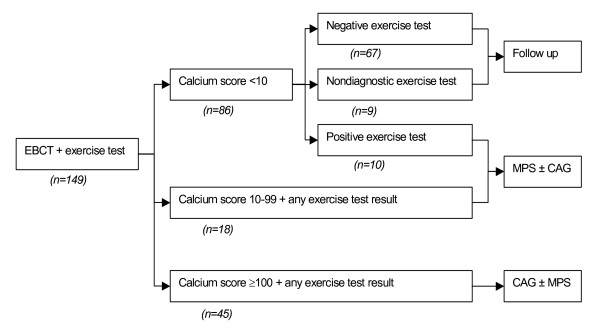
Asymptomatic subjects with ST-T changes on a rest ECG were selected from the population based PREVEND cohort study and underwent measurement of calcium scores by electron beam tomography and exercise testing. With calcium scores > or =10 or a positive exercise test, myocardial perfusion imaging (MPS) or coronary angiography (CAG) was recommended. The primary endpoint was documented obstructive CAD (>/=50% stenosis).
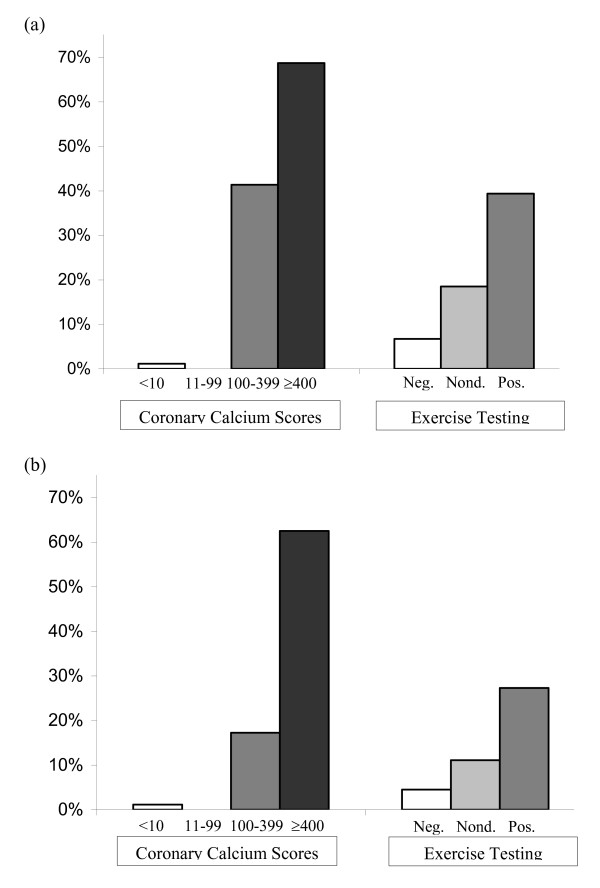
Of 153 subjects included, 149 subjects completed the study protocol. Calcium scores > or =400, 100-399, 10-99 and <10 were found in 16, 29, 18 and 86 subjects and the primary endpoint was present in 11 (69%), 12 (41%), 0 (0%) and 1 (1%) subjects, respectively. A positive, nondiagnostic and negative exercise test was present in 33, 27 and 89 subjects and the primary endpoint was present in 13 (39%), 5 (19%) and 6 (7%) subjects, respectively. Receiver operator characteristics analysis showed that the area under the curve, as measure of diagnostic yield, of 0.91 (95% CI 0.84-0.97) for calcium scores was superior to 0.74 (95% CI 0.64-0.83) for exercise testing (p = 0.004).
Measurement of coronary calcium scores is an appropriate initial non-invasive test in asymptomatic subjects at increased coronary risk.
处于中等冠心病风险的无症状受试者可能需要进行诊断性检查以进行风险分层。冠状动脉钙化积分测量和运动试验都是用于此目的的成熟检查。然而,尚不清楚哪种检查应作为初始诊断检查的首选。我们根据钙化积分和运动试验结果评估了有记录的冠状动脉疾病(CAD)的患病率。
从基于人群的PREVEND队列研究中选取静息心电图有ST-T改变的无症状受试者,通过电子束断层扫描测量钙化积分并进行运动试验。若钙化积分≥10或运动试验阳性,则建议进行心肌灌注成像(MPS)或冠状动脉造影(CAG)。主要终点是有记录的阻塞性CAD(狭窄≥50%)。
纳入的153名受试者中,149名完成了研究方案。钙化积分≥400、100 - 399、10 - 99和<10的受试者分别有16、29、18和86名,主要终点分别出现在11名(69%)、12名(41%)、0名(0%)和1名(1%)受试者中。运动试验阳性、非诊断性和阴性的受试者分别有33、27和89名,主要终点分别出现在13名(39%)、5名(19%)和6名(7%)受试者中。受试者工作特征分析显示,作为诊断效能衡量指标的钙化积分曲线下面积为0.91(95%CI 0.84 - 0.97),优于运动试验的0.74(95%CI 0.64 - 0.83)(p = 0.004)。
对于冠状动脉风险增加的无症状受试者,冠状动脉钙化积分测量是一种合适的初始非侵入性检查。