Oladehin Akinniran, Margret Cecilia P, Maier Susan E, Li Cheng X, Jan Taha A, Chappell Tyson D, Waters Robert S
Department of Anatomy and Neurobiology, University of Tennessee Health Science Center, College of Medicine, 855 Monroe Avenue, Memphis, TN 38163, USA.
Alcohol. 2007 Jun;41(4):253-61. doi: 10.1016/j.alcohol.2007.04.005.
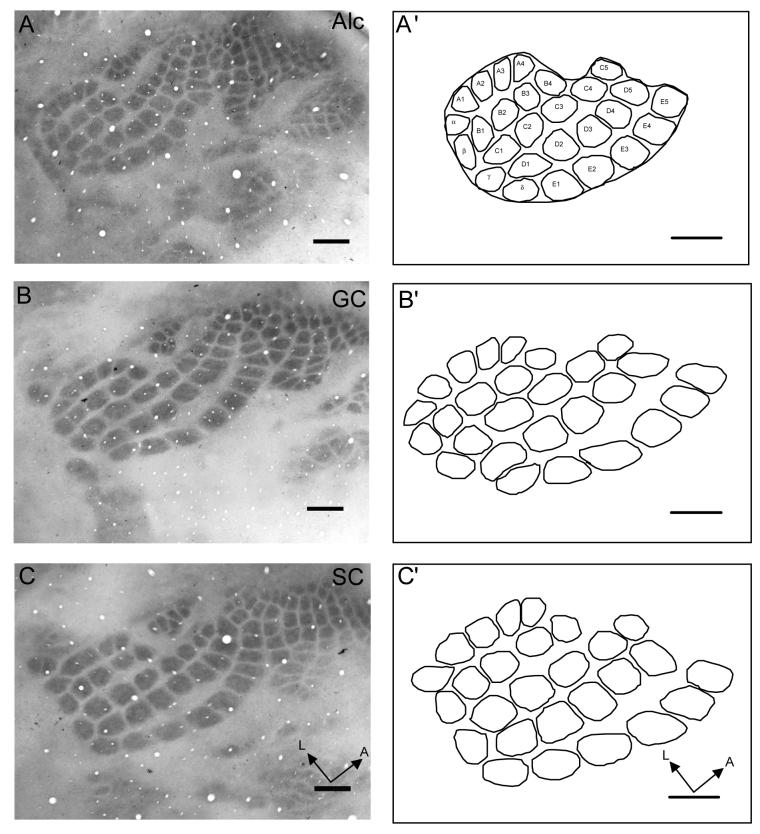
Prenatal alcohol exposure (PAE) has been shown to alter the somatosensory cortex in both human and animal studies. In rodents, PAE reduced the size, but not the pattern of the posteromedial barrel subfield (PMBSF) associated with the representation of the whiskers, in newborn, juvenile, and adult rats. However, the PMBSF is not present at birth, but rather first appears in the middle of the first postnatal week during the brain-growth spurt period. These findings raise questions whether early postnatal alcohol exposure might disrupt both barrel field pattern and size, questions that were investigated in the present study. Newborn Sprague-Dawley rats were assigned into alcohol (Alc), nutritional gastric control (GC), and suckle control (SC) groups on postnatal day 4 (P4). Rat pups in Alc and GC were artificially fed with alcohol and maltose-dextrin dissolved in milk, respectively, via an implant gastrostomy tube, from P4 to P9. Pups in the Alc group received alcohol (6.0 g/kg) in milk, while the GC controls received isocaloric equivalent maltose-dextrin dissolved in milk. Pups in the SC group remained with their mothers and breast fed throughout the experimental period. On P10, pups in each group were weighed, sacrificed, and their brains removed and weighed. Cortical hemispheres were separated, weighed, flattened, sectioned tangentially, stained with cytochrome oxidase, and PMBSF measured. The sizes of barrels and the interbarrel septal region within PMBSF, as well as body and brain weights were compared between the three groups. The sizes of PMSBF barrel and septal areas were significantly smaller (P<.01) in Alc group compared to controls, while the PMBSF barrel pattern remained unaltered. Body, whole-brain, forebrain, and hemisphere weights were significantly reduced (P<.01) in Alc pups compared to control groups. GC and SC groups did not differ significantly in all dependent variables, except body weight at P9 and P10 (P<.01). These results suggest that postnatal alcohol exposure, like prenatal exposure, significantly influenced the size of the barrel field, but not barrel field pattern formation, indicating that barrel field pattern formation consolidated prior to P4. These results are important for understanding sensorimotor deficits reported in children suffering from fetal alcohol spectrum disorder (FASD).
在人体和动物研究中均已表明,产前酒精暴露(PAE)会改变体感皮层。在啮齿动物中,PAE会减小新生、幼年和成年大鼠中与胡须表征相关的后内侧桶状亚区(PMBSF)的大小,但不会改变其模式。然而,PMBSF在出生时并不存在,而是在出生后第一周中期脑生长突增期首次出现。这些发现引发了关于产后早期酒精暴露是否可能破坏桶状区模式和大小的问题,本研究对这些问题进行了调查。新生的斯普拉格-道利大鼠在出生后第4天(P4)被分为酒精组(Alc)、营养性胃对照组(GC)和哺乳对照组(SC)。Alc组和GC组的幼鼠分别通过植入式胃造瘘管从P4到P9人工喂食溶解在牛奶中的酒精和麦芽糖糊精。Alc组的幼鼠在牛奶中摄入酒精(6.0 g/kg),而GC对照组摄入等热量的溶解在牛奶中的麦芽糖糊精。SC组的幼鼠在整个实验期间与母亲在一起并进行母乳喂养。在P10时,对每组幼鼠称重、处死,取出大脑并称重。分离皮质半球,称重、展平,进行切线切片,用细胞色素氧化酶染色,并测量PMBSF。比较了三组之间PMBSF内桶状区和桶间隔区的大小以及体重和脑重。与对照组相比,Alc组的PMSBF桶状区和间隔区面积显著更小(P<0.01),而PMBSF桶状区模式保持不变。与对照组相比,Alc组幼鼠的体重、全脑、前脑和半球重量显著降低(P<0.01)。GC组和SC组在所有因变量上均无显著差异,除了P9和P10时的体重(P<0.01)。这些结果表明,产后酒精暴露与产前暴露一样,显著影响桶状区的大小,但不影响桶状区模式的形成,表明桶状区模式的形成在P4之前就已巩固。这些结果对于理解患有胎儿酒精谱系障碍(FASD)的儿童中报告的感觉运动缺陷很重要。