Laboratoire de Physiologie Neurovégétative, UMR CNRS 6153-INRA 1147, Institut Fédératif de Recherche Jean Roche IFR 11, Université Paul Cézanne, Aix-Marseille III, Faculté des Sciences et Techniques, Marseille, France.
PLoS One. 2007 Jul 18;2(7):e612. doi: 10.1371/journal.pone.0000612.
Action potentials are the classic mechanism by which neurons convey a state of excitation throughout their length, leading, after synaptic transmission, to the activation of other neurons and consequently to network functioning. Using an in vitro integrated model, we found previously that peripheral networks in the autonomic nervous system can organise an unconventional regulatory reflex of the digestive tract motility without action potentials.
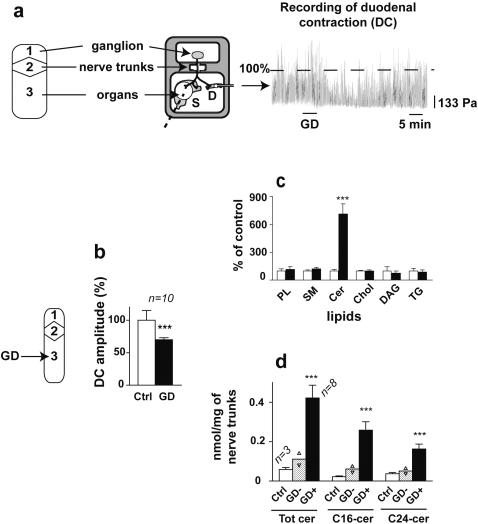
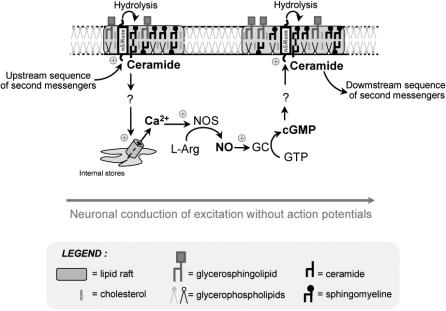
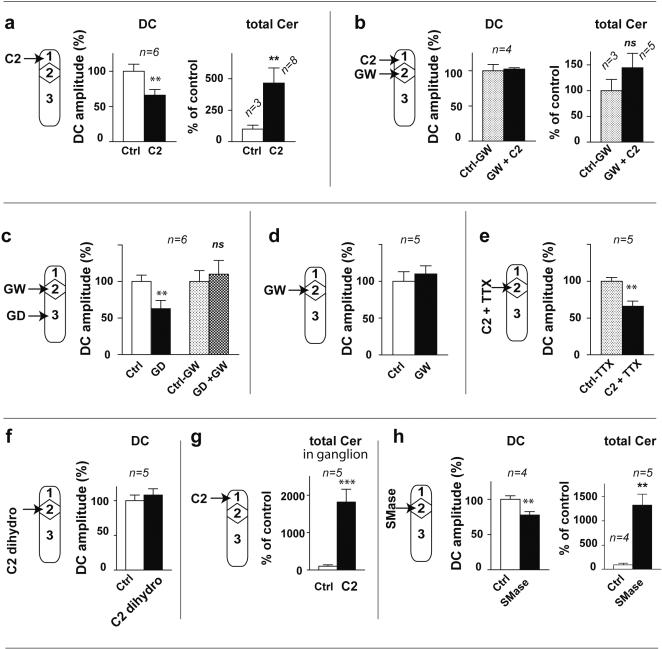
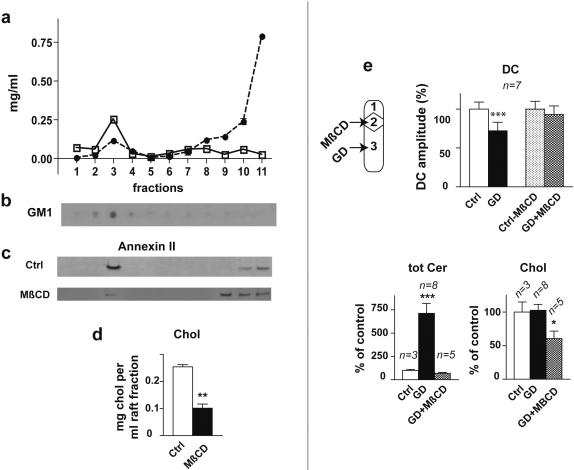
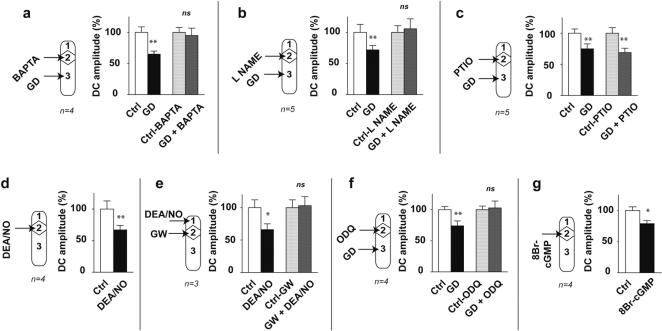
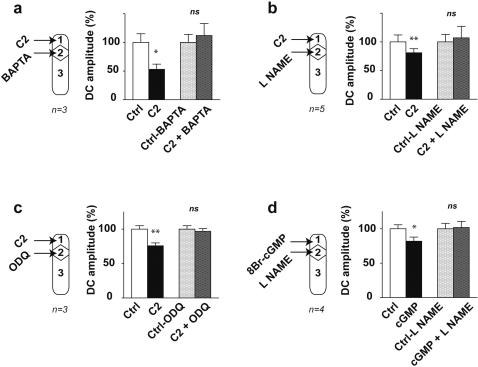
METHODOLOGY/PRINCIPAL FINDINGS: In this report, we used combined neuropharmacological and biochemical approaches to elucidate some steps of the mechanism that conveys excitation along the nerves fibres without action potentials. This mechanism requires the production of ceramide in membrane lipid rafts, which triggers in the cytoplasm an increase in intracellular calcium concentration, followed by activation of a neuronal nitric oxide synthase leading to local production of nitric oxide, and then to guanosine cyclic monophosphate. This sequence of second messengers is activated in cascade from rafts to rafts to ensure conduction of the excitation along the nerve fibres.
CONCLUSIONS/SIGNIFICANCE: Our results indicate that second messengers are involved in neuronal conduction of excitation without action potentials. This mechanism represents the first evidence-to our knowledge-that excitation is carried along nerves independently of electrical signals. This unexpected ceramide-based conduction of excitation without action potentials along the autonomic nerve fibres opens up new prospects in our understanding of neuronal functioning.
动作电位是神经元在其全长范围内传递兴奋状态的经典机制,导致突触传递后其他神经元的激活,进而导致网络功能。使用体外整合模型,我们之前发现自主神经系统的周围网络可以组织消化道运动的非常规调节反射,而无需动作电位。
方法/主要发现:在本报告中,我们使用联合神经药理学和生化方法来阐明沿无动作电位神经纤维传递兴奋的机制的一些步骤。该机制需要在膜脂筏中产生神经酰胺,这会在细胞质中引发细胞内钙离子浓度增加,随后激活神经元一氧化氮合酶导致局部产生一氧化氮,然后产生鸟苷环单磷酸。这些第二信使的序列从筏到筏级联激活,以确保兴奋沿着神经纤维传导。
结论/意义:我们的结果表明,第二信使参与了无动作电位的神经元兴奋传导。据我们所知,这种机制代表了兴奋是独立于电信号沿神经纤维传导的第一个证据。这种出乎意料的基于神经酰胺的无动作电位自主神经纤维兴奋传导为我们理解神经元功能开辟了新的前景。