Bartsch Rupert, Steger Guenther G, Forstner Birgit, Wenzel Catharina, Pluschnig Ursula, Rizovski Blanka, Altorjai Gabriela, Zielinski Christoph C, Mader Robert M
First Department of Medicine and Cancer Centre, Clinical Division of Oncology, Medical University of Vienna, Vienna, Austria.
BMC Clin Pharmacol. 2007 Jul 18;7:7. doi: 10.1186/1472-6904-7-7.
A synergistic cytotoxic effect has been hypothesized for taxanes and capecitabine, a prodrug of 5-fluorouracil. Based on preclinical studies, this synergism has been attributed to an up-regulation of the enzyme thymidine phosphorylase (TP). Beside tumour tissue, TP is highly expressed in white blood cells, possibly causing increased hematotoxicity, when taxanes are combined with capecitabine. So far, this hypothesis has not been investigated in humans.
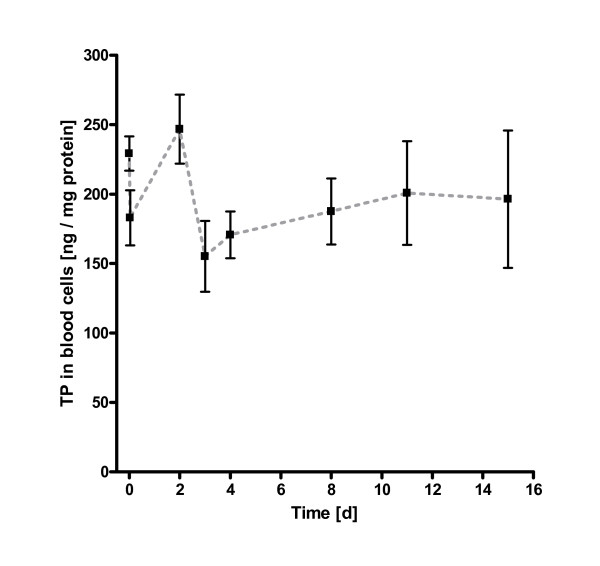
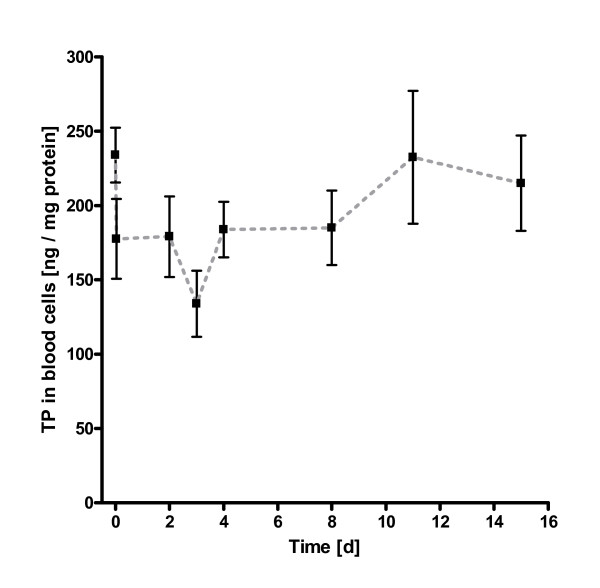
A total of 128 consecutive blood samples were collected from eight patients with advanced breast cancer receiving paclitaxel weekly at a dose of 80 mg/m2. To assess the expression of TP in blood cells, samples were collected prior to first therapy, at the end of infusion, and up to 15 days thereafter. This procedure was repeated during the sixth application of paclitaxel. After isolation of the peripheral mononuclear blood cells, the expression of TP was assessed by ELISA. In parallel, paclitaxel level in plasma was evaluated at three selected time points as pharmacokinetic control parameter.
Paclitaxel concentrations at the end of infusion did not change significantly from week 1 to week 6. The expression of TP in peripheral mononuclear blood cells decreased significantly after infusion below pretherapeutic values (p = 0.023; n = 8). After the nadir on day 3, the expression of TP increased moderately returning to baseline levels within one week. The overall picture in week 6 was similar to week 1. Using a trend analysis, neither a short-term nor a long-term induction of TP was observed.
TP in peripheral mononuclear blood cells was hardly regulated under therapy with paclitaxel. Therefore, no increased haematotoxicity due to TP upregulation is expected from the combination of taxanes and capecitabine.
紫杉烷类药物与5-氟尿嘧啶的前体药物卡培他滨具有协同细胞毒性作用,这一假说已得到验证。基于临床前研究,这种协同作用被认为是由于胸苷磷酸化酶(TP)的上调所致。除肿瘤组织外,TP在白细胞中也有高表达,因此当紫杉烷类药物与卡培他滨联合使用时,可能会增加血液毒性。迄今为止,这一假说尚未在人体中得到验证。
从8例晚期乳腺癌患者中连续采集128份血样,这些患者每周接受一次剂量为80mg/m²的紫杉醇治疗。为评估血细胞中TP的表达,在首次治疗前、输注结束时及此后15天内采集样本。在紫杉醇第六次应用时重复此过程。分离外周血单个核细胞后,通过酶联免疫吸附测定法(ELISA)评估TP的表达。同时,在三个选定时间点评估血浆中紫杉醇水平,作为药代动力学控制参数。
从第1周到第6周,输注结束时的紫杉醇浓度无显著变化。外周血单个核细胞中TP的表达在输注后显著下降,低于治疗前水平(p = 0.023;n = 8)。在第3天达到最低点后,TP的表达适度增加,在一周内恢复到基线水平。第6周的总体情况与第1周相似。通过趋势分析,未观察到TP的短期或长期诱导。
在紫杉醇治疗过程中,外周血单个核细胞中的TP几乎未受到调节。因此,紫杉烷类药物与卡培他滨联合使用不会因TP上调而增加血液毒性。