Tey Siok-Keen, Dotti Gianpietro, Rooney Cliona M, Heslop Helen E, Brenner Malcolm K
Center for Cell and Gene Therapy, Baylor College of Medicine, The Methodist Hospital, Houston, Texas 77030, USA.
Biol Blood Marrow Transplant. 2007 Aug;13(8):913-24. doi: 10.1016/j.bbmt.2007.04.005. Epub 2007 May 29.
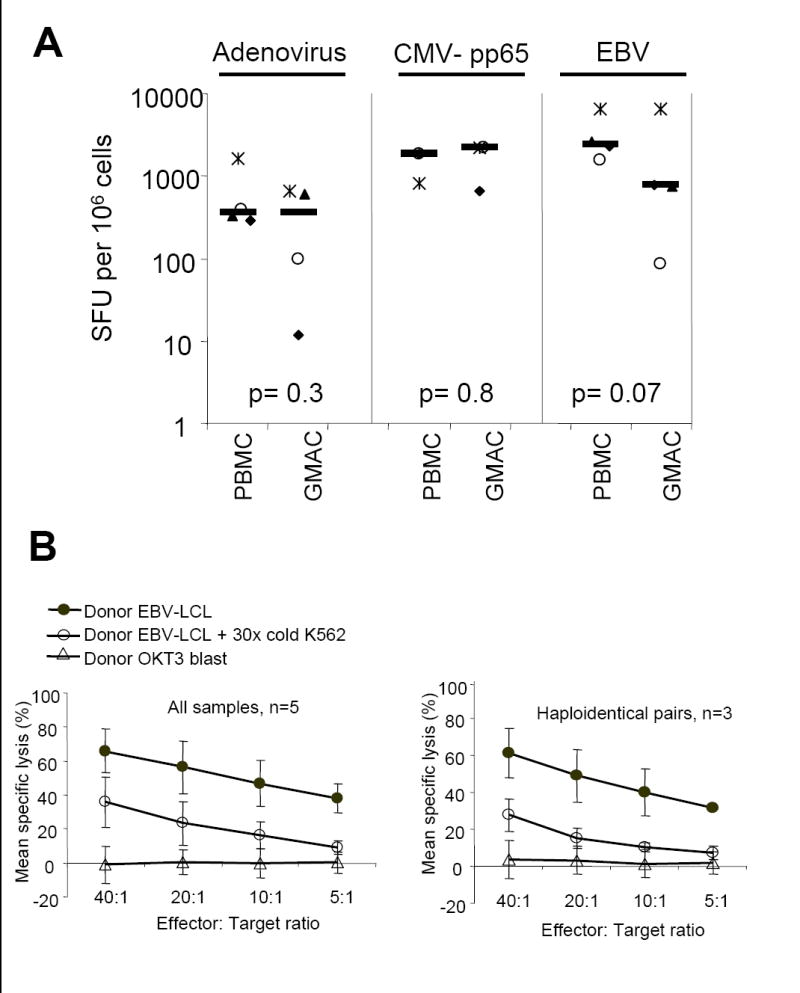
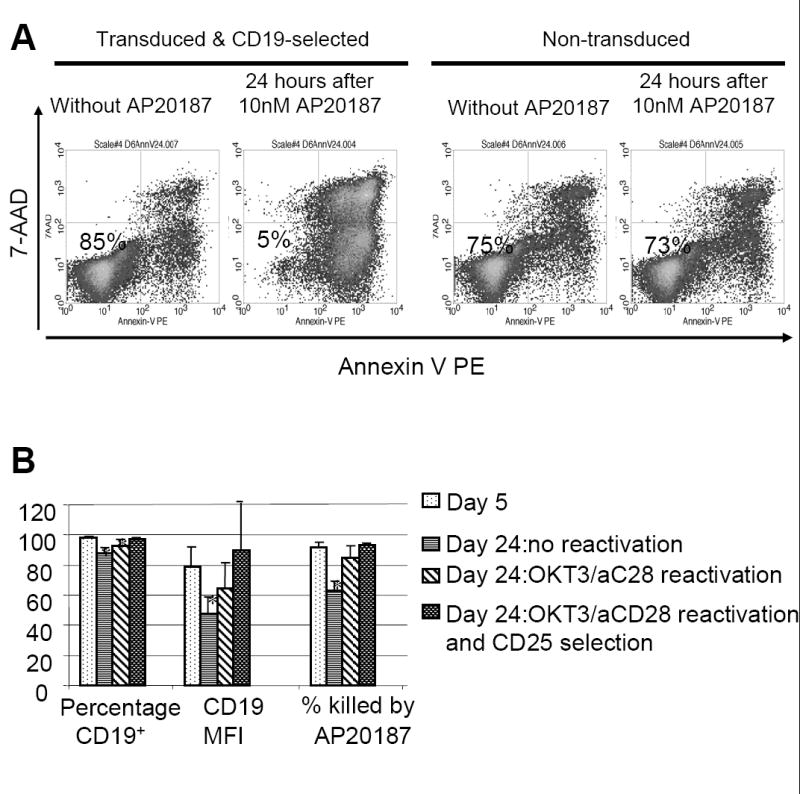
Addback of donor T cells following T cell-depleted stem cell transplantation (SCT) can accelerate immune reconstitution and be effective against relapsed malignancy. After haploidentical SCT, a high risk of graft-versus-host disease (GVHD) essentially precludes this option, unless the T cells are first depleted of alloreactive precursor cells. Even then, the risks of severe GVHD remain significant. To increase the safety of the approach and thereby permit administration of larger T cell doses, we used a suicide gene, inducible caspase 9 (iCasp9), to transduce allodepleted T cells, permitting their destruction should administration have adverse effects. We made a retroviral vector encoding iCasp9 and a selectable marker (truncated CD19). Even after allodepletion (using anti-CD25 immunotoxin), donor T cells could be efficiently transduced, expanded, and subsequently enriched by CD19 immunomagnetic selection to >90% purity. These engineered cells retained antiviral specificity and functionality, and contained a subset with regulatory phenotype and function. Activating iCasp9 with a small-molecule dimerizer rapidly produced >90% apoptosis. Although transgene expression was downregulated in quiescent T cells, iCasp9 remained an efficient suicide gene, as expression was rapidly upregulated in activated (alloreactive) T cells. We have demonstrated the clinical feasibility of this approach after haploidentical transplantation by scaling up production using clinical grade materials.
在T细胞去除的干细胞移植(SCT)后回输供体T细胞可加速免疫重建,并有效对抗复发的恶性肿瘤。在单倍体相合SCT后,移植物抗宿主病(GVHD)的高风险基本上排除了这种选择,除非T细胞首先去除同种异体反应性前体细胞。即便如此,严重GVHD的风险仍然很大。为了提高该方法的安全性,从而允许给予更大剂量的T细胞,我们使用了一种自杀基因——诱导型半胱天冬酶9(iCasp9)来转导去除同种异体反应性的T细胞,以便在给药产生不良反应时将其破坏。我们构建了一种编码iCasp9和一个选择标记(截短的CD19)的逆转录病毒载体。即使在去除同种异体反应性(使用抗CD25免疫毒素)之后,供体T细胞仍能被有效地转导、扩增,随后通过CD19免疫磁珠分选富集至纯度>90%。这些经过基因工程改造的细胞保留了抗病毒特异性和功能,并包含具有调节表型和功能的亚群。用小分子二聚体激活iCasp9可迅速产生>90%的细胞凋亡。尽管转基因表达在静止T细胞中下调,但iCasp9仍然是一种有效的自杀基因,因为其表达在活化的(同种异体反应性)T细胞中迅速上调。我们通过使用临床级材料扩大生产规模,证明了这种方法在单倍体相合移植后的临床可行性。