Zhang Qiuyang, Chen Yuanbin, Wang Bi-Dar, He Ping, Su Yan A
Department of Biochemistry and Molecular Biology, the George Washington University School of Medicine and Health Sciences, Washington, DC 20037, USA.
Int J Biol Sci. 2007 Jul 16;3(6):342-8. doi: 10.7150/ijbs.3.342.
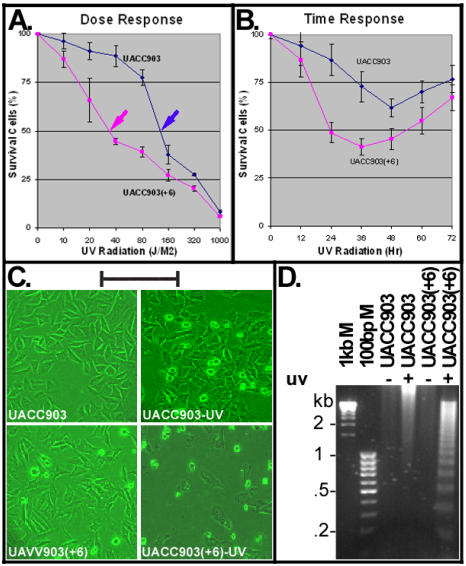
Introduction of human chromosome 6 into malignant melanoma cell line UACC903 resulted in generation of the chromosome 6-mediated suppressed cell subline UACC903(+6) that displays attenuated growth rate, anchorage-dependency, and reduced tumorigenicity. We have showed that overexpression of a chromosome 6-encoded tumor suppressor gene led to partial suppression to UACC903 cell growth. We now describe the differences in apoptosis and cell cycle between UACC903 and UACC903(+6) before and after UV irradiation. MTT assay revealed 86.92+/-8.24% of UACC903 cells viable, significantly (p<0.01) higher than 48.76+/-5.31% of UACC903(+6), at 24 hr after 254-nm UV irradiation (40 J/M(2)). Before UV treatment, flow cytometry analysis revealed 6.06+/-0.20% apoptosis in UACC903, significantly (p=0.01) lower than 6.67+/-0.15% in UACC903(+6). The G0/G1, S and G2/M phase cells of UACC903 were, respectively, 54.10+/-0.59%, 22.31+/-0.50% and 16.85+/-0.25%, all significantly (p<0.01) different from the corresponding percentages (58.82+/-0.35%, 20.48+/-0.05%, and 13.17+/-0.45%) of UACC903(+6). After the UV treatment, UACC903 cells in apoptosis, G0/G1, S, and G2/M became 12.59+/-0.17%, 38.90+/-0.67%, 19.74+/-0.70%, and 27.01+/-0.66%, respectively, while UACC903(+6) cells were 24.16+/-0.48%, 37.97+/-0.62%, 19.20+/-0.52%, and 15.69+/-0.14%. TUNEL assay revealed 2.31+/-0.62% apoptosis in UACC903, significantly (p<0.01) lower than 9.60+/-1.14% of UACC903(+6), and a linear and exponential increase of apoptosis, respectively, in response to the UV treatment. These results indicate that UACC903(+6) cells have a greater tendency to undergo apoptosis and are thus much more sensitive to UV irradiation. Our findings further suggest a novel mechanism for chromosome 6-mediated suppression of tumorigenesis and metastasis, i.e., through increased cell death.
将人类6号染色体导入恶性黑色素瘤细胞系UACC903后,产生了由6号染色体介导的生长受抑制细胞亚系UACC903(+6),该亚系表现出生长速率减缓、贴壁依赖性降低以及致瘤性减弱。我们已经表明,一个由6号染色体编码的肿瘤抑制基因的过表达导致了对UACC903细胞生长的部分抑制。我们现在描述UACC903和UACC903(+6)在紫外线照射前后凋亡和细胞周期的差异。MTT分析显示,在254纳米紫外线照射(40 J/M(2))24小时后,86.92±8.24%的UACC903细胞存活,显著高于(p<0.01)UACC903(+6)的48.76±5.31%。在紫外线处理前,流式细胞术分析显示UACC903中有6.06±0.20%的细胞凋亡,显著低于(p=0.01)UACC903(+6)中的6.67±0.15%。UACC903的G0/G1期、S期和G2/M期细胞分别为54.10±0.59%、22.31±0.50%和16.85±0.25%,均与UACC903(+6)的相应百分比(58.82±0.35%、20.48±0.05%和13.17±0.45%)有显著差异(p<0.01)。紫外线处理后,UACC903细胞的凋亡率、G0/G1期、S期和G2/M期分别变为12.59±0.17%、38.90±0.67%、19.74±0.70%和27.01±0.66%,而UACC903(+6)细胞分别为24.16±0.48%、37.97±0.62%、19.20±0.52%和15.69±0.14%。TUNEL分析显示UACC903中有2.31±0.62%的细胞凋亡,显著低于(p<0.01)UACC903(+6)的9.60±1.14%,并且在紫外线处理后凋亡呈线性和指数增加。这些结果表明,UACC903(+6)细胞有更大的凋亡倾向,因此对紫外线照射更敏感。我们的发现进一步提示了6号染色体介导的肿瘤发生和转移抑制的一种新机制,即通过增加细胞死亡。