Pertin Marie, Allchorne Andrew J, Beggah Ahmed T, Woolf Clifford J, Decosterd Isabelle
Anesthesiology Pain Research Unit, Department of Anesthesiology, University Hospital Center and University of Lausanne, Lausanne, Switzerland.
Mol Pain. 2007 Jul 31;3:21. doi: 10.1186/1744-8069-3-21.
Clinical and experimental studies of neuropathic pain support the hypothesis that a functional coupling between postganglionic sympathetic efferent and sensory afferent fibers contributes to the pain. We investigated whether neuropathic pain-related behavior in the spared nerve injury (SNI) rat model is dependent on the sympathetic nervous system.
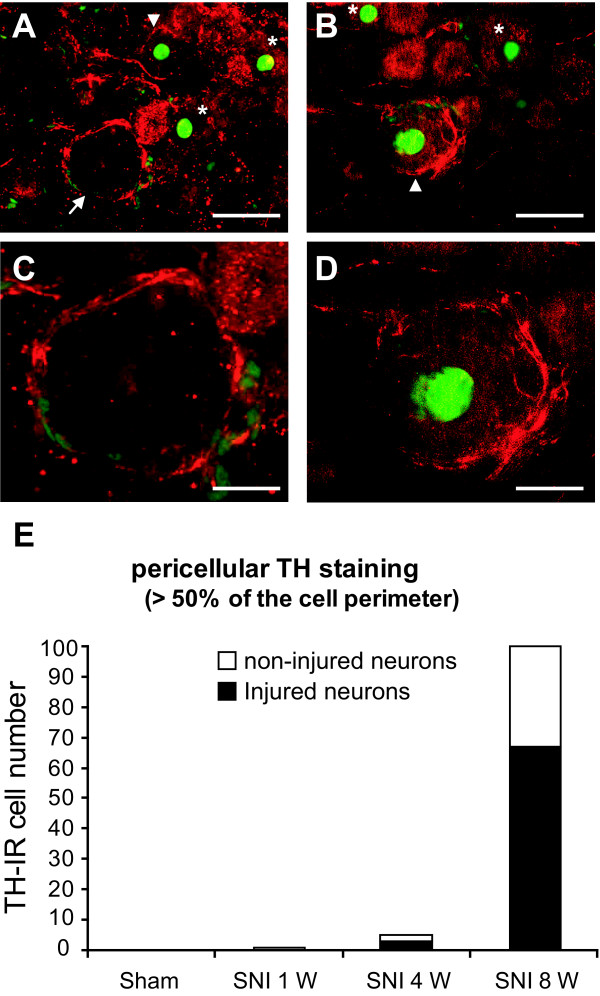
Permanent chemical sympathectomy was achieved by daily injection of guanethidine (50 mg/kg s.c.) from age P8 to P21. SNI was performed at adulthood followed by 11 weeks of mechanical and thermal hypersensitivity testing. A significant but limited effect of the sympathectomy on SNI-induced pain sensitivity was observed. The effect was delayed and restricted to cold allodynia-like behavior: SNI-related cold scores were lower in the sympathectomized group compared to the control group at 8 and 11 weeks after the nerve injury but not before. Mechanical hypersensitivity tests (pinprick and von Frey hair threshold tests) showed no difference between groups during the study period. Concomitantly, pericellular tyrosine-hydroxylase immunoreactive basket structures were observed around dorsal root ganglia (DRG) neurons 8 weeks after SNI, but were absent at earlier time points after SNI and in sham operated controls.
These results suggest that the early establishment of neuropathic pain-related behavior after distal nerve injury such as in the SNI model is mechanistically independent of the sympathetic system, whereas the system contributes to the maintenance, albeit after a delay of many weeks, of response to cold-related stimuli.
神经性疼痛的临床和实验研究支持这样一种假说,即节后交感神经传出纤维与感觉传入纤维之间的功能耦合导致了疼痛。我们研究了 spared nerve injury(SNI)大鼠模型中与神经性疼痛相关的行为是否依赖于交感神经系统。
从出生后第8天到第21天,每天皮下注射胍乙啶(50mg/kg)可实现永久性化学性交感神经切除术。成年后进行SNI手术,随后进行11周的机械性和热超敏反应测试。观察到交感神经切除术对SNI诱导的疼痛敏感性有显著但有限的影响。这种影响出现延迟,且仅限于冷觉异常样行为:在神经损伤后8周和11周,交感神经切除组的SNI相关冷觉评分低于对照组,但在损伤前无此差异。在研究期间,机械性超敏反应测试(针刺和von Frey毛发阈值测试)显示两组之间无差异。同时,在SNI术后8周,在背根神经节(DRG)神经元周围观察到细胞周围酪氨酸羟化酶免疫反应性篮状结构,但在SNI术后早期时间点以及假手术对照组中未观察到。
这些结果表明,在诸如SNI模型等远端神经损伤后,神经性疼痛相关行为的早期建立在机制上独立于交感神经系统,而该系统尽管在数周延迟后,仍有助于对冷相关刺激的反应维持。