Ji Cheng, Shinohara Masao, Kuhlenkamp John, Chan Christine, Kaplowitz Neil
University of Southern California Research Center for Liver Disease, Department of Medicine, Keck School of Medicine, University of Southern California, Los Angeles, California, USA.
Hepatology. 2007 Nov;46(5):1586-96. doi: 10.1002/hep.21854.
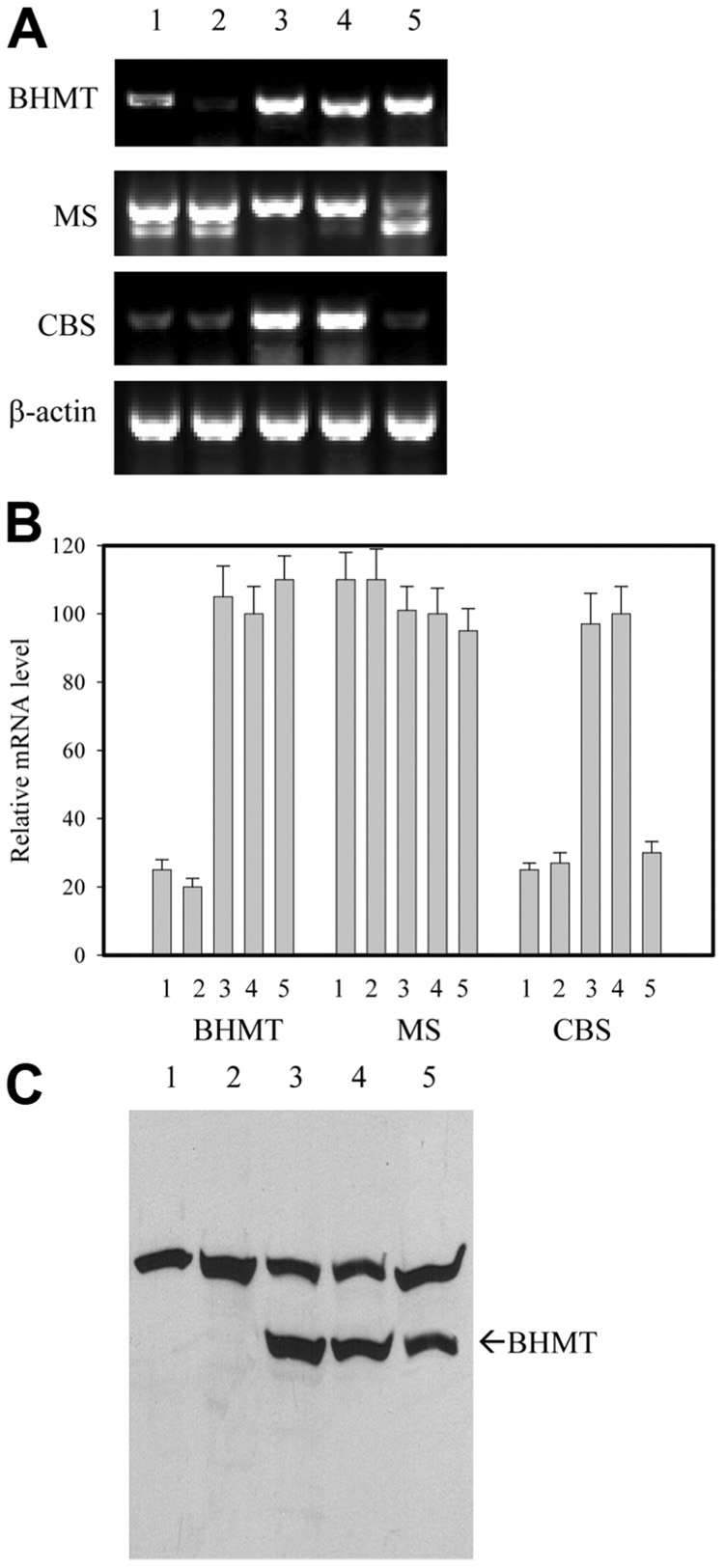
Betaine-homocysteine methyltransferase (BHMT) regulates homocysteine levels in the liver. We previously reported that the alteration of BHMT is associated with alcoholic liver steatosis and injury. In this study, we tested whether BHMT protects hepatocytes from homocysteine-induced injury and lipid accumulation. Both BHMT transfectants of HepG2 cells and primary mouse hepatocytes with suppressed BHMT were generated. Comparisons were made between the cell models with respect to their response to homocysteine treatments. Homocysteine metabolism was impaired in HepG2 cells, and the expression of BHMT in HepG2 cells ameliorated the impairment and stabilized the levels of intracellular homocysteine after the addition of exogenous homocysteine. BHMT expression inhibited homocysteine-induced glucose-regulated protein 78 (GRP78) and C/EBP-homologous protein (CHOP) and homocysteine-induced cell death. A betaine treatment protected primary mouse hepatocytes from a homocysteine-induced increase in GRP78 and cell death but not a tunicamycin-induced increase. Homocysteine induced greater CHOP expression (2.7-fold) in BHMT small interfering RNA (siRNA)-transfected cells than in a control (1.9-fold). Homocysteine-induced cell death was increased by 40% in the siRNA-treated cells in comparison with the control. Apolipoprotein B (apoB) expression was higher and triglycerides and cholesterol were lower in HepG2 expressing BHMT. In primary mouse hepatocytes, homocysteine induced the accumulation of triglycerides and cholesterol, which was reduced in the presence of betaine. Betaine partially reduced homocysteine-induced sterol regulatory element binding protein 1 expression in HepG2 cells and increased S-adenosylmethionine in primary mouse hepatocytes.
The BHMT/betaine system directly protects hepatocytes from homocysteine-induced injury but not tunicamycin-induced injury, including an endoplasmic reticulum stress response, lipid accumulation, and cell death. This system also exhibits a more generalized effect on liver lipids by inducing ApoB expression and increasing S-adenosylmethionine/S-adenosylhomocysteine.
甜菜碱-同型半胱氨酸甲基转移酶(BHMT)调节肝脏中的同型半胱氨酸水平。我们之前报道过BHMT的改变与酒精性肝脂肪变性和损伤有关。在本研究中,我们测试了BHMT是否能保护肝细胞免受同型半胱氨酸诱导的损伤和脂质积累。我们构建了HepG2细胞的BHMT转染子以及BHMT受抑制的原代小鼠肝细胞。对这些细胞模型对同型半胱氨酸处理的反应进行了比较。HepG2细胞中的同型半胱氨酸代谢受损,在添加外源性同型半胱氨酸后,HepG2细胞中BHMT的表达改善了这种损伤并稳定了细胞内同型半胱氨酸的水平。BHMT表达抑制了同型半胱氨酸诱导的葡萄糖调节蛋白78(GRP78)和C/EBP同源蛋白(CHOP)以及同型半胱氨酸诱导的细胞死亡。甜菜碱处理可保护原代小鼠肝细胞免受同型半胱氨酸诱导的GRP78增加和细胞死亡,但不能保护其免受衣霉素诱导的增加。同型半胱氨酸在BHMT小干扰RNA(siRNA)转染的细胞中诱导的CHOP表达(2.7倍)高于对照组(1.9倍)。与对照组相比,siRNA处理的细胞中同型半胱氨酸诱导的细胞死亡增加了40%。在表达BHMT的HepG2细胞中,载脂蛋白B(apoB)表达较高,甘油三酯和胆固醇较低。在原代小鼠肝细胞中,同型半胱氨酸诱导甘油三酯和胆固醇积累,而在甜菜碱存在的情况下这种积累减少。甜菜碱部分降低了同型半胱氨酸诱导的HepG2细胞中固醇调节元件结合蛋白1的表达,并增加了原代小鼠肝细胞中的S-腺苷甲硫氨酸。
BHMT/甜菜碱系统直接保护肝细胞免受同型半胱氨酸诱导的损伤,但不能保护其免受衣霉素诱导的损伤,包括内质网应激反应、脂质积累和细胞死亡。该系统还通过诱导ApoB表达和增加S-腺苷甲硫氨酸/S-腺苷同型半胱氨酸对肝脏脂质表现出更广泛的影响。