• 文献检索
  • 文档翻译
  • 深度研究
  • 学术资讯
  • Suppr Zotero 插件Zotero 插件
  • 邀请有礼
  • 套餐&价格
  • 历史记录
应用&插件
Suppr Zotero 插件Zotero 插件浏览器插件Mac 客户端Windows 客户端微信小程序
定价
高级版会员购买积分包购买API积分包
服务
文献检索文档翻译深度研究API 文档MCP 服务
关于我们
关于 Suppr公司介绍联系我们用户协议隐私条款
关注我们

Suppr 超能文献

核心技术专利:CN118964589B侵权必究
粤ICP备2023148730 号-1Suppr @ 2026

文献检索

告别复杂PubMed语法,用中文像聊天一样搜索,搜遍4000万医学文献。AI智能推荐,让科研检索更轻松。

立即免费搜索

文件翻译

保留排版,准确专业,支持PDF/Word/PPT等文件格式,支持 12+语言互译。

免费翻译文档

深度研究

AI帮你快速写综述,25分钟生成高质量综述,智能提取关键信息,辅助科研写作。

立即免费体验

生物启发的纳米表面粗糙度对免疫分析生物传感器应用中抗原-抗体相互作用的影响。

Influence of biologically inspired nanometer surface roughness on antigen-antibody interactions for immunoassay-biosensor applications.

作者信息

Tuttle Paul V, Rundell Ann E, Webster Thomas J

机构信息

Weldon School of Biomedical Engineering, Purdue University, West Lafayette, IN 47907, USA.

出版信息

Int J Nanomedicine. 2006;1(4):497-505. doi: 10.2147/nano.2006.1.4.497.

DOI:10.2147/nano.2006.1.4.497
PMID:17722282
原文链接:https://pmc.ncbi.nlm.nih.gov/articles/PMC2676634/
Abstract

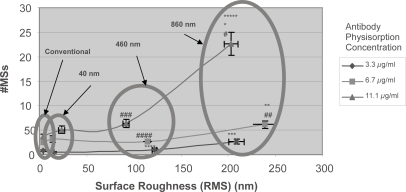
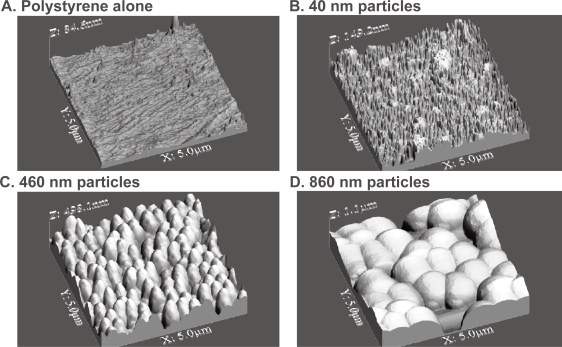
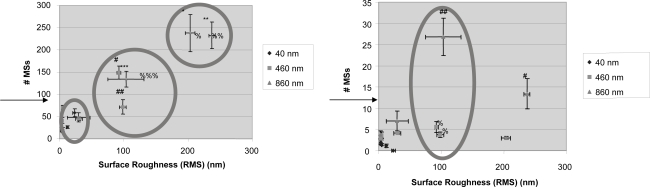
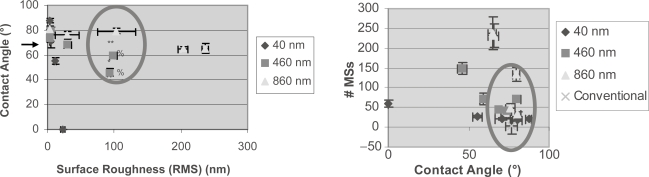
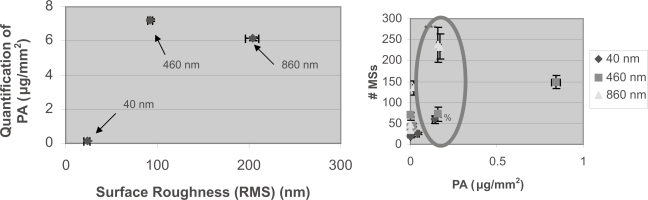
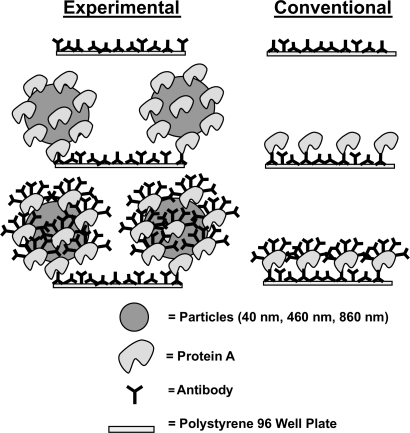
Current research efforts to improve immunoassay-biosensor functionality have centered on detection through the optimal design of microfluidic chambers, electrical circuitry, optical sensing elements, and so on. To date, little attention has been paid to the immunoassay-biosensor membrane surface on which interactions between antibodies and antigens must occur. For this reason, the objective of the present study was to manipulate the nanometer surface roughness of a model immunoassay-biosensor membrane to determine its role on sensitivity and specificity. It was hypothesized that surface roughness characteristics similar to those used by the body's own immune system with B-lymphocyte cell membranes would promote antigen-antibody interactions and minimize non-specific binding. To test this hypothesis, polystyrene 96-well plate surfaces were modified to possess similar topographies as those of B-lymphocyte cell membranes. This was accomplished by immobilizing Protein A conjugated gold particles and Protein A conjugated polystyrene particles ranging in sizes from 40 to 860 nm to the bottom of polystyrene wells. Atomic force microscopy results provided evidence of well-dispersed immunoassay-biosensor surfaces for all particles tested with high degrees of biologically inspired nanometer roughness. Testing the functionality of these immunosurfaces using antigenic fluorescent microspheres showed that specific antigen capture increased with greater nanometer surface roughness while nonspecific antigen capture did not correlate with surface roughness. In this manner, results from this study suggest that large degrees of biologically inspired nanometer surface roughness not only increases the amount of immobilized antibodies onto the immunosurface membrane, but it also enhances the functionality of those antibodies for optimal antigen capture, criteria critical for improving immunoassay-biosensor sensitivity and specificity.

摘要

目前,为改善免疫分析生物传感器功能所做的研究工作主要集中在通过微流控腔室、电路、光学传感元件等的优化设计来进行检测。迄今为止,对于免疫分析生物传感器的膜表面(抗体与抗原之间的相互作用必须在此发生)关注甚少。因此,本研究的目的是操控一种模型免疫分析生物传感器膜的纳米表面粗糙度,以确定其对灵敏度和特异性的作用。研究假设是,与人体自身免疫系统中B淋巴细胞细胞膜所具有的表面粗糙度特征相似,将促进抗原 - 抗体相互作用并使非特异性结合最小化。为验证这一假设,对聚苯乙烯96孔板表面进行修饰,使其具有与B淋巴细胞细胞膜相似的形貌。这是通过将尺寸范围为40至860纳米的蛋白A共轭金颗粒和蛋白A共轭聚苯乙烯颗粒固定到聚苯乙烯孔的底部来实现的。原子力显微镜结果为所有测试颗粒提供了免疫分析生物传感器表面分散良好的证据,这些表面具有高度的受生物启发的纳米粗糙度。使用抗原性荧光微球测试这些免疫表面的功能表明,随着纳米表面粗糙度的增加,特异性抗原捕获增加,而非特异性抗原捕获与表面粗糙度无关。通过这种方式,本研究结果表明,高度的受生物启发的纳米表面粗糙度不仅增加了固定在免疫表面膜上的抗体数量,还增强了这些抗体进行最佳抗原捕获的功能,这是提高免疫分析生物传感器灵敏度和特异性的关键标准。
https://cdn.ncbi.nlm.nih.gov/pmc/blobs/5a18/2676634/2a85ae53ac60/ijn-1-497f6.jpg
https://cdn.ncbi.nlm.nih.gov/pmc/blobs/5a18/2676634/adf1c8235e3f/ijn-1-497f1.jpg
https://cdn.ncbi.nlm.nih.gov/pmc/blobs/5a18/2676634/95883932bd4e/ijn-1-497f2.jpg
https://cdn.ncbi.nlm.nih.gov/pmc/blobs/5a18/2676634/89f258fae558/ijn-1-497f3.jpg
https://cdn.ncbi.nlm.nih.gov/pmc/blobs/5a18/2676634/51701eb610a0/ijn-1-497f4.jpg
https://cdn.ncbi.nlm.nih.gov/pmc/blobs/5a18/2676634/1796710d0949/ijn-1-497f5.jpg
https://cdn.ncbi.nlm.nih.gov/pmc/blobs/5a18/2676634/2a85ae53ac60/ijn-1-497f6.jpg
https://cdn.ncbi.nlm.nih.gov/pmc/blobs/5a18/2676634/adf1c8235e3f/ijn-1-497f1.jpg
https://cdn.ncbi.nlm.nih.gov/pmc/blobs/5a18/2676634/95883932bd4e/ijn-1-497f2.jpg
https://cdn.ncbi.nlm.nih.gov/pmc/blobs/5a18/2676634/89f258fae558/ijn-1-497f3.jpg
https://cdn.ncbi.nlm.nih.gov/pmc/blobs/5a18/2676634/51701eb610a0/ijn-1-497f4.jpg
https://cdn.ncbi.nlm.nih.gov/pmc/blobs/5a18/2676634/1796710d0949/ijn-1-497f5.jpg
https://cdn.ncbi.nlm.nih.gov/pmc/blobs/5a18/2676634/2a85ae53ac60/ijn-1-497f6.jpg

相似文献

1
Influence of biologically inspired nanometer surface roughness on antigen-antibody interactions for immunoassay-biosensor applications.生物启发的纳米表面粗糙度对免疫分析生物传感器应用中抗原-抗体相互作用的影响。
Int J Nanomedicine. 2006;1(4):497-505. doi: 10.2147/nano.2006.1.4.497.
2
Biosensor immunosurface engineering inspired by B-cell membrane-bound antibodies: modeling and analysis of multivalent antigen capture by immobilized antibodies.受B细胞膜结合抗体启发的生物传感器免疫表面工程:固定化抗体对多价抗原捕获的建模与分析
IEEE Trans Nanobioscience. 2003 Mar;2(1):14-25. doi: 10.1109/tnb.2003.810158.
3
Biochemical and immunochemical characterization of the antigen-antibody reaction on a non-toxic biomimetic interface immobilized red blood cells of crucian carp and gold nanoparticles.鲫鱼固定化红细胞与金纳米颗粒在无毒仿生界面上抗原-抗体反应的生化与免疫化学表征
Biosens Bioelectron. 2007 Jan 15;22(6):1116-20. doi: 10.1016/j.bios.2006.04.031. Epub 2006 Jun 19.
4
Application of impedance spectroscopy for monitoring colloid Au-enhanced antibody immobilization and antibody-antigen reactions.阻抗谱在监测胶体金增强抗体固定及抗体-抗原反应中的应用。
Biosens Bioelectron. 2004 Jan 15;19(6):575-82. doi: 10.1016/s0956-5663(03)00252-5.
5
Atomic force spectroscopy-based study of antibody pesticide interactions for characterization of immunosensor surface.基于原子力光谱法研究抗体与农药的相互作用以表征免疫传感器表面
Biosens Bioelectron. 2004 Sep 15;20(2):284-93. doi: 10.1016/j.bios.2004.01.012.
6
The investigation of Protein A and Salmonella antibody adsorption onto biosensor surfaces by atomic force microscopy.通过原子力显微镜研究蛋白A和沙门氏菌抗体在生物传感器表面的吸附情况。
Biotechnol Bioeng. 2008 Mar 1;99(4):949-59. doi: 10.1002/bit.21644.
7
Effective monitoring of protein reaction on glass plate surfaces by TOF-SIMS.通过飞行时间二次离子质谱法有效监测玻璃板表面的蛋白质反应。
Biosens Bioelectron. 2005 Feb 15;20(8):1626-30. doi: 10.1016/j.bios.2004.06.040.
8
Label-Free Real-Time Detection of HBsAg Using a QCM Immunosensor.无标记实时检测乙肝表面抗原的 QCM 免疫传感器
Clin Lab. 2022 Apr 1;68(4). doi: 10.7754/Clin.Lab.2021.210537.
9
Immobilization of antibodies on ultraflat polystyrene surfaces.抗体在超平聚苯乙烯表面的固定化。
Clin Chem. 2000 Sep;46(9):1456-63.
10
Comparison of antibody functionality using different immobilization methods.使用不同固定方法对抗体功能的比较。
Biotechnol Bioeng. 2003 Oct 20;84(2):215-23. doi: 10.1002/bit.10760.

引用本文的文献

1
An Impedance-Based Immunosensor for the Detection of Ovalbumin in White Wine.基于阻抗的白葡萄酒卵清蛋白检测免疫传感器。
Biosensors (Basel). 2023 Jun 22;13(7):669. doi: 10.3390/bios13070669.
2
Fructose-enhanced reduction of bacterial growth on nanorough surfaces.果糖增强纳米粗糙表面上细菌生长的减少。
Int J Nanomedicine. 2012;7:537-45. doi: 10.2147/IJN.S27957. Epub 2012 Feb 1.
3
Highly adherent bioactive glass thin films synthetized by magnetron sputtering at low temperature.通过磁控溅射在低温下合成的高附着力生物活性玻璃薄膜。

本文引用的文献

1
Nano-biotechnology: carbon nanofibres as improved neural and orthopaedic implants.纳米生物技术:作为改良神经和骨科植入物的碳纳米纤维
Nanotechnology. 2004 Jan 1;15(1). doi: 10.1088/0957-4484/15/1/009.
2
American Chemical Society meeting. Fast, sensitive scan targets anthrax.美国化学学会会议。快速、灵敏的扫描针对炭疽杆菌。
Science. 2005 Apr 1;308(5718):45. doi: 10.1126/science.308.5718.45.
3
Biosensor immunosurface engineering inspired by B-cell membrane-bound antibodies: modeling and analysis of multivalent antigen capture by immobilized antibodies.
J Mater Sci Mater Med. 2011 Dec;22(12):2693-710. doi: 10.1007/s10856-011-4441-1. Epub 2011 Sep 14.
4
An alternative pathway for alphavirus entry.甲病毒进入的替代途径。
Virol J. 2011 Jun 15;8:304. doi: 10.1186/1743-422X-8-304.
5
Bayesian analysis of heterogeneity in the distribution of binding properties of immobilized surface sites.固定化表面位点结合特性分布异质性的贝叶斯分析。
Langmuir. 2008 Oct 21;24(20):11577-86. doi: 10.1021/la801186w. Epub 2008 Sep 24.
受B细胞膜结合抗体启发的生物传感器免疫表面工程:固定化抗体对多价抗原捕获的建模与分析
IEEE Trans Nanobioscience. 2003 Mar;2(1):14-25. doi: 10.1109/tnb.2003.810158.
4
Effect of titanium surface topography on macrophage activation and secretion of proinflammatory cytokines and chemokines.钛表面形貌对巨噬细胞活化及促炎细胞因子和趋化因子分泌的影响。
J Biomed Mater Res A. 2004 Aug 1;70(2):194-205. doi: 10.1002/jbm.a.30075.
5
Biocompatibility of poly(epsilon-caprolactone)/poly(ethylene glycol) diblock copolymers with nanophase separation.具有纳米相分离的聚(ε-己内酯)/聚(乙二醇)二嵌段共聚物的生物相容性
Biomaterials. 2004 Nov;25(25):5593-601. doi: 10.1016/j.biomaterials.2004.01.061.
6
Osteoblast function on nanophase alumina materials: Influence of chemistry, phase, and topography.纳米相氧化铝材料上的成骨细胞功能:化学、相和形貌的影响。
J Biomed Mater Res A. 2003 Dec 15;67(4):1284-93. doi: 10.1002/jbm.a.20011.
7
Comparative locomotory behavior of T lymphocytes versus T lymphoma cells on flat and grooved surfaces.T淋巴细胞与T淋巴瘤细胞在平坦和有凹槽表面上的比较运动行为。
Ann Biomed Eng. 2003 Oct;31(9):1106-13. doi: 10.1114/1.1603261.
8
Endothelial and vascular smooth muscle cell function on poly(lactic-co-glycolic acid) with nano-structured surface features.具有纳米结构表面特征的聚乳酸-乙醇酸共聚物上的内皮细胞和血管平滑肌细胞功能
Biomaterials. 2004 Jan;25(1):53-61. doi: 10.1016/s0142-9612(03)00471-x.
9
Anthrax as a biological weapon, 2002: updated recommendations for management.2002年炭疽作为生物武器:管理的最新建议
JAMA. 2002 May 1;287(17):2236-52. doi: 10.1001/jama.287.17.2236.
10
Interactions between human whole blood and modified TiO2-surfaces: influence of surface topography and oxide thickness on leukocyte adhesion and activation.人全血与改性二氧化钛表面之间的相互作用:表面形貌和氧化物厚度对白细胞黏附及活化的影响。
Biomaterials. 2001 Jul;22(14):1987-96. doi: 10.1016/s0142-9612(00)00382-3.