Thiselton Dawn L, Vladimirov Vladimir I, Kuo Po-Hsiu, McClay Joseph, Wormley Brandon, Fanous Ayman, O'Neill Francis A, Walsh Dermot, Van den Oord Edwin J C G, Kendler Kenneth S, Riley Brien P
Department of Psychiatry, Virginia Commonwealth University, Richmond, Virginia 23298-0424, USA.
Biol Psychiatry. 2008 Mar 1;63(5):449-57. doi: 10.1016/j.biopsych.2007.06.005. Epub 2007 Sep 6.
The phosphatidylinositol 3-kinase (PI3K)-AKT signal transduction pathway is critical to cell growth and survival. In vitro functional studies indicate that the candidate schizophrenia susceptibility gene DTNBP1 influences AKT signaling to promote neuronal viability. The AKT1 gene has also been implicated in schizophrenia by association studies and decreased protein expression in the brains of schizophrenic patients.
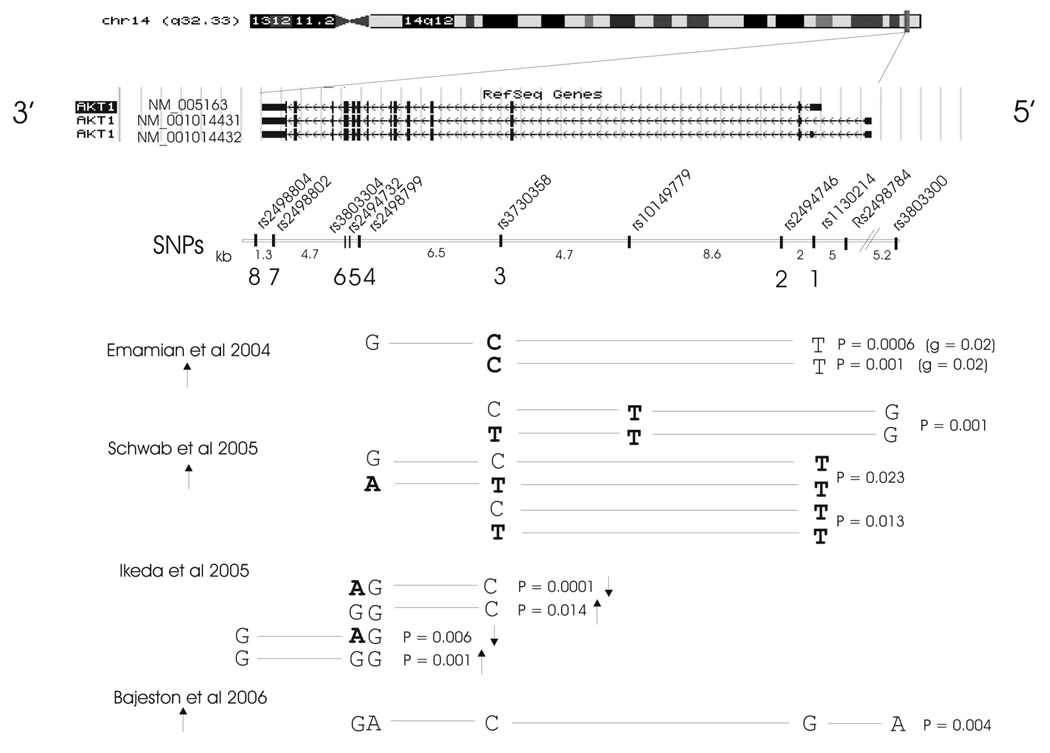
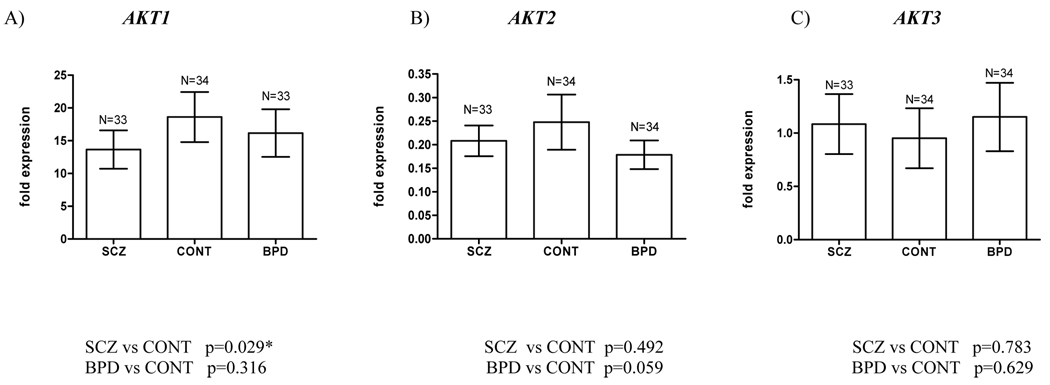
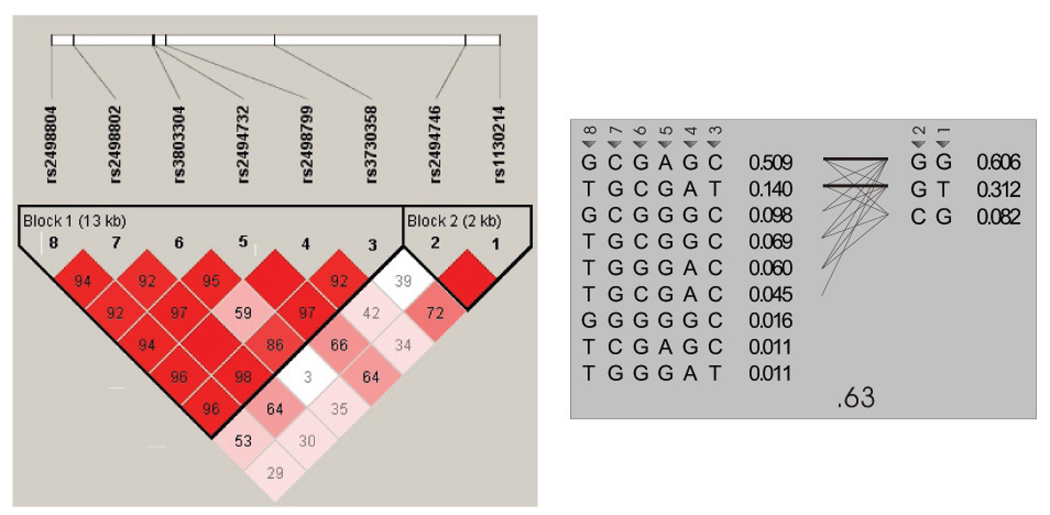
The association of DTNBP1 in the Irish Study of High Density Schizophrenia Families (ISHDSF) prompted our investigation of AKT1 for association with disease in this sample. Eight single nucleotide polymorphisms spanning AKT1 were analyzed for association with schizophrenia across four definitions of affection and according to Operational Criteria Checklist of Psychotic Illness (OPCRIT) symptom scales. We examined expression of AKT1 messenger RNA from postmortem brain tissue of schizophrenic, bipolar, and control individuals.
No single marker showed significant association, but the risk haplotype previously found over-transmitted to Caucasian schizophrenic patients was significantly under-transmitted in the ISHDSF (.01 < p < .05), across all OPCRIT symptom dimensions. Exploratory haplotype analysis confirmed association with schizophrenia toward the 5' end of AKT1 (.008 < p < .049, uncorrected). We found significantly decreased RNA levels in prefrontal cortex of schizophrenic individuals, consistent with reduced AKT1 protein levels reported in schizophrenic brain.
The replication of association of AKT1 gene variants in a further Caucasian family sample adds support for involvement of AKT signaling in schizophrenia, perhaps encompassing a broader clinical phenotype that includes mood dysregulation. We show that AKT signaling might be compromised in schizophrenic and bipolar patients via reduced RNA expression of specific AKT isoforms.
磷脂酰肌醇3激酶(PI3K)-AKT信号转导通路对细胞生长和存活至关重要。体外功能研究表明,候选精神分裂症易感基因DTNBP1影响AKT信号传导以促进神经元活力。关联研究也表明AKT1基因与精神分裂症有关,且精神分裂症患者大脑中该基因的蛋白表达降低。
爱尔兰高密度精神分裂症家族研究(ISHDSF)中DTNBP1的关联性促使我们在该样本中研究AKT1与疾病的关联性。我们分析了跨越AKT1的8个单核苷酸多态性与精神分裂症的关联性,这是根据四种情感定义以及精神病性疾病操作标准清单(OPCRIT)症状量表进行的。我们检测了精神分裂症患者、双相情感障碍患者和对照个体死后脑组织中AKT1信使核糖核酸的表达。
没有单个标记显示出显著关联性,但先前发现过度传递给白种人精神分裂症患者的风险单倍型在ISHDSF中显著传递不足(0.01 < p < 0.05),涵盖所有OPCRIT症状维度。探索性单倍型分析证实了在AKT1的5'端与精神分裂症有关联(0.008 < p < 0.049,未校正)。我们发现精神分裂症患者前额叶皮质中的RNA水平显著降低,这与精神分裂症大脑中报道的AKT1蛋白水平降低一致。
在另一个白种人家族样本中重复检测到AKT1基因变异的关联性,这为AKT信号传导参与精神分裂症提供了支持,可能涉及包括情绪失调在内的更广泛临床表型。我们表明,精神分裂症患者和双相情感障碍患者的AKT信号传导可能因特定AKT亚型的RNA表达降低而受损。