Suttie S A, Park K G M, Smith T A D
Department of Surgery, School of Medical Sciences, University of Aberdeen, Foresterhill, Aberdeen AB25 2ZN, UK.
Br J Cancer. 2007 Oct 8;97(7):902-9. doi: 10.1038/sj.bjc.6603971. Epub 2007 Sep 11.
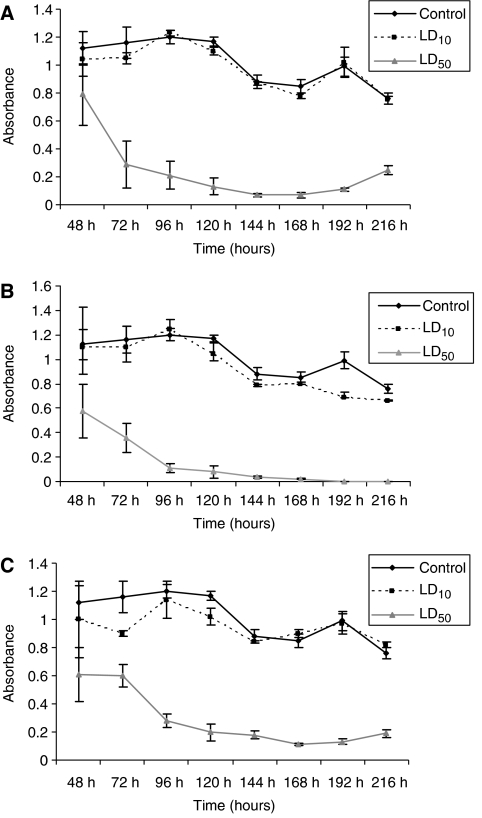
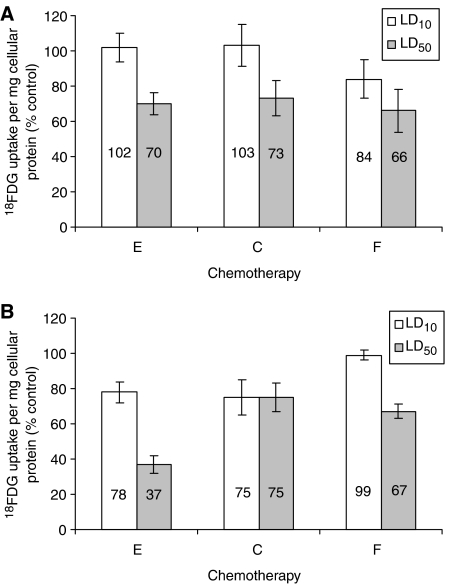
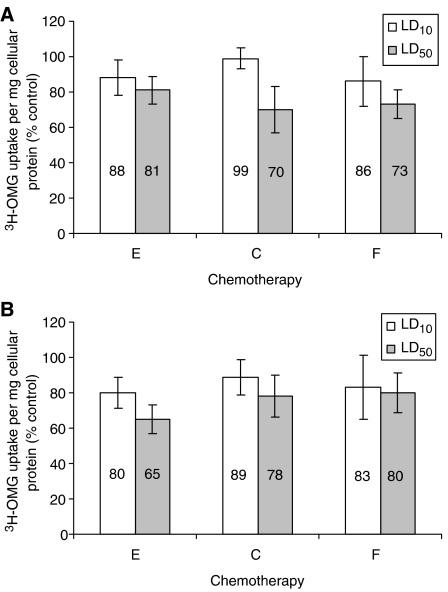
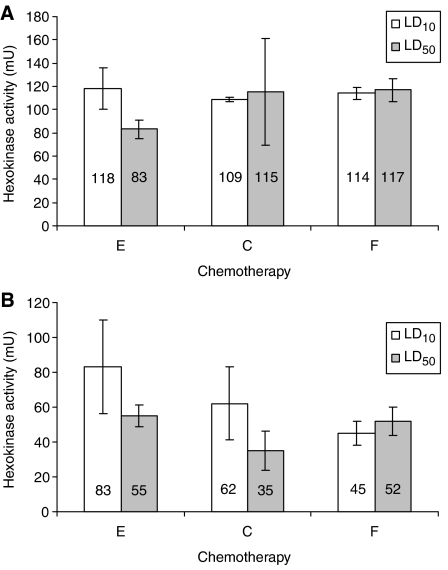
Decreased tumour [(18)F]2-fluoro-2-deoxy-D-glucose ((18)FDG) incorporation is related to response however its significance at the cell level in gastro-oesophageal cancer and how it relates to cell death is unknown. Here human gastric adenocarcinoma (AGS) cells were treated with lethal dose 10 and 50 (LD(10) and LD(50)), determined by using the MTT assay, of the three drugs, epirubicin, 5-fluorouracil and cisplatin, commonly used in the treatment of patients with gastro-oesophageal cancer. (18)FDG incorporation was determined after 48 and 72 h of treatment with each drug and related to drug-induced changes in glucose transport, hexokinase activity, cell cycle distribution and annexin V-PE binding (a measure of apoptosis). Treatment of cells for 48 and 72 h with LD(50) doses of cisplatin resulted in reductions in (18)FDG incorporation of 27 and 25% respectively and of 5-fluorouracil reduced (18)FDG incorporation by 34 and 33% respectively: epirubicin treatment reduced incorporation by 30 and 69% respectively. Cells that had been treated for 72 h with each drug were incubated in drug-free media for a further 6 days to determine their ability to recover. Comparison of the ability to recover from the chemotherapy agent, with (18)FDG incorporation before the recovery period allowed an assessment of the predictive ability of (18)FDG incorporation. Cells treated with either 5-fluorouracil or cisplatin demonstrated recovery on removal of the drug. In contrast, cells treated with epirubicin did not recover corresponding with the greatest 72 h treatment decrease in (18)FDG incorporation. In contrast to adherent cells treated with cisplatin or 5-fluorouracil, adherent epirubicin-treated cells also exhibited very high levels of apoptosis. Glucose transport was decreased after each treatment whilst hexokinase activity was only decreased after 72 h of treatment with each drug. There was no consistent relationship observed between (18)FDG incorporation and cell cycle distribution. Our results show that at the tumour cell level in gastric tumour cells, decreased (18)FDG incorporation and glucose transport, accompanies therapeutic growth inhibition. (18)FDG incorporation is particularly diminished in cells exhibiting apoptosis.
肿瘤[(18)F]2-氟-2-脱氧-D-葡萄糖((18)FDG)摄取减少与反应相关,但其在胃食管癌细胞水平的意义以及与细胞死亡的关系尚不清楚。在此,使用MTT法确定了三种常用于治疗胃食管癌患者的药物表柔比星、5-氟尿嘧啶和顺铂的致死剂量10和50(LD(10)和LD(50)),并用其处理人胃腺癌细胞(AGS)。每种药物处理48小时和72小时后测定(18)FDG摄取,并将其与药物诱导的葡萄糖转运、己糖激酶活性、细胞周期分布和膜联蛋白V-PE结合(细胞凋亡的一种测量指标)变化相关联。用LD(50)剂量的顺铂处理细胞48小时和72小时后,(18)FDG摄取分别降低了27%和25%,5-氟尿嘧啶处理使(18)FDG摄取分别降低了34%和33%:表柔比星处理分别使摄取降低了30%和69%。用每种药物处理72小时的细胞在无药物培养基中再孵育6天,以确定其恢复能力。通过比较从化疗药物恢复的能力与恢复期前的(18)FDG摄取情况,可评估(18)FDG摄取的预测能力。用5-氟尿嘧啶或顺铂处理的细胞在去除药物后表现出恢复。相反,用表柔比星处理的细胞未恢复,这与72小时处理后(18)FDG摄取的最大降低相对应。与用顺铂或5-氟尿嘧啶处理的贴壁细胞相比,用表柔比星处理的贴壁细胞也表现出非常高的细胞凋亡水平。每次处理后葡萄糖转运均降低,而每种药物处理72小时后己糖激酶活性才降低。未观察到(18)FDG摄取与细胞周期分布之间存在一致的关系。我们的结果表明,在胃肿瘤细胞的肿瘤细胞水平上,(18)FDG摄取和葡萄糖转运减少伴随着治疗性生长抑制。在表现出细胞凋亡的细胞中,(18)FDG摄取尤其减少。