Poulsen Michael, Erhardt Daniel P, Molinaro Daniel J, Lin Ting-Li, Currie Cameron R
Department of Bacteriology, University of Wisconsin-Madison, Madison, Wisconsin, USA.
PLoS One. 2007 Sep 26;2(9):e960. doi: 10.1371/journal.pone.0000960.
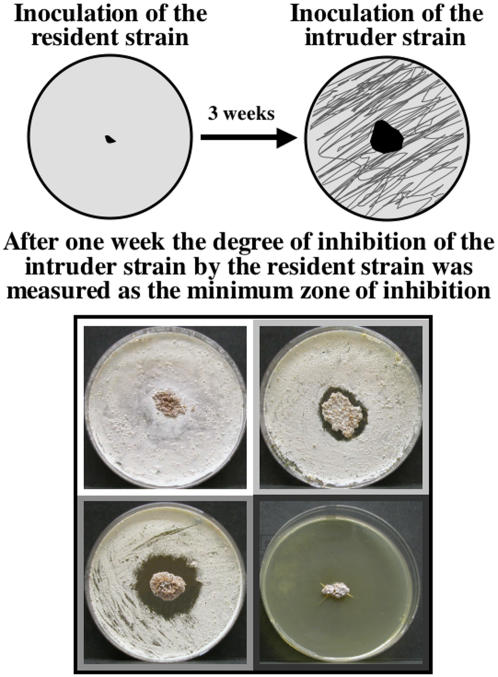
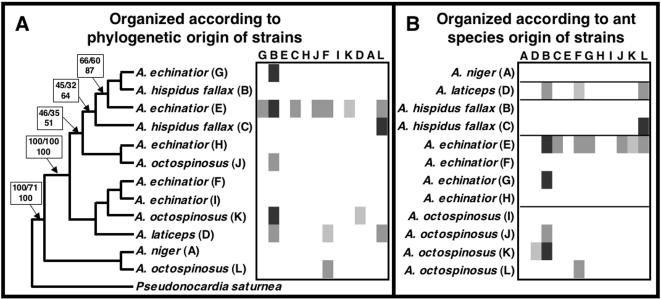
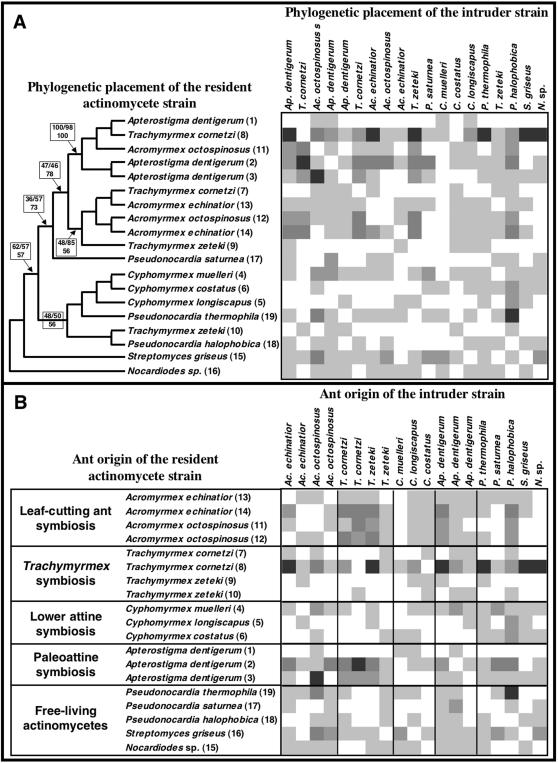
Conflict within mutually beneficial associations is predicted to destabilize relationships, and theoretical and empirical work exploring this has provided significant insight into the dynamics of cooperative interactions. Within mutualistic associations, the expression and regulation of conflict is likely more complex than in intraspecific cooperative relationship, because of the potential presence of: i) multiple genotypes of microbial species associated with individual hosts, ii) multiple species of symbiotic lineages forming cooperative partner pairings, and iii) additional symbiont lineages. Here we explore complexity of conflict expression within the ancient and coevolved mutualistic association between attine ants, their fungal cultivar, and actinomycetous bacteria (Pseudonocardia). Specifically, we examine conflict between the ants and their Pseudonocardia symbionts maintained to derive antibiotics against parasitic microfungi (Escovopsis) infecting the ants' fungus garden. Symbiont assays pairing isolates of Pseudonocardia spp. associated with fungus-growing ants spanning the phylogenetic diversity of the mutualism revealed that antagonism between strains is common. In contrast, antagonism was substantially less common between more closely related bacteria associated with Acromyrmex leaf-cutting ants. In both experiments, the observed variation in antagonism across pairings was primarily due to the inhibitory capabilities and susceptibility of individual strains, but also the phylogenetic relationships between the ant host of the symbionts, as well as the pair-wise genetic distances between strains. The presence of antagonism throughout the phylogenetic diversity of Pseudonocardia symbionts indicates that these reactions likely have shaped the symbiosis from its origin. Antagonism is expected to prevent novel strains from invading colonies, enforcing single-strain rearing within individual ant colonies. While this may align ant-actinomycete interests in the bipartite association, the presence of single strains of Pseudonocardia within colonies may not be in the best interest of the ants, because increasing the diversity of bacteria, and thereby antibiotic diversity, would help the ant-fungus mutualism deal with the specialized parasites.
互利共生关系中的冲突预计会破坏关系的稳定性,对此进行探索的理论和实证研究为合作互动的动态变化提供了重要见解。在互利共生关系中,冲突的表达和调控可能比种内合作关系更为复杂,因为可能存在以下情况:i)与单个宿主相关的微生物物种有多种基因型;ii)形成合作伙伴配对的共生谱系有多个物种;iii)还有其他共生谱系。在这里,我们探讨了切叶蚁、其真菌培养物和放线菌(假诺卡氏菌)之间古老且共同进化的互利共生关系中冲突表达的复杂性。具体而言,我们研究了蚂蚁与其假诺卡氏菌共生体之间的冲突,这些共生体可产生抗生素以对抗感染蚂蚁真菌园的寄生微真菌(埃氏菌)。对与种植真菌的蚂蚁相关的假诺卡氏菌属分离株进行配对的共生体分析显示,跨越互利共生系统发育多样性的菌株之间的拮抗作用很常见。相比之下,与切叶蚁相关的亲缘关系更近的细菌之间的拮抗作用则要少得多。在这两个实验中,配对间观察到的拮抗作用差异主要归因于单个菌株的抑制能力和易感性,以及共生体蚂蚁宿主之间的系统发育关系,还有菌株之间的成对遗传距离。假诺卡氏菌共生体整个系统发育多样性中都存在拮抗作用,这表明这些反应可能从共生起源就塑造了这种共生关系。拮抗作用预计会阻止新菌株侵入蚁群,促使单个蚁群内只培养单一菌株。虽然这可能使蚂蚁与放线菌在二元共生关系中的利益保持一致,但蚁群内单一假诺卡氏菌菌株的存在可能不符合蚂蚁的最佳利益,因为增加细菌多样性,进而增加抗生素多样性,将有助于蚂蚁 - 真菌互利共生关系应对专门的寄生虫。