Ikeda Masanori, Kato Nobuyuki
Department of Molecular Biology, Okayama University Graduate School of Medicine, Dentistry, and Pharmaceutical Sciences, 2-5-1, Shikata-cho, Okayama 700-8558, Japan.
Adv Drug Deliv Rev. 2007 Oct 10;59(12):1277-89. doi: 10.1016/j.addr.2007.03.021. Epub 2007 Aug 11.
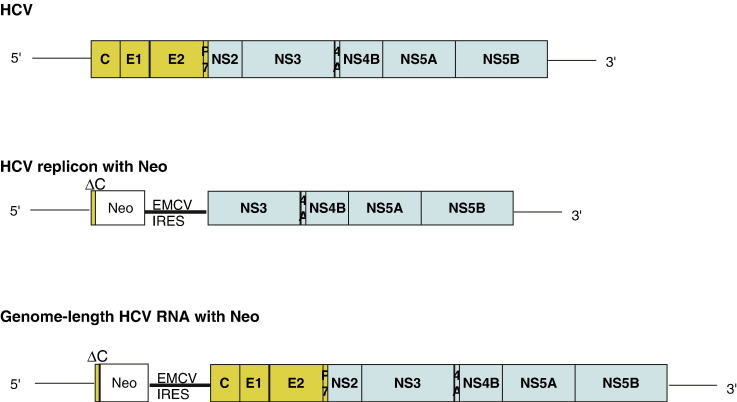
The therapy for chronic hepatitis C (CH-C) started with interferon (IFN) monotherapy in the early 1990s and this therapy was considered effective in about 10% of cases. The present standard therapy of pegylated IFN with ribavirin achieves a sustained virologic response in about 50% of patients. However, about half of the CH-C patients are still at risk of fatal liver cirrhosis and hepatocellular carcinoma. The other significant event in hepatitis C virus (HCV) research has been the development of a cell culture system. The subgenomic replicon system enables robust HCV RNA replication in hepatoma cells. And recently, the complete life cycle of HCV has been achieved using a genotype 2a strain, JFH1. These hallmarks have provided much information about the mechanisms of HCV replication, including information on the host molecules required for the replication. Anti-HCV reagents targeting HCV proteins have been developed, and some of them are now in clinical trials. However, the RNA-dependent RNA polymerase frequently causes mutations in the HCV genome, which lead to the emergence of drug-resistant HCV mutants. Some of the cellular proteins essential for HCV RNA replication have already been discovered using the HCV cell culture system. These host molecules are also candidate targets for antivirals. Here, we describe the recent progress regarding the anti-HCV reagents targeting host metabolism.
慢性丙型肝炎(CH-C)的治疗始于20世纪90年代初的干扰素(IFN)单药治疗,该疗法在约10%的病例中被认为有效。目前聚乙二醇化干扰素联合利巴韦林的标准疗法在约50%的患者中实现了持续病毒学应答。然而,约一半的CH-C患者仍有发生致命性肝硬化和肝细胞癌的风险。丙型肝炎病毒(HCV)研究中的另一重大事件是细胞培养系统的开发。亚基因组复制子系统能够在肝癌细胞中实现强大的HCV RNA复制。最近,使用2a基因型毒株JFH1实现了HCV的完整生命周期。这些标志性成果提供了许多关于HCV复制机制的信息,包括复制所需宿主分子的信息。针对HCV蛋白的抗HCV试剂已被开发出来,其中一些目前正在进行临床试验。然而,RNA依赖性RNA聚合酶经常在HCV基因组中引起突变,从而导致耐药性HCV突变体的出现。利用HCV细胞培养系统已经发现了一些HCV RNA复制所必需的细胞蛋白。这些宿主分子也是抗病毒药物的候选靶点。在此,我们描述了针对宿主代谢的抗HCV试剂的最新进展。