Stigter E C A, de Jong G J, van Bennekom W P
Division of Biomedical Analysis, Department of Pharmaceutical Sciences, Faculty of Sciences, Utrecht University, Sorbonnelaan 16, 3584 CA, Utrecht, The Netherlands.
Anal Bioanal Chem. 2007 Nov;389(6):1967-77. doi: 10.1007/s00216-007-1584-5. Epub 2007 Sep 22.
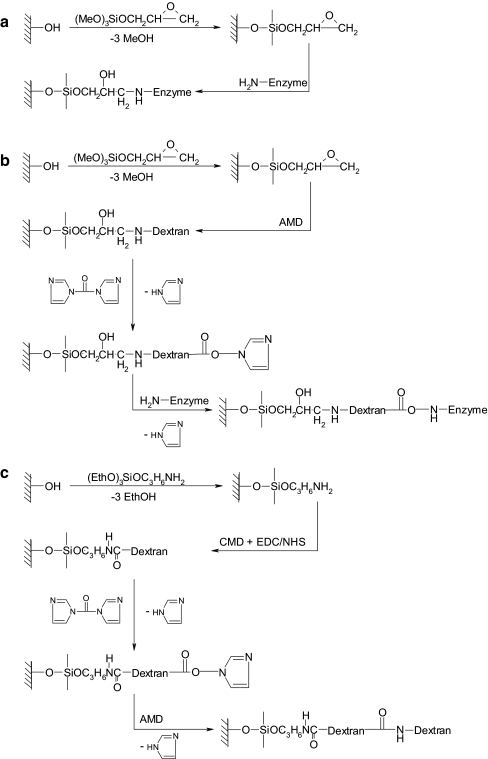
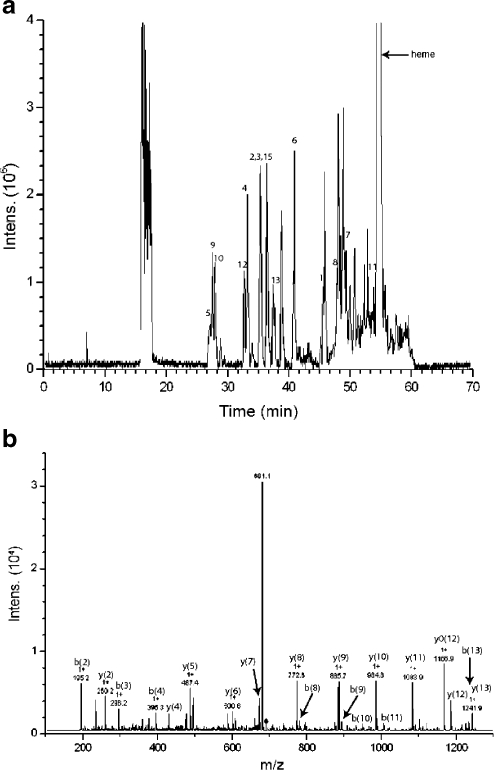
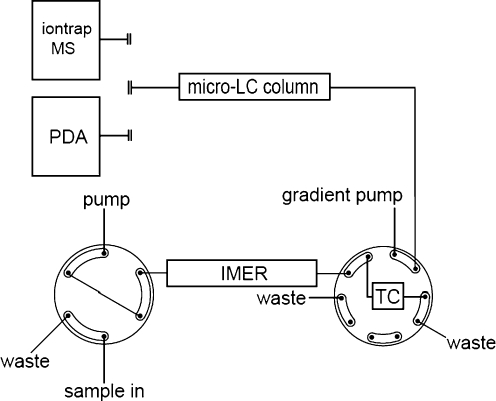
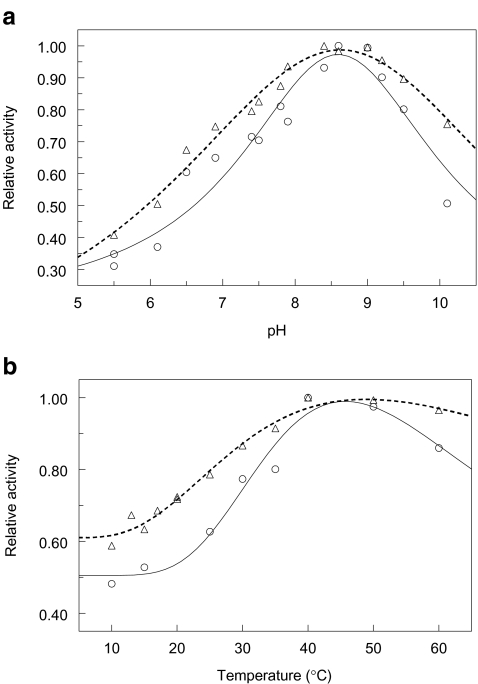
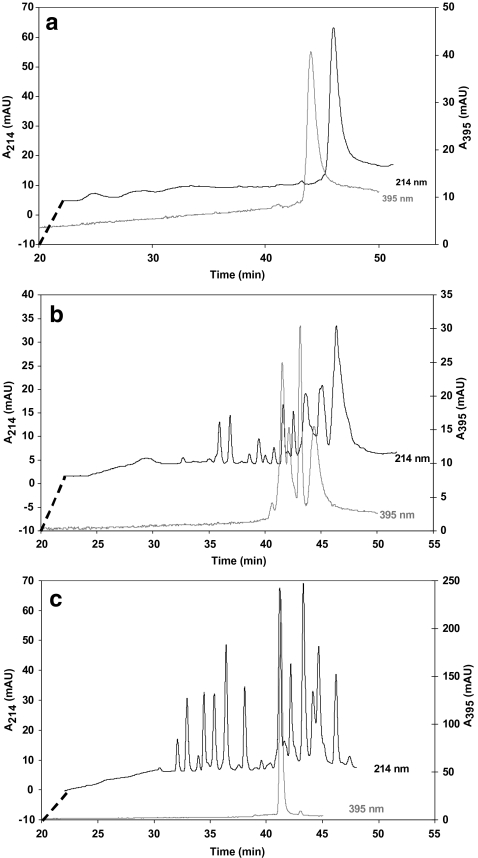
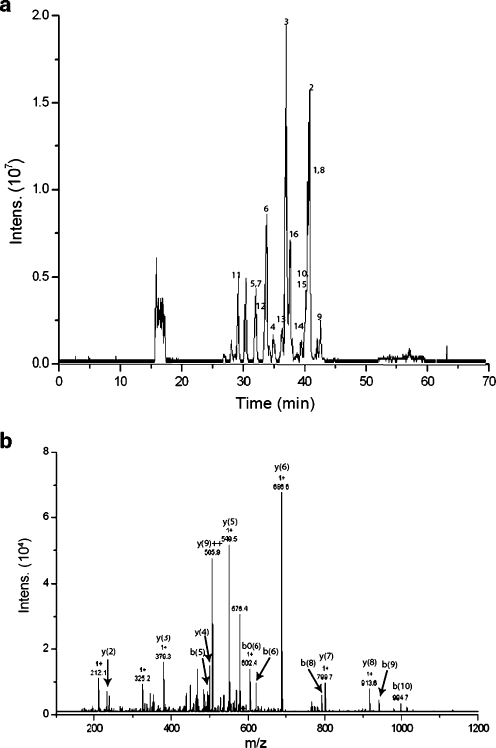
A study was initiated to construct a micro-reactor for protein digestion based on trypsin-coated fused-silica capillaries. Initially, surface plasmon resonance was used both for optimization of the surface chemistry applied in the preparation and for monitoring the amount of enzyme that was immobilized. The highest amount of trypsin was immobilized on dextran-coated SPR surfaces which allowed the covalent coupling of 11 ng mm(-2) trypsin. Fused-silica capillaries were modified in a similar manner and the resulting open-tubular trypsin-reactors having a pH optimum of pH 8.5, display a high activity when operated at 37 degrees C and are stable for at least two weeks when used continuously. Trypsin auto-digestion fragments, sample carry-over, and loss of signal due to adsorption of the protein were not observed. On-line digestion without prior protein denaturation, followed by micro-LC separation and photodiode array detection, was tested with horse-heart cytochrome C and horse skeletal-muscle myoglobin. The complete digestion of 20 pmol microL(-1) horse cytochrome C was observed when the average residence time of the protein sample in a 140 cm x 50 microm capillary immobilized enzyme reactor (IMER) was 165 s. Mass spectrometric identification of the injected protein on the basis of the tryptic peptides proved possible. Protein digestion was favorable with respect to reaction time and fragments formed when compared with other on-line and off-line procedures. These results and the easy preparation of this micro-reactor provide possibilities for miniaturized enzyme-reactors for on-line peptide mapping and inhibitor screening.
开展了一项研究,以构建基于胰蛋白酶包被的熔融石英毛细管的蛋白质消化微反应器。最初,表面等离子体共振用于优化制备过程中应用的表面化学以及监测固定化酶的量。最高量的胰蛋白酶固定在葡聚糖包被的表面等离子体共振表面上,该表面允许共价偶联11 ng mm(-2)的胰蛋白酶。以类似方式对熔融石英毛细管进行修饰,所得的pH最适值为pH 8.5的开管胰蛋白酶反应器在37℃下运行时显示出高活性,并且连续使用时至少稳定两周。未观察到胰蛋白酶自消化片段、样品残留以及由于蛋白质吸附导致的信号损失。使用马心细胞色素C和马骨骼肌肌红蛋白测试了无需预先蛋白质变性的在线消化,随后进行微液相色谱分离和光电二极管阵列检测。当蛋白质样品在140 cm×50μm毛细管固定化酶反应器(IMER)中的平均停留时间为165 s时,观察到20 pmol μL(-1)马细胞色素C的完全消化。基于胰蛋白酶肽段对注入蛋白质进行质谱鉴定被证明是可行的。与其他在线和离线方法相比,蛋白质消化在反应时间和形成的片段方面具有优势。这些结果以及该微反应器的简易制备为用于在线肽图谱分析和抑制剂筛选的小型化酶反应器提供了可能性。