Alkan Can, Ventura Mario, Archidiacono Nicoletta, Rocchi Mariano, Sahinalp S Cenk, Eichler Evan E
Department of Genome Sciences, University of Washington School of Medicine, Seattle, Washington, USA.
PLoS Comput Biol. 2007 Sep;3(9):1807-18. doi: 10.1371/journal.pcbi.0030181.
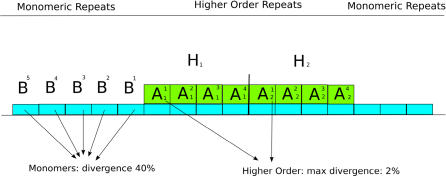
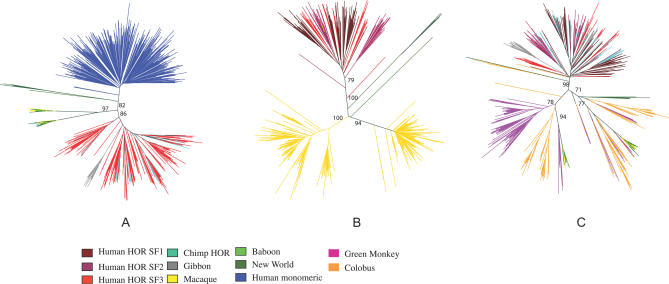
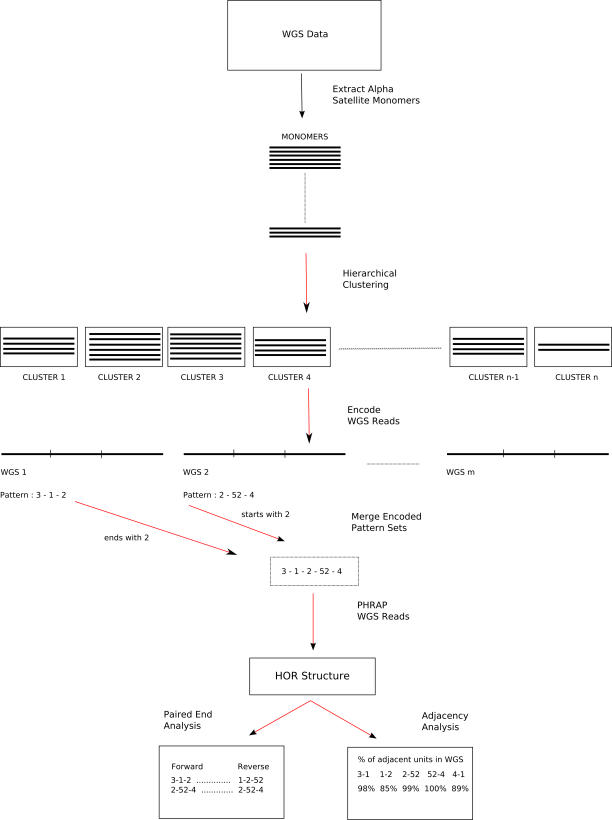
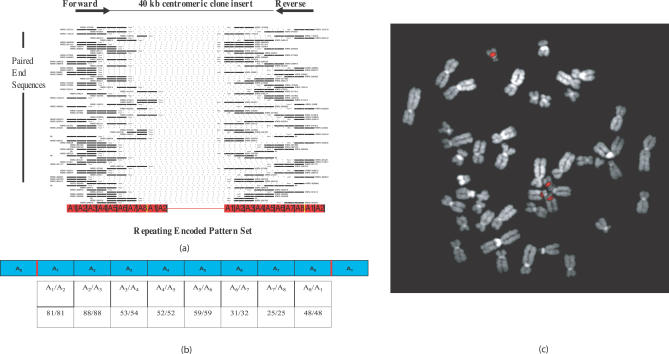
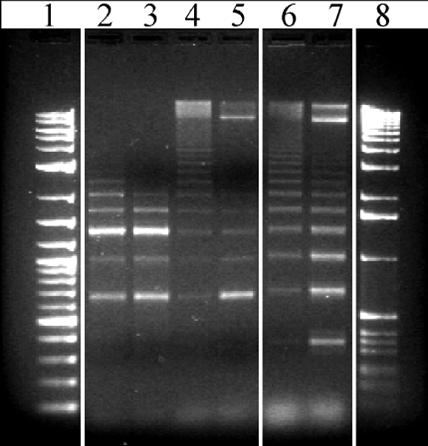
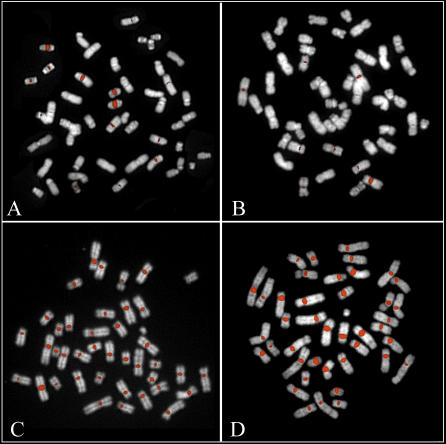
The major DNA constituent of primate centromeres is alpha satellite DNA. As much as 2%-5% of sequence generated as part of primate genome sequencing projects consists of this material, which is fragmented or not assembled as part of published genome sequences due to its highly repetitive nature. Here, we develop computational methods to rapidly recover and categorize alpha-satellite sequences from previously uncharacterized whole-genome shotgun sequence data. We present an algorithm to computationally predict potential higher-order array structure based on paired-end sequence data and then experimentally validate its organization and distribution by experimental analyses. Using whole-genome shotgun data from the human, chimpanzee, and macaque genomes, we examine the phylogenetic relationship of these sequences and provide further support for a model for their evolution and mutation over the last 25 million years. Our results confirm fundamental differences in the dispersal and evolution of centromeric satellites in the Old World monkey and ape lineages of evolution.
灵长类动物着丝粒的主要DNA成分是α卫星DNA。在灵长类动物基因组测序项目中,多达2% - 5%的测序序列由这种物质组成,由于其高度重复的性质,这些序列在已发表的基因组序列中呈片段化或未组装状态。在此,我们开发了计算方法,以从先前未表征的全基因组鸟枪法序列数据中快速恢复并分类α卫星序列。我们提出一种算法,基于双末端序列数据通过计算预测潜在的高阶阵列结构,然后通过实验分析对其组织和分布进行实验验证。利用来自人类、黑猩猩和猕猴基因组的全基因组鸟枪法数据,我们研究了这些序列的系统发育关系,并为它们在过去2500万年中的进化和突变模型提供了进一步支持。我们的结果证实了旧世界猴和猿进化谱系中着丝粒卫星在扩散和进化方面的根本差异。