Lammers Twan, Peschke Peter, Ehemann Volker, Debus Jürgen, Slobodin Boris, Lavi Sara, Huber Peter
Department of Innovative Cancer Diagnosis and Therapy, Clinical Cooperation Unit Radiotherapeutic Oncology, German Cancer Research Center, Im Neuenheimer Feld 280, 69120 Heidelberg, Germany.
Mol Cancer. 2007 Oct 17;6:65. doi: 10.1186/1476-4598-6-65.
PP2Calpha is the representative member of the type 2C family of protein phosphatases, and it has recently been implicated in the regulation of p53-, TGFbeta-, cyclin-dependent kinase- and apoptosis-signaling. To investigate the role of PP2Calpha in cell growth and in radio- and chemosensitivity, wild type and PP2Calpha siRNA-expressing MCF7 cells were subjected to several different viability and cell cycle analyses, both under basal conditions and upon treatment with radio- and chemotherapy. By comparing the growth of tumors established from both types of cells, we also evaluated the involvement of PP2Calpha in tumorigenesis.
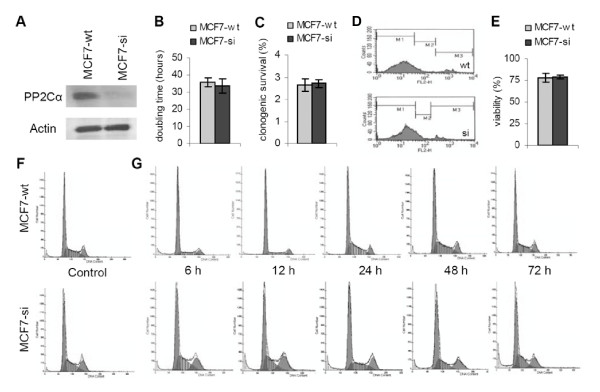
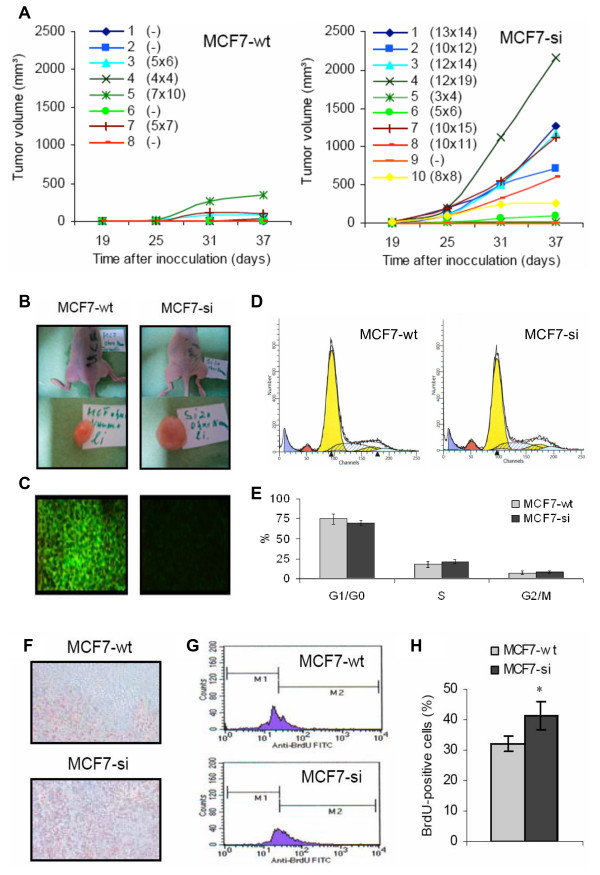
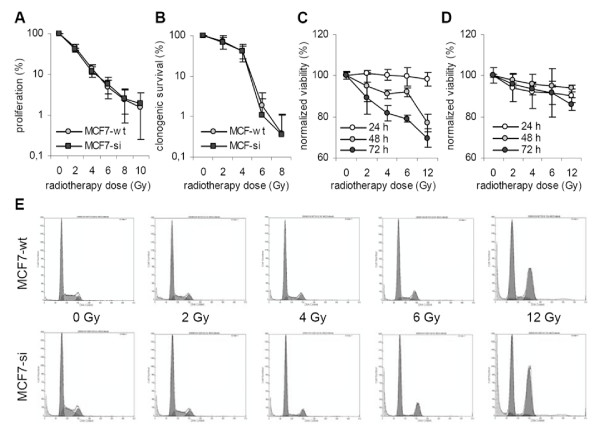
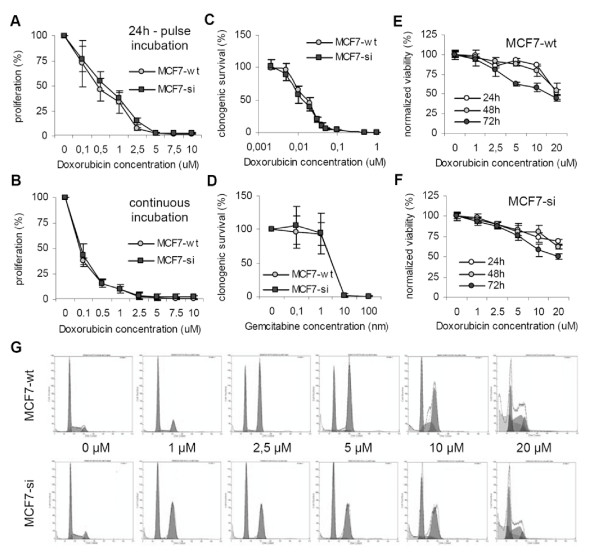
It was found that knockdown of PP2Calpha did not affect the proliferation, the clonogenic survival and the membrane integrity of MCF7 cells. In addition, it did not alter their radio- and chemosensitivity. For PP2Calpha siRNA-expressing MCF7 cells, the number of cells in the G0/G1 phase of the cell cycle was reduced, the induction of the G1 block was attenuated, the number of cells in G2/M was increased, and the induction of the G2 block was enhanced. The tumorigenic potential of PP2Calpha siRNA-expressing MCF7 cells was found to be higher than that of wild type MCF7 cells, and the in vivo proliferation of these cells was found to be increased.
Based on these findings, we conclude that PP2Calpha is not involved in controlling cell growth and radio- and chemosensitivity in vitro. It does, however, play a role in the regulation of the cell cycle, in the induction of cell cycle checkpoints and in tumorigenesis. The latter notion implies that PP2Calpha may possess tumor-suppressing properties, and it thereby sets the stage for more elaborate analyses on its involvement in the development and progression of cancer.
PP2Cα是蛋白磷酸酶2C家族的代表性成员,最近被认为参与了p53、转化生长因子β、细胞周期蛋白依赖性激酶和凋亡信号的调控。为了研究PP2Cα在细胞生长以及放射和化学敏感性中的作用,对野生型和表达PP2Cα小干扰RNA(siRNA)的MCF7细胞进行了几种不同的活力和细胞周期分析,包括在基础条件下以及经放射和化疗处理后。通过比较由这两种细胞形成的肿瘤的生长情况,我们还评估了PP2Cα在肿瘤发生中的作用。
发现敲低PP2Cα不影响MCF7细胞的增殖、克隆形成存活率和膜完整性。此外,它也不改变细胞的放射和化学敏感性。对于表达PP2Cα siRNA的MCF7细胞,细胞周期G0/G1期的细胞数量减少,G期阻滞的诱导减弱,G2/M期的细胞数量增加,G2期阻滞的诱导增强。发现表达PP2Cα siRNA的MCF7细胞的致瘤潜力高于野生型MCF7细胞,并且这些细胞在体内的增殖增加。
基于这些发现,我们得出结论,PP2Cα在体外不参与控制细胞生长以及放射和化学敏感性。然而,它在细胞周期调控、细胞周期检查点的诱导以及肿瘤发生中发挥作用。后一种观点意味着PP2Cα可能具有肿瘤抑制特性,从而为更详细地分析其在癌症发生和发展中的作用奠定了基础。