Takahashi Rieko, Watanabe Katsutoshi, Nishida Mutsumi, Hori Michio
Department of Zoology, Division of Biological Science, Graduate school of Science, Kyoto University, Kitashirakawa-Oiwake, Sakyo, Kyoto 606-8502, Japan.
BMC Evol Biol. 2007 Oct 18;7:195. doi: 10.1186/1471-2148-7-195.
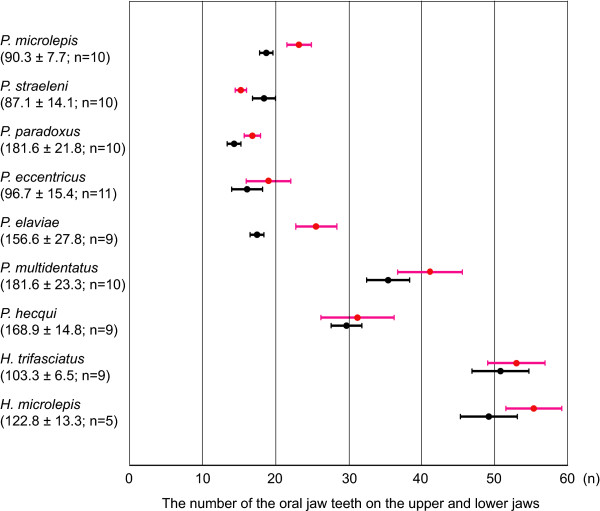
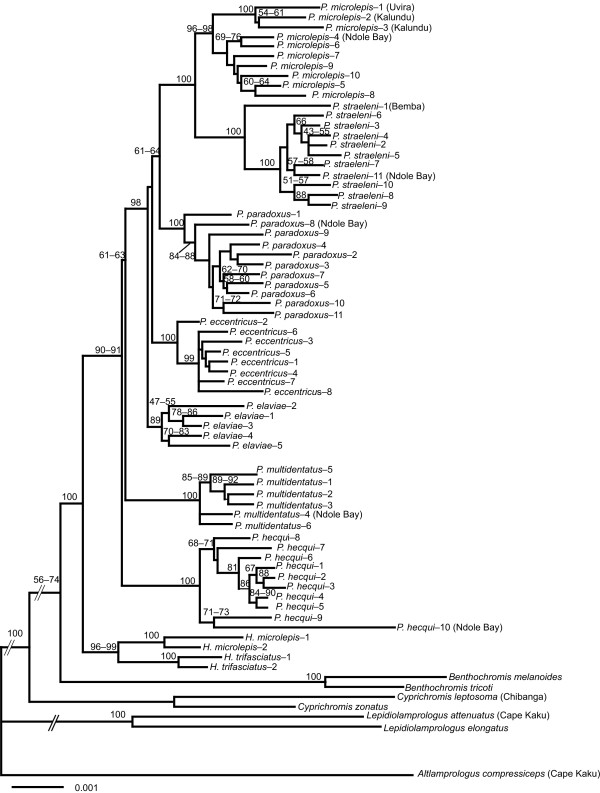
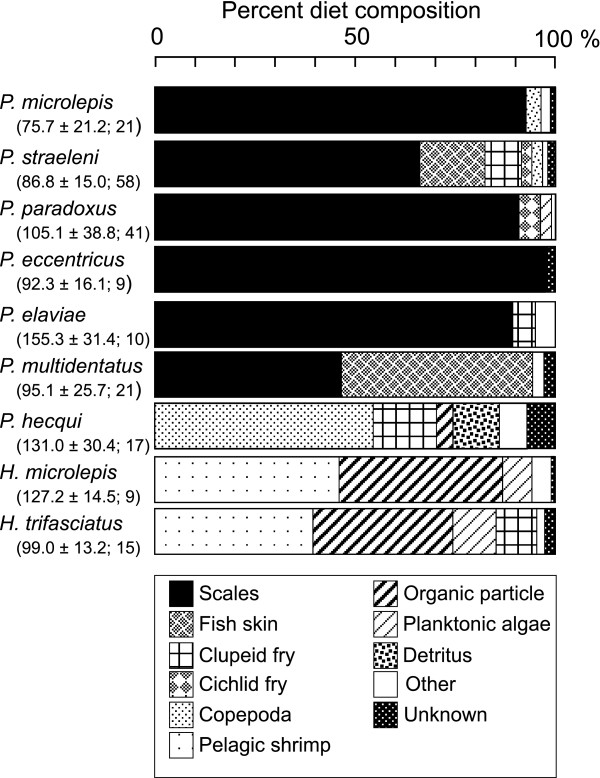
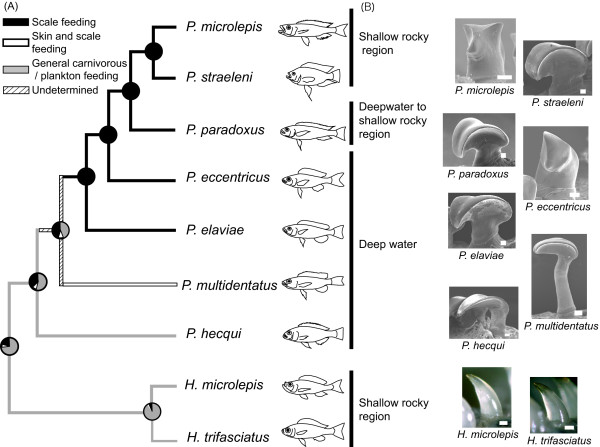
Cichlid fishes in Lake Tanganyika exhibit remarkable diversity in their feeding habits. Among them, seven species in the genus Perissodus are known for their unique feeding habit of scale eating with specialized feeding morphology and behaviour. Although the origin of the scale-eating habit has long been questioned, its evolutionary process is still unknown. In the present study, we conducted interspecific phylogenetic analyses for all nine known species in the tribe Perissodini (seven Perissodus and two Haplotaxodon species) using amplified fragment length polymorphism (AFLP) analyses of the nuclear DNA. On the basis of the resultant phylogenetic frameworks, the evolution of their feeding habits was traced using data from analyses of stomach contents, habitat depths, and observations of oral jaw tooth morphology.
AFLP analyses resolved the phylogenetic relationships of the Perissodini, strongly supporting monophyly for each species. The character reconstruction of feeding ecology based on the AFLP tree suggested that scale eating evolved from general carnivorous feeding to highly specialized scale eating. Furthermore, scale eating is suggested to have evolved in deepwater habitats in the lake. Oral jaw tooth shape was also estimated to have diverged in step with specialization for scale eating.
The present evolutionary analyses of feeding ecology and morphology based on the obtained phylogenetic tree demonstrate for the first time the evolutionary process leading from generalised to highly specialized scale eating, with diversification in feeding morphology and behaviour among species.
坦噶尼喀湖的丽鱼科鱼类在摄食习性上表现出显著的多样性。其中,佩氏丽鱼属的7个物种以其独特的食鳞习性而闻名,它们具有专门的摄食形态和行为。尽管食鳞习性的起源长期以来一直受到质疑,但其进化过程仍然未知。在本研究中,我们对佩氏丽鱼族的所有9个已知物种(7个佩氏丽鱼物种和2个单型丽鱼属物种)进行了种间系统发育分析,采用核DNA的扩增片段长度多态性(AFLP)分析。基于所得的系统发育框架,利用胃内容物分析、栖息地深度数据以及口腔颌骨牙齿形态观察结果,追踪了它们摄食习性的进化过程。
AFLP分析解析了佩氏丽鱼族的系统发育关系,有力地支持了每个物种的单系性。基于AFLP树的摄食生态学特征重建表明,食鳞习性是从一般肉食性摄食进化到高度特化的食鳞习性。此外,食鳞习性被认为是在该湖的深水栖息地中进化而来的。口腔颌骨牙齿形状也被估计随着食鳞特化而发生了分化。
基于所得系统发育树对摄食生态学和形态学进行的当前进化分析首次证明了从广义到高度特化食鳞习性的进化过程,以及物种间摄食形态和行为的多样化。