Menashe Idan, Abaffy Tatjana, Hasin Yehudit, Goshen Sivan, Yahalom Vered, Luetje Charles W, Lancet Doron
Department of Molecular Genetics, Weizmann Institute of Science, Rehovot, Israel.
PLoS Biol. 2007 Oct 30;5(11):e284. doi: 10.1371/journal.pbio.0050284.
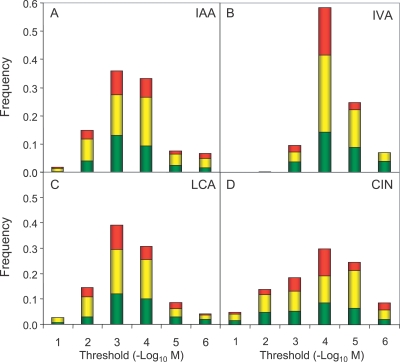
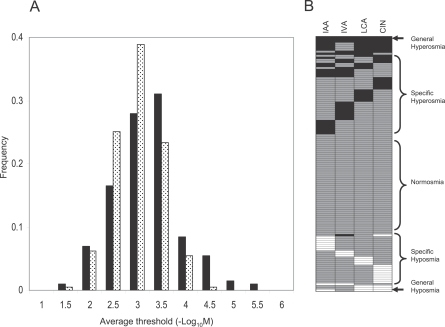
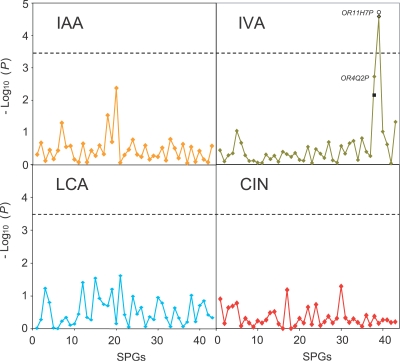
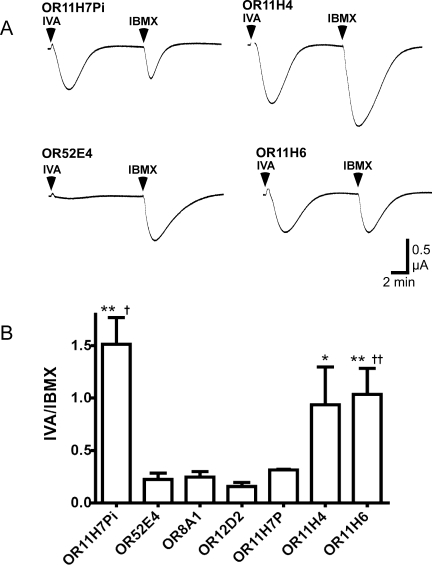
The genetic basis of odorant-specific variations in human olfactory thresholds, and in particular of enhanced odorant sensitivity (hyperosmia), remains largely unknown. Olfactory receptor (OR) segregating pseudogenes, displaying both functional and nonfunctional alleles in humans, are excellent candidates to underlie these differences in olfactory sensitivity. To explore this hypothesis, we examined the association between olfactory detection threshold phenotypes of four odorants and segregating pseudogene genotypes of 43 ORs genome-wide. A strong association signal was observed between the single nucleotide polymorphism variants in OR11H7P and sensitivity to the odorant isovaleric acid. This association was largely due to the low frequency of homozygous pseudogenized genotype in individuals with specific hyperosmia to this odorant, implying a possible functional role of OR11H7P in isovaleric acid detection. This predicted receptor-ligand functional relationship was further verified using the Xenopus oocyte expression system, whereby the intact allele of OR11H7P exhibited a response to isovaleric acid. Notably, we also uncovered another mechanism affecting general olfactory acuity that manifested as a significant inter-odorant threshold concordance, resulting in an overrepresentation of individuals who were hyperosmic to several odorants. An involvement of polymorphisms in other downstream transduction genes is one possible explanation for this observation. Thus, human hyperosmia to isovaleric acid is a complex trait, contributed to by both receptor and other mechanisms in the olfactory signaling pathway.
人类嗅觉阈值中气味特异性差异的遗传基础,尤其是增强的气味敏感性(嗅觉过敏),在很大程度上仍然未知。嗅觉受体(OR)分离假基因在人类中显示出功能性和非功能性等位基因,是嗅觉敏感性这些差异的潜在优秀候选因素。为了探究这一假设,我们在全基因组范围内检查了四种气味的嗅觉检测阈值表型与43种OR分离假基因基因型之间的关联。在OR11H7P的单核苷酸多态性变体与对异戊酸气味的敏感性之间观察到强烈的关联信号。这种关联很大程度上是由于对这种气味具有特定嗅觉过敏的个体中纯合假基因化基因型的频率较低,这意味着OR11H7P在异戊酸检测中可能具有功能作用。使用非洲爪蟾卵母细胞表达系统进一步验证了这种预测受体 - 配体的功能关系,由此OR11H7P的完整等位基因对异戊酸表现出反应。值得注意的是,我们还发现了另一种影响一般嗅觉敏锐度的机制,表现为显著的气味间阈值一致性,导致对几种气味具有嗅觉过敏的个体比例过高。其他下游转导基因中的多态性参与是对此观察结果的一种可能解释。因此,人类对异戊酸的嗅觉过敏是一种复杂的性状,由嗅觉信号通路中的受体和其他机制共同导致。