Halees Anason S, El-Badrawi Rashad, Khabar Khalid S A
The Biomolecular Research Program, King Faisal Specialist Hospital and Research Center, Riyadh 11211, Saudi Arabia.
Nucleic Acids Res. 2008 Jan;36(Database issue):D137-40. doi: 10.1093/nar/gkm959. Epub 2007 Nov 4.
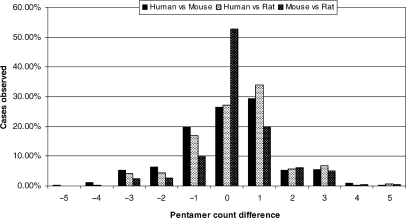
ARED Organism represents the expansion of the adenylate uridylate (AU)-rich element (ARE)-containing human mRNA database into the transcriptomes of mouse and rat. As a result, we performed quantitative assessment of ARE conservation in human, mouse and rat transcripts. We found that a significant proportion ( approximately 25%) of human genes differ in their ARE patterns from mouse and rat transcripts. ARED-Integrated, another updated and expanded version of ARED, is a compilation of ARED versions 1.0 to 3.0 and updated version 4.0 that is devoted to human mRNAs. Thus, ARED-Integrated and ARED-Organism databases, both publicly available at http://brp.kfshrc.edu.sa/ARED, offer scientists a comprehensive view of AREs in the human transcriptome and the ability to study the comparative genomics of AREs in model organisms. This ultimately will help in inferring the biological consequences of ARE variation in these key animal models as opposed to humans, particularly, in relationships to the role of RNA stability in disease.
ARED生物数据库代表了富含腺苷酸尿苷酸(AU)元件(ARE)的人类mRNA数据库向小鼠和大鼠转录组的扩展。因此,我们对人类、小鼠和大鼠转录本中的ARE保守性进行了定量评估。我们发现,相当一部分(约25%)人类基因的ARE模式与小鼠和大鼠转录本不同。ARED整合版是ARED的另一个更新和扩展版本,它是ARED 1.0至3.0版本以及专门针对人类mRNA的更新版本4.0的汇编。因此,可在http://brp.kfshrc.edu.sa/ARED上公开获取的ARED整合版数据库和ARED生物数据库,为科学家提供了人类转录组中ARE的全面视图,以及研究模式生物中ARE比较基因组学的能力。这最终将有助于推断这些关键动物模型(与人类相对)中ARE变异的生物学后果,特别是与RNA稳定性在疾病中的作用的关系。