Arnaud Frederick, Caporale Marco, Varela Mariana, Biek Roman, Chessa Bernardo, Alberti Alberto, Golder Matthew, Mura Manuela, Zhang Ya-Ping, Yu Li, Pereira Filipe, Demartini James C, Leymaster Kreg, Spencer Thomas E, Palmarini Massimo
Institute of Comparative Medicine, University of Glasgow Veterinary School, Glasgow, Scotland.
PLoS Pathog. 2007 Nov;3(11):e170. doi: 10.1371/journal.ppat.0030170.
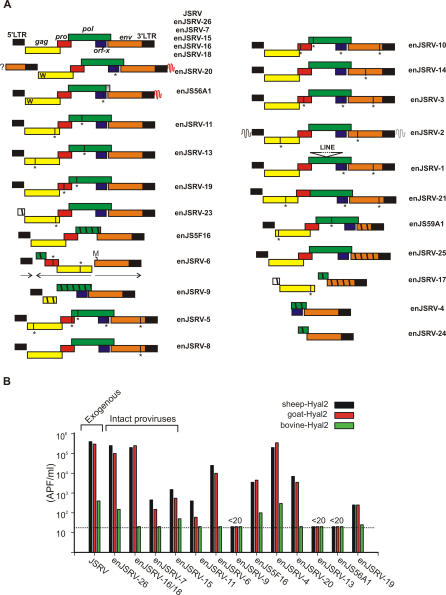
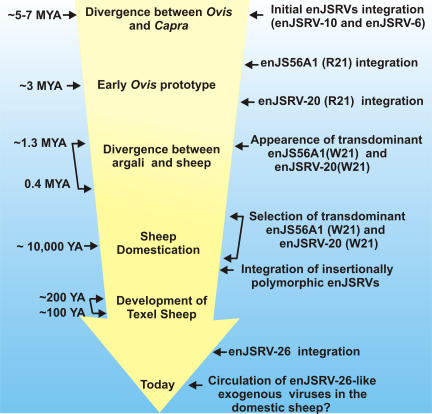
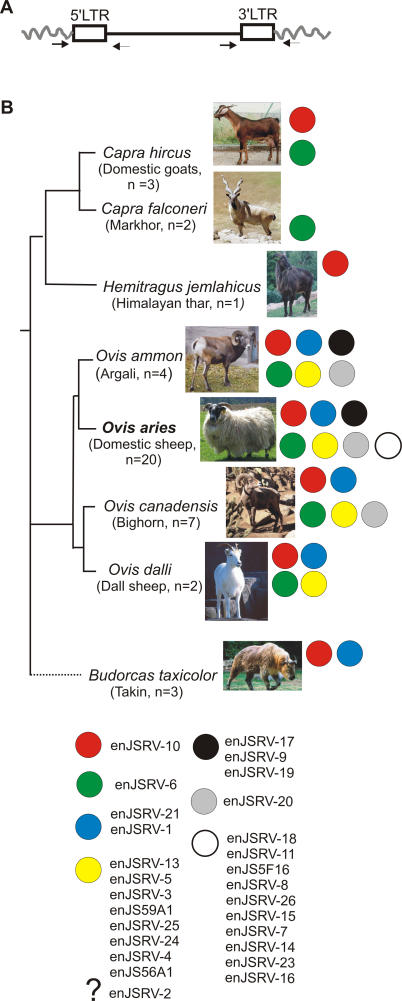
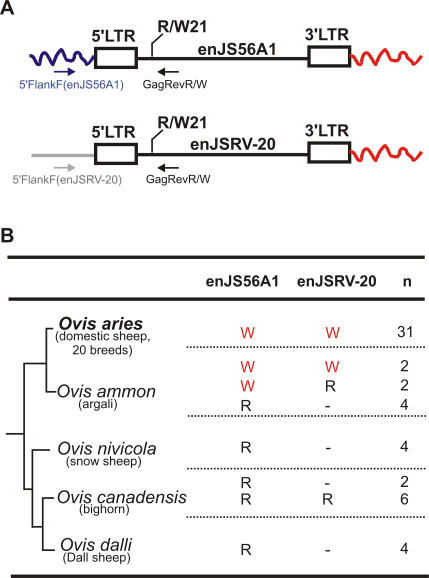
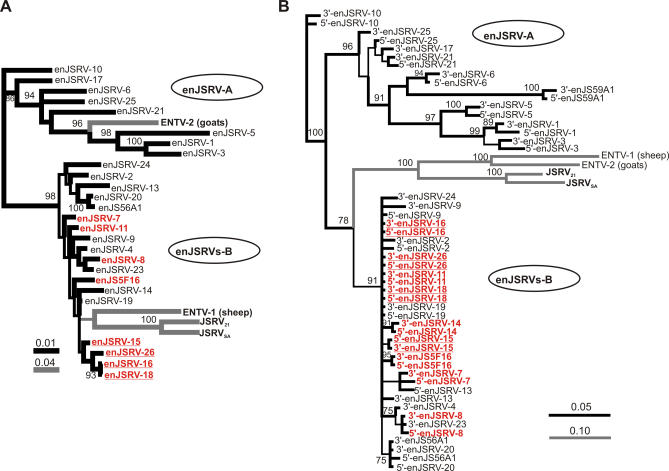
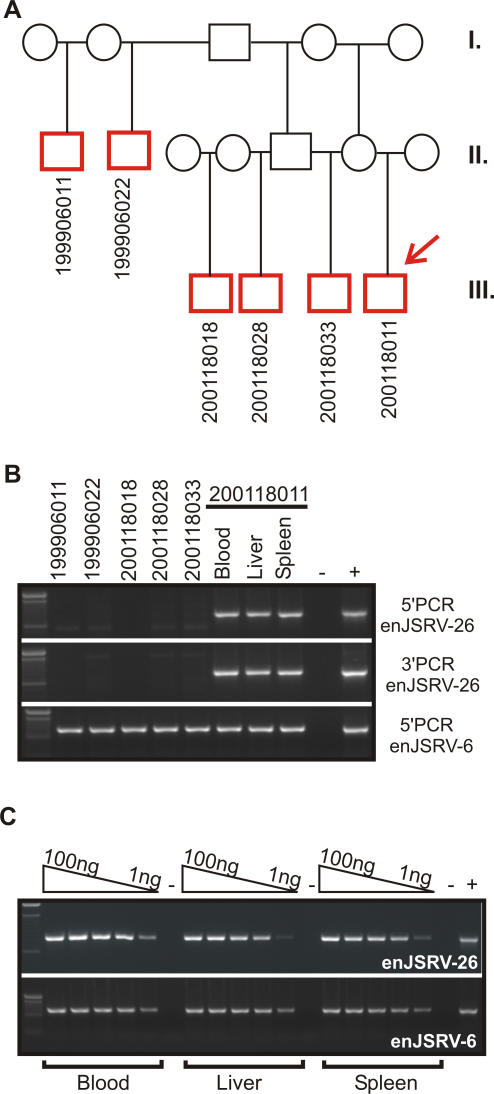
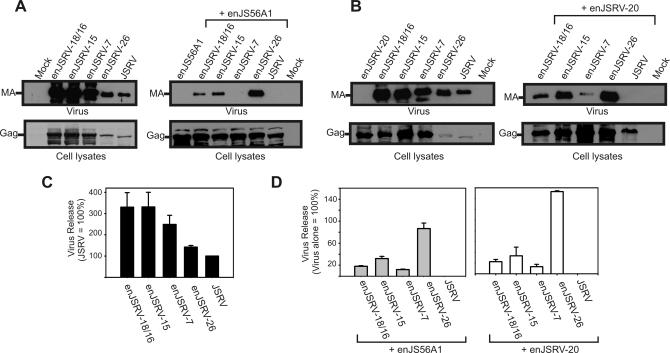
Endogenous retroviruses (ERVs) are remnants of ancient retroviral infections of the host germline transmitted vertically from generation to generation. It is hypothesized that some ERVs are used by the host as restriction factors to block the infection of pathogenic retroviruses. Indeed, some ERVs efficiently interfere with the replication of related exogenous retroviruses. However, data suggesting that these mechanisms have influenced the coevolution of endogenous and/or exogenous retroviruses and their hosts have been more difficult to obtain. Sheep are an interesting model system to study retrovirus-host coevolution because of the coexistence in this animal species of two exogenous (i.e., horizontally transmitted) oncogenic retroviruses, Jaagsiekte sheep retrovirus and Enzootic nasal tumor virus, with highly related and biologically active endogenous retroviruses (enJSRVs). Here, we isolated and characterized the evolutionary history and molecular virology of 27 enJSRV proviruses. enJSRVs have been integrating in the host genome for the last 5-7 million y. Two enJSRV proviruses (enJS56A1 and enJSRV-20), which entered the host genome within the last 3 million y (before and during speciation within the genus Ovis), acquired in two temporally distinct events a defective Gag polyprotein resulting in a transdominant phenotype able to block late replication steps of related exogenous retroviruses. Both transdominant proviruses became fixed in the host genome before or around sheep domestication (approximately 9,000 y ago). Interestingly, a provirus escaping the transdominant enJSRVs has emerged very recently, most likely within the last 200 y. Thus, we determined sequentially distinct events during evolution that are indicative of an evolutionary antagonism between endogenous and exogenous retroviruses. This study strongly suggests that endogenization and selection of ERVs acting as restriction factors is a mechanism used by the host to fight retroviral infections.
内源性逆转录病毒(ERVs)是宿主种系古代逆转录病毒感染的遗迹,通过垂直方式代代相传。据推测,宿主会利用某些ERVs作为限制因子来阻断致病性逆转录病毒的感染。事实上,一些ERVs能有效干扰相关外源性逆转录病毒的复制。然而,要获得表明这些机制影响了内源性和/或外源性逆转录病毒及其宿主共同进化的数据却更加困难。绵羊是研究逆转录病毒与宿主共同进化的一个有趣模型系统,因为在这种动物物种中,两种外源性(即水平传播)致癌逆转录病毒——绵羊肺腺瘤病毒和地方流行性鼻肿瘤病毒,与高度相关且具有生物活性的内源性逆转录病毒(enJSRVs)共存。在此,我们分离并表征了27种enJSRV原病毒的进化历史和分子病毒学特征。在过去的500万至700万年里,enJSRVs一直在宿主基因组中整合。两种enJSRV原病毒(enJS56A1和enJSRV - 20)在过去300万年(在绵羊属物种形成之前和期间)进入宿主基因组,在两个时间上不同的事件中获得了有缺陷的Gag多蛋白,从而产生了一种能阻断相关外源性逆转录病毒后期复制步骤的显性负表型。这两种显性负原病毒在绵羊驯化之前或大约驯化时(约9000年前)在宿主基因组中固定下来。有趣的是,一种逃避显性负enJSRVs的原病毒最近才出现,很可能是在过去200年内。因此,我们确定了进化过程中一系列不同的事件,这些事件表明内源性和外源性逆转录病毒之间存在进化拮抗作用。这项研究有力地表明,作为限制因子的ERVs的内源性化和选择是宿主对抗逆转录病毒感染所采用的一种机制。