Díaz González Rosario, Pérez Pertejo Yolanda, Ordóñez David, Balaña-Fouce Rafael, Reguera Rosa M
Departamento de Farmacología y Toxicología (INTOXCAL), Universidad de León, León, Spain.
PLoS One. 2007 Nov 14;2(11):e1177. doi: 10.1371/journal.pone.0001177.
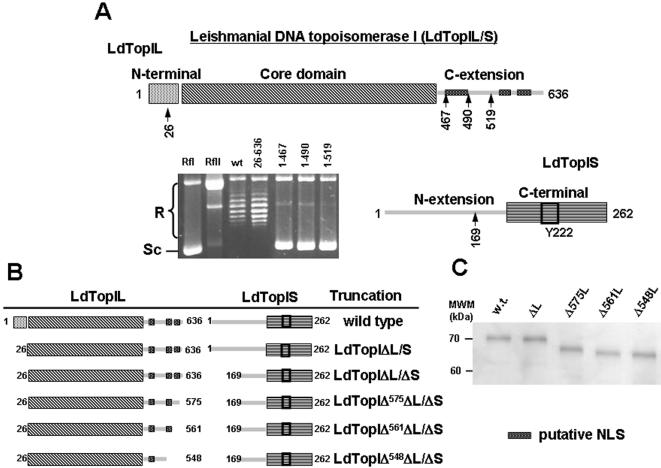
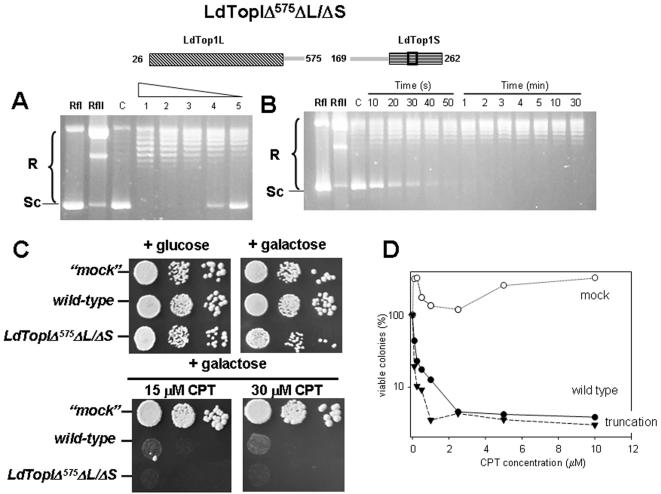
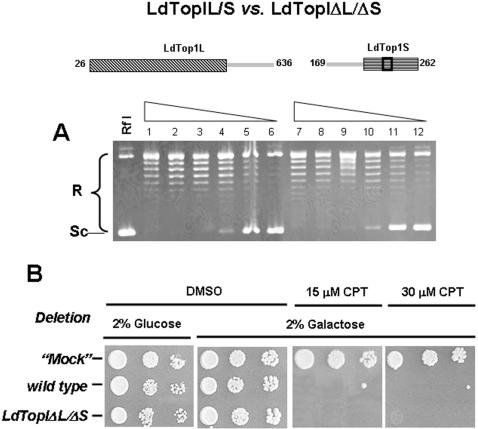
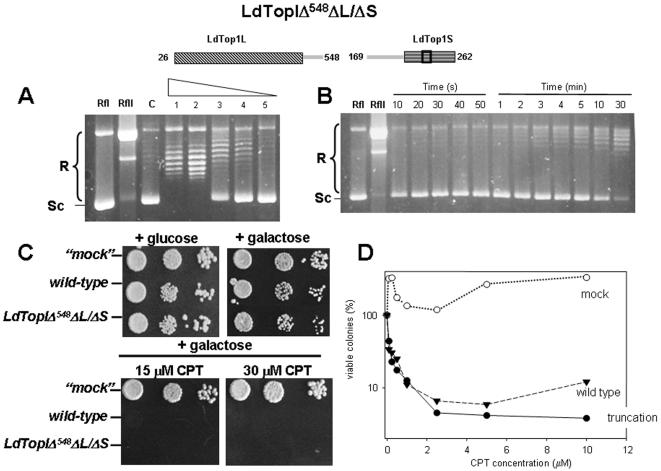
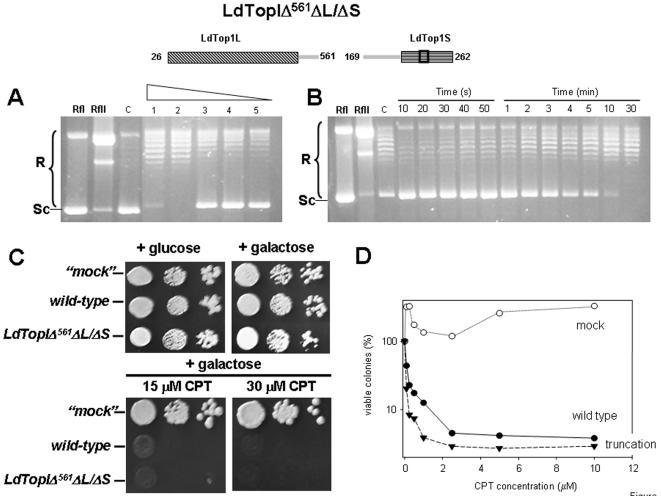
The substantial differences between trypanosomal and leishmanial DNA topoisomerase IB concerning to their homologues in mammals have provided a new lead in the study of the structural determinants that can be effectively targeted. Leishmania donovani, the causative agent of visceral leishmaniasis, contains an unusual heterodimeric DNA topoisomerase IB. The catalytically active enzyme consists of a large subunit (LdTopIL), which contains the non-conserved N-terminal end and the phylogenetically conserved "core" domain, and of a small subunit (LdTopIS) which harbors the C-terminal region with the characteristic tyrosine residue in the active site. Heterologous co-expression of LdTopIL and LdTopIS genes in a topoisomerase I deficient yeast strain, reconstitutes a fully functional enzyme LdTopIL/S which can be used for structural studies. An approach by combinatorial cloning of deleted genes encoding for truncated versions of both subunits was used in order to find out structural insights involved in enzyme activity or protein-protein interaction. The role played by the non-conserved N-terminal extension of LdTopIL in both relaxation activity and CPT sensitivity has been examined co-expressing the full-length LdTopIS and a fully active LdTopIDeltaS deletion with several deletions of LdTopIL lacking growing sequences of the N-terminal end. The sequential deletion study shows that the first 26 amino acids placed at the N-terminal end and a variable region comprised between Ala548 to end of the C-terminal extension of LdTopIL were enzymatically dispensable. Altogether this combinatorial approach provides important structural insights of the regions involved in relaxation activity and for understanding the atypical structure of this heterodimeric enzyme.
锥虫和利什曼原虫的DNA拓扑异构酶IB与其哺乳动物同源物之间的显著差异,为可有效靶向的结构决定因素的研究提供了新线索。内脏利什曼病的病原体杜氏利什曼原虫含有一种不寻常的异源二聚体DNA拓扑异构酶IB。具有催化活性的酶由一个大亚基(LdTopIL)和一个小亚基(LdTopIS)组成,大亚基包含非保守的N末端和系统发育保守的“核心”结构域,小亚基含有C末端区域,其活性位点带有特征性酪氨酸残基。LdTopIL和LdTopIS基因在拓扑异构酶I缺陷酵母菌株中的异源共表达,重构了一种可用于结构研究的全功能酶LdTopIL/S。为了找出参与酶活性或蛋白质-蛋白质相互作用的结构见解,采用了对编码两个亚基截短版本的缺失基因进行组合克隆的方法。通过共表达全长LdTopIS和具有几种LdTopIL缺失(缺少N末端不断增长的序列)的完全活性LdTopIDeltaS缺失,研究了LdTopIL非保守N末端延伸在松弛活性和CPT敏感性中所起的作用。序列缺失研究表明,位于N末端的前26个氨基酸以及LdTopIL C末端延伸的Ala548至末端之间的可变区域在酶促反应中是可有可无的。总之,这种组合方法为参与松弛活性的区域提供了重要的结构见解,并有助于理解这种异源二聚体酶的非典型结构。