Chahine Teresa, Baccarelli Andrea, Litonjua Augusto, Wright Robert O, Suh Helen, Gold Diane R, Sparrow David, Vokonas Pantel, Schwartz Joel
Department of Environmental Health, Harvard School of Public Health, Boston, Massachusetts 02215, USA.
Environ Health Perspect. 2007 Nov;115(11):1617-22. doi: 10.1289/ehp.10318.
We have previously shown that reduced defenses against oxidative stress due to glutathione S-transferase M1 (GSTM1) deletion modify the effects of PM(2.5) (fine-particulate air pollution of < 2.5 microm in aerodynamic diameter) on heart rate variability (HRV) in a cross-sectional analysis of the Normative Aging Study, an elderly cohort. We have extended this to include a longitudinal analysis with more subjects and examination of the GT short tandem repeat polymorphism in the heme oxygenase-1 (HMOX-1) promoter.
HRV measurements were taken on 539 subjects. Linear mixed effects models were fit for the logarithm of HRV metrics-including standard deviation of normal-to-normal intervals (SDNN), high frequency (HF), and low frequency (LF)-and PM(2.5) concentrations in the 48 hr preceding HRV measurement, controlling for confounders and a random subject effect.
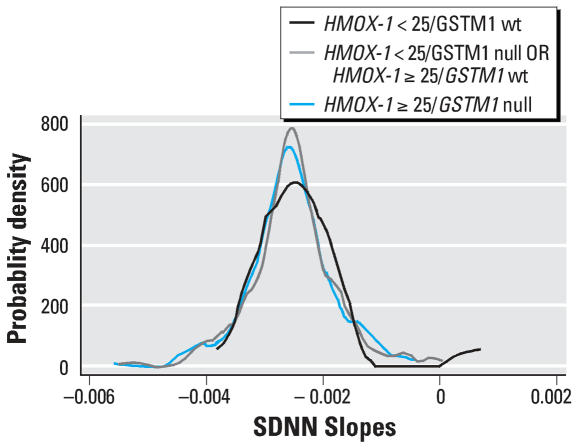
PM(2.5) was significantly associated with SDNN (p = 0.04) and HF (p = 0.03) in all subjects. There was no association in subjects with GSTM1, whereas there was a significant association with SDNN, HF, and LF in subjects with the deletion. Similarly, there was no association with any HRV measure in subjects with the short repeat variant of HMOX-1, and significant associations in subjects with any long repeat. We found a significant three-way interaction of PM(2.5) with GSTM1 and HMOX-1 determining SDNN (p = 0.008), HF (p = 0.01) and LF (p = 0.04). In subjects with the GSTM1 deletion and the HMOX-1 long repeat, SDNN decreased by 13% [95% confidence interval (CI), -21% to -4%], HF decreased by 28% (95% CI, -43% to -9%), and LF decreased by 20% (95% CI, -35% to -3%) per 10 microg/m(3) increase in PM.
Oxidative stress is an important pathway for the autonomic effects of particles.
在对老年人群规范性衰老研究的横断面分析中,我们之前已经表明,由于谷胱甘肽S-转移酶M1(GSTM1)缺失导致的抗氧化应激防御能力降低,会改变细颗粒物(空气动力学直径<2.5微米的细颗粒物污染,即PM(2.5))对心率变异性(HRV)的影响。我们进一步开展研究,纳入更多受试者进行纵向分析,并检测血红素加氧酶-1(HMOX-1)启动子中的GT短串联重复多态性。
对539名受试者进行HRV测量。采用线性混合效应模型分析HRV指标(包括正常到正常间期的标准差(SDNN)、高频(HF)和低频(LF))的对数与HRV测量前48小时内的PM(2.5)浓度之间的关系,同时控制混杂因素和随机个体效应。
在所有受试者中,PM(2.5)与SDNN(p = 0.04)和HF(p = 0.03)显著相关。在GSTM1基因存在的受试者中无相关性,而在GSTM1基因缺失的受试者中,PM(2.5)与SDNN、HF和LF显著相关。同样,在HMOX-1短重复变异的受试者中,PM(2.5)与任何HRV指标均无相关性,而在HMOX-1长重复的受试者中有显著相关性。我们发现PM(2.5)与GSTM1和HMOX-1之间存在显著的三因素交互作用,共同决定SDNN(p = 0.008)、HF(p = 0.01)和LF(p = 0.04)。在GSTM1基因缺失且HMOX-1长重复的受试者中,PM每增加10微克/立方米,SDNN下降13% [95%置信区间(CI),-21%至-4%],HF下降28%(95% CI,-43%至-9%),LF下降20%(95% CI,-35%至-3%)。
氧化应激是颗粒物产生自主神经效应的重要途径。