Zimmerman D L, Walter P
Department of Biochemistry and Biophysics University of California, Medical School San Francisco 94143-0448.
Cell Regul. 1991 Oct;2(10):851-9. doi: 10.1091/mbc.2.10.851.
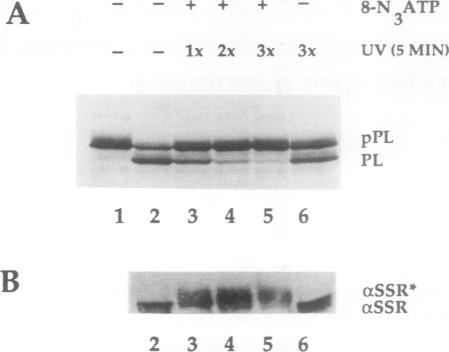
The role of nucleotides in providing energy for polypeptide transfer across the endoplasmic reticulum (ER) membrane is still unknown. To address this question, we treated ER-derived mammalian microsomal vesicles with a photoactivatable analogue of ATP, 8-N3ATP. This treatment resulted in a progressive inhibition of translocation activity. Approximately 20 microsomal membrane proteins were labeled by [alpha 32P]8-N3ATP. Two of these were identified as proteins with putative roles in translocation, alpha signal sequence receptor (SSR), the 35-kDa subunit of the signal sequence receptor complex, and ER-p180, a putative ribosome receptor. We found that there was a positive correlation between inactivation of translocation activity and photolabeling of alpha SSR. In contrast, our data demonstrate that the ATP-binding domain of ER-p180 is dispensable for translocation activity and does not contribute to the observed 8-N3ATP sensitivity of the microsomal vesicles.
核苷酸在为多肽跨内质网(ER)膜转运提供能量方面的作用仍不清楚。为了解决这个问题,我们用一种可光活化的ATP类似物8-N3ATP处理源自ER的哺乳动物微粒体囊泡。这种处理导致转运活性逐渐受到抑制。大约20种微粒体膜蛋白被[α-32P]8-N3ATP标记。其中两种被鉴定为在转运中可能起作用的蛋白,α信号序列受体(SSR),信号序列受体复合物的35 kDa亚基,以及ER-p180,一种假定的核糖体受体。我们发现转运活性的失活与α SSR的光标记之间存在正相关。相比之下,我们的数据表明,ER-p180的ATP结合结构域对于转运活性是可有可无的,并且对观察到的微粒体囊泡的8-N3ATP敏感性没有贡献。