Amaral Lia Q
Department of Applied Physics, Institute of Physics, University of São Paulo, São Paulo, Brazil.
Naturwissenschaften. 2008 Apr;95(4):281-92. doi: 10.1007/s00114-007-0325-0. Epub 2007 Nov 21.
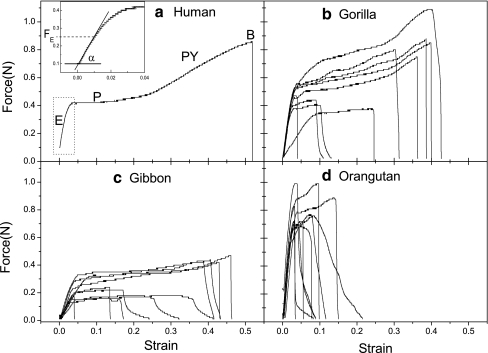
In all higher nonhuman primates, species survival depends upon safe carrying of infants clinging to body hair of adults. In this work, measurements of mechanical properties of ape hair (gibbon, orangutan, and gorilla) are presented, focusing on constraints for safe infant carrying. Results of hair tensile properties are shown to be species-dependent. Analysis of the mechanics of the mounting position, typical of heavier infant carrying among African apes, shows that both clinging and friction are necessary to carry heavy infants. As a consequence, a required relationship between infant weight, hair-hair friction coefficient, and body angle exists. The hair-hair friction coefficient is measured using natural ape skin samples, and dependence on load and humidity is analyzed. Numerical evaluation of the equilibrium constraint is in agreement with the knuckle-walking quadruped position of African apes. Bipedality is clearly incompatible with the usual clinging and mounting pattern of infant carrying, requiring a revision of models of hominization in relation to the divergence between apes and hominins. These results suggest that safe carrying of heavy infants justify the emergence of biped form of locomotion. Ways to test this possibility are foreseen here.
在所有高等非人类灵长类动物中,物种的生存依赖于成年个体安全携带紧紧依附在其体毛上的幼崽。在这项研究中,我们展示了对猿类毛发(长臂猿、猩猩和大猩猩)力学性能的测量结果,重点关注安全携带幼崽的限制因素。毛发拉伸性能的结果显示具有物种依赖性。对非洲猿类中较重幼崽携带典型的附着位置力学分析表明,附着和摩擦力对于携带较重幼崽都是必要的。因此,幼崽体重、毛发间摩擦系数和身体角度之间存在所需的关系。使用天然猿类皮肤样本测量毛发间摩擦系数,并分析其对负荷和湿度的依赖性。平衡约束的数值评估与非洲猿类的指关节行走四足姿势一致。两足行走显然与通常的幼崽携带附着和攀爬模式不相容,这需要修正关于猿类和人类之间差异的人类进化模型。这些结果表明,安全携带较重幼崽是两足运动形式出现的合理原因。本文预见了检验这种可能性的方法。