Churbanov Alexander, Baribault Carl, Winters-Hilt Stephen
The Research Institute for Children, 200 Henry Clay Ave, New Orleans, LA 70118, USA.
BMC Bioinformatics. 2007 Nov 1;8 Suppl 7(Suppl 7):S14. doi: 10.1186/1471-2105-8-S7-S14.
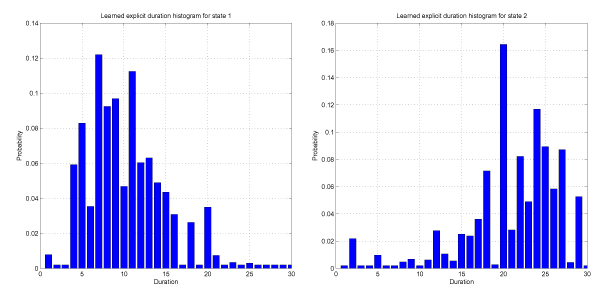
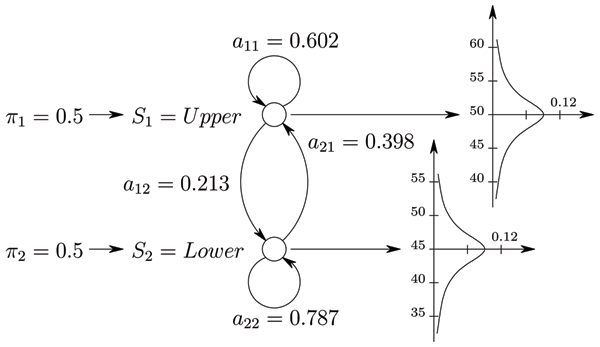
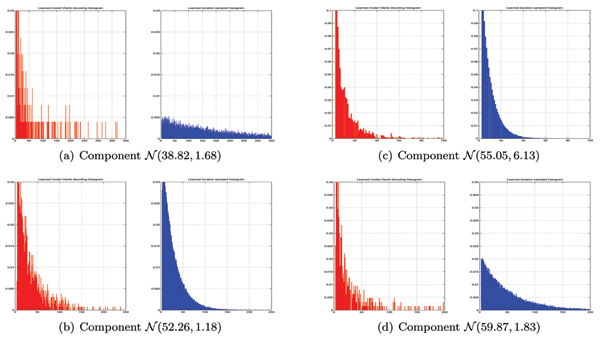
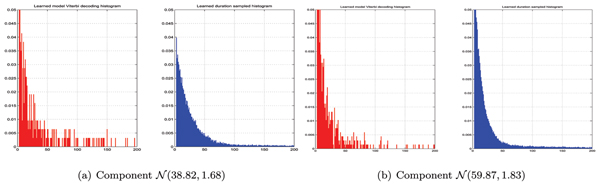
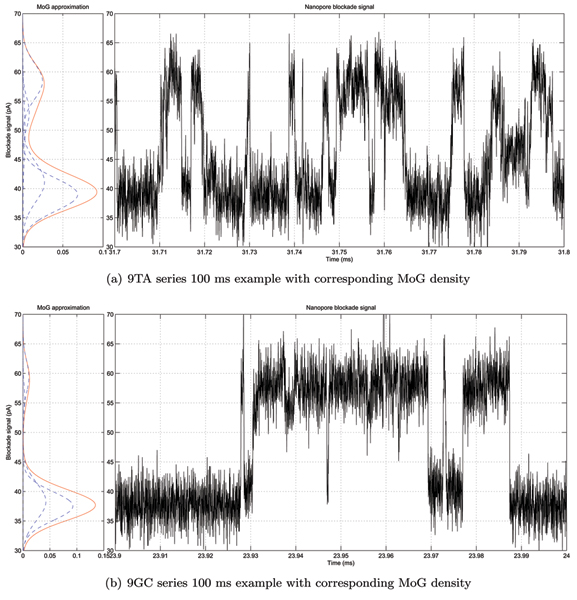
Ionic current blockade signal processing, for use in nanopore detection, offers a promising new way to analyze single molecule properties, with potential implications for DNA sequencing. The alpha-Hemolysin transmembrane channel interacts with a translocating molecule in a nontrivial way, frequently evidenced by a complex ionic flow blockade pattern. Typically, recorded current blockade signals have several levels of blockade, with various durations, all obeying a fixed statistical profile for a given molecule. Hidden Markov Model (HMM) based duration learning experiments on artificial two-level Gaussian blockade signals helped us to identify proper modeling framework. We then apply our framework to the real multi-level DNA hairpin blockade signal.
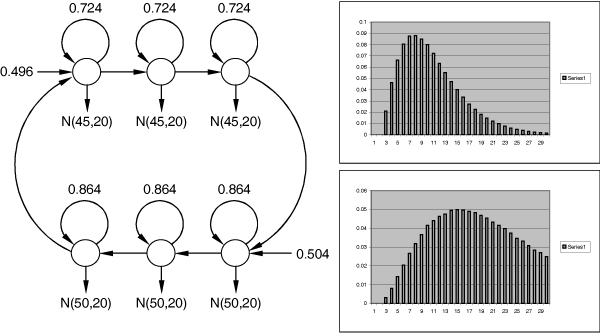
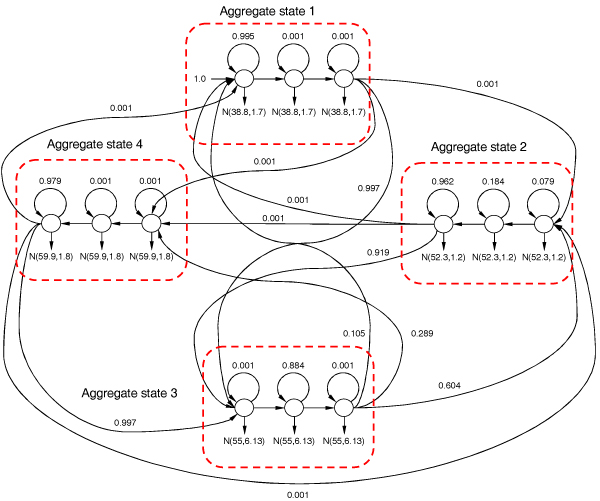
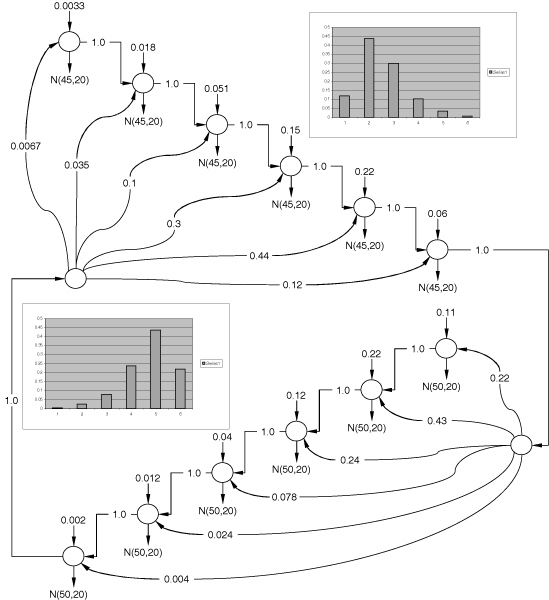
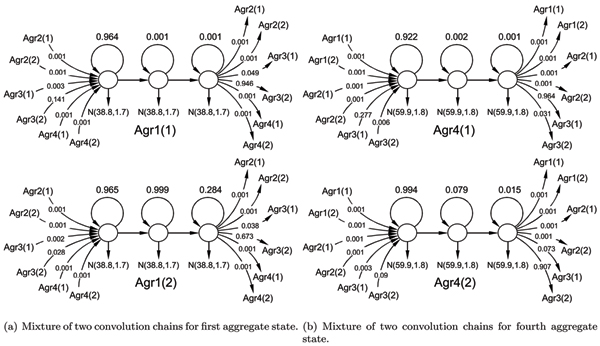
The identified upper level blockade state is observed with durations that are geometrically distributed (consistent with an a physical decay process for remaining in any given state). We show that mixture of convolution chains of geometrically distributed states is better for presenting multimodal long-tailed duration phenomena. Based on learned HMM profiles we are able to classify 9 base-pair DNA hairpins with accuracy up to 99.5% on signals from same-day experiments.
We have demonstrated several implementations for de novo estimation of duration distribution probability density function with HMM framework and applied our model topology to the real data. The proposed design could be handy in molecular analysis based on nanopore current blockade signal.
用于纳米孔检测的离子电流阻断信号处理为分析单分子特性提供了一种有前景的新方法,对DNA测序具有潜在影响。α-溶血素跨膜通道以一种复杂的方式与易位分子相互作用,这通常表现为复杂的离子流阻断模式。通常,记录的电流阻断信号有多个阻断水平,具有不同的持续时间,对于给定分子,所有这些都遵循固定的统计分布。基于隐马尔可夫模型(HMM)对人工二级高斯阻断信号进行的持续时间学习实验帮助我们确定了合适的建模框架。然后我们将该框架应用于实际的多级DNA发夹阻断信号。
观察到所确定的上层阻断状态的持续时间呈几何分布(这与处于任何给定状态下的物理衰减过程一致)。我们表明,几何分布状态的卷积链混合对于呈现多峰长尾持续时间现象更好。基于学习到的HMM分布,我们能够对同一天实验信号中的9碱基对DNA发夹进行分类,准确率高达99.5%。
我们展示了几种使用HMM框架从头估计持续时间分布概率密度函数的方法,并将我们的模型拓扑应用于实际数据。所提出的设计在基于纳米孔电流阻断信号的分子分析中可能会很方便。