Winters-Hilt Stephen
Research Institute for Children, Children's Hospital, 200 Henry Clay Ave, New Orleans, LA 70118, USA.
BMC Bioinformatics. 2007 Nov 1;8 Suppl 7(Suppl 7):S9. doi: 10.1186/1471-2105-8-S7-S9.
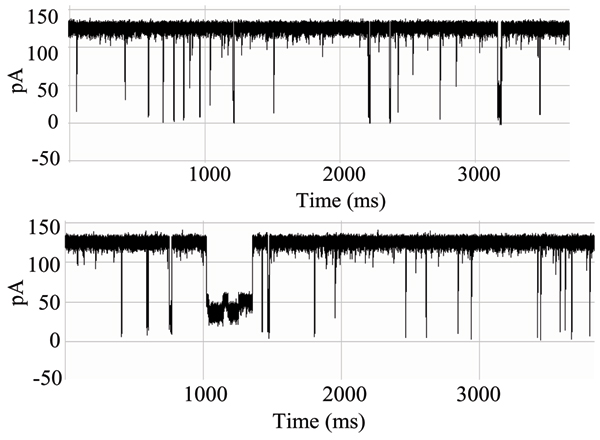
Nanopore detection is based on observations of the ionic current threading a single, highly stable, nanometer-scale channel. The dimensions are such that small biomolecules and biopolymers (like DNA and peptides) can translocate or be captured in the channel. The identities of translocating or captured molecules can often be discerned, one from another, based on their channel blockade "signatures". There is a self-limiting aspect to a translocation-based detection mechanism: as the channel fits tighter around the translocating molecule the dynamic range of the ionic current signal is reduced. In this study, a lengthy, highly structure, high dynamic-range, molecular capture is sought as a key component of a transduction-based nanopore detection platform.
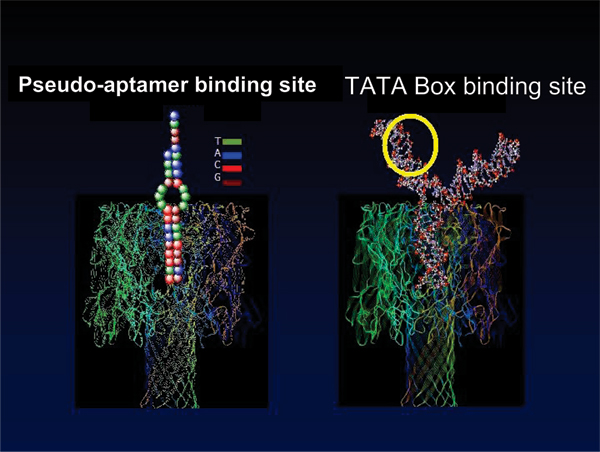
A specialized role, or device augmentation, involving bifunctional molecules has been explored. The bifunctional molecule has one function to enter and blockade the channel in an information-rich self-modulating manner, while the other function is for binding (usually), located on a non-channel-captured portion of the molecule. Part of the bifunctional molecule is, thus, external to the channel and is free to bind or rigidly link to a larger molecule of interest. What results is an event transduction detector: molecular events are directly transduced into discernible changes in the stationary statistics of the bifunctional molecule's channel blockade. Several results are presented of nanopore-based event-transduction detection.
It may be possible to directly track the bound versus unbound state of a huge variety of molecules using nanopore transduction detection.
纳米孔检测基于对穿过单个高度稳定的纳米级通道的离子电流的观测。其尺寸使得小的生物分子和生物聚合物(如DNA和肽)能够在通道中转运或被捕获。根据分子的通道阻断“特征”,通常可以区分转运或捕获的分子。基于转运的检测机制存在一个自限性问题:随着通道与转运分子的结合更紧密,离子电流信号的动态范围会减小。在本研究中,寻求一种长链、高度结构化、高动态范围的分子捕获方法,作为基于转导的纳米孔检测平台的关键组成部分。
探索了一种涉及双功能分子的特殊作用或装置增强方法。双功能分子具有一种功能,即以信息丰富的自调节方式进入并阻断通道,而另一种功能(通常)是用于结合,位于分子的未被通道捕获的部分。因此,双功能分子的一部分位于通道外部,可以自由地与感兴趣的更大分子结合或刚性连接。结果得到了一种事件转导检测器:分子事件被直接转导为双功能分子通道阻断静态统计数据中可辨别的变化。给出了基于纳米孔的事件转导检测的几个结果。
使用纳米孔转导检测可能直接跟踪各种各样分子的结合态与未结合态。