Guo Hongshen, Lin Yifeng, Zhang Hongwei, Liu Juan, Zhang Nong, Li Yiming, Kong Desheng, Tang Qiqun, Ma Duan
Key Laboratory of Molecular Medicine, Ministry of Education, Yixueyuan Road 138#, Shanghai Medical College, Fudan University, Shanghai 200032, China.
BMC Mol Biol. 2007 Dec 3;8:110. doi: 10.1186/1471-2199-8-110.
Tissue factor pathway inhibitor-2 (TFPI-2) is a matrix-associated Kunitz inhibitor that inhibits plasmin and trypsin-mediated activation of zymogen matrix metalloproteinases involved in tumor progression, invasion and metastasis. Here, we have investigated the mechanism of DNA methylation on the repression of TFPI-2 in breast cancer cell lines.
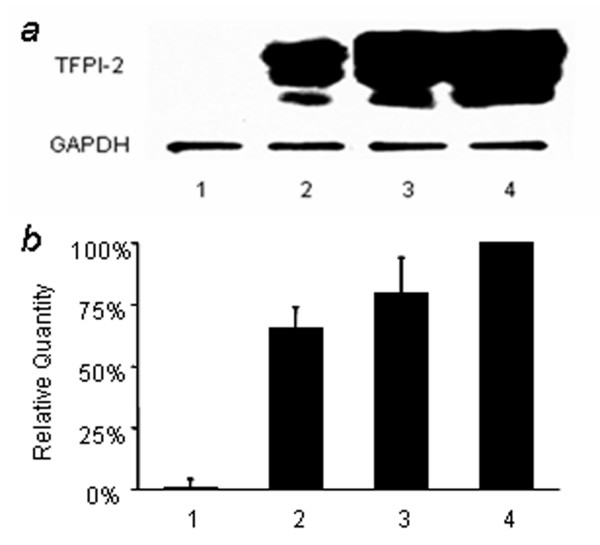
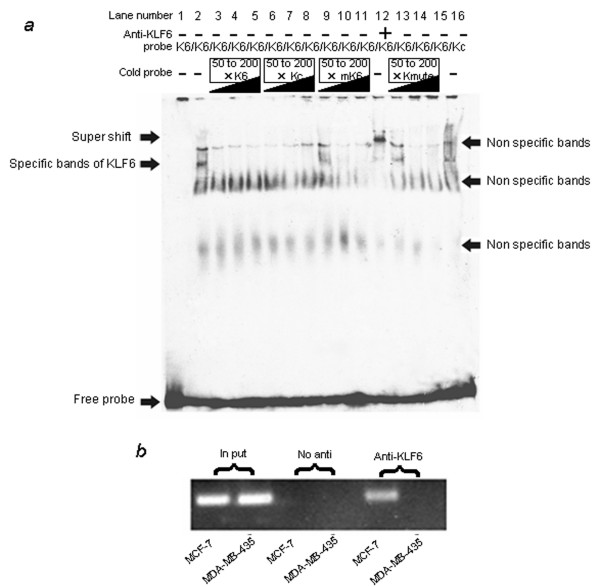
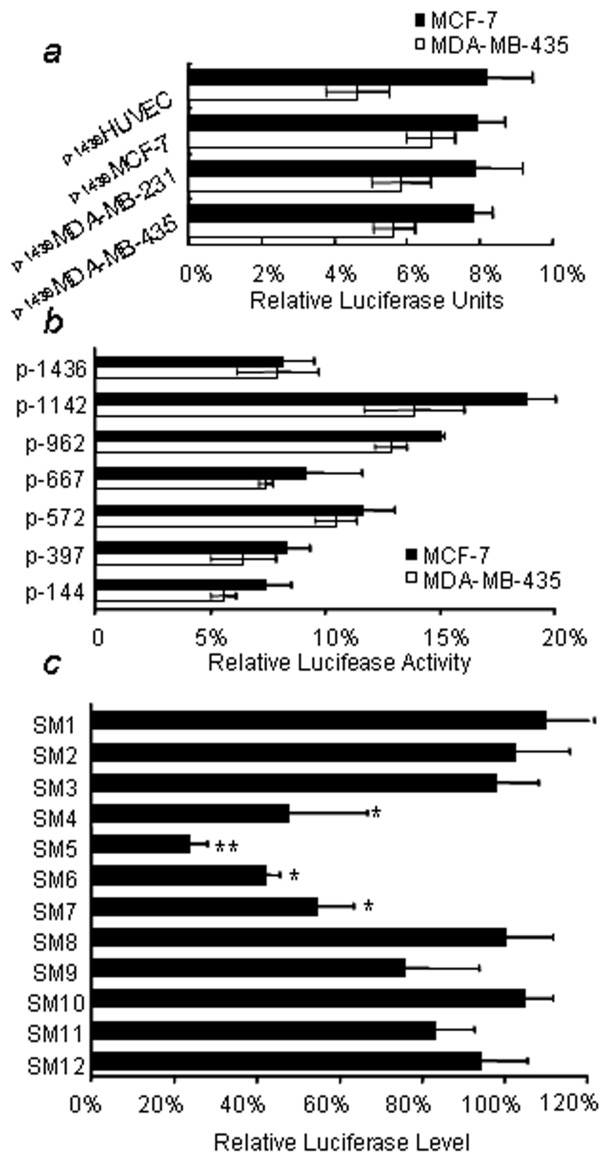
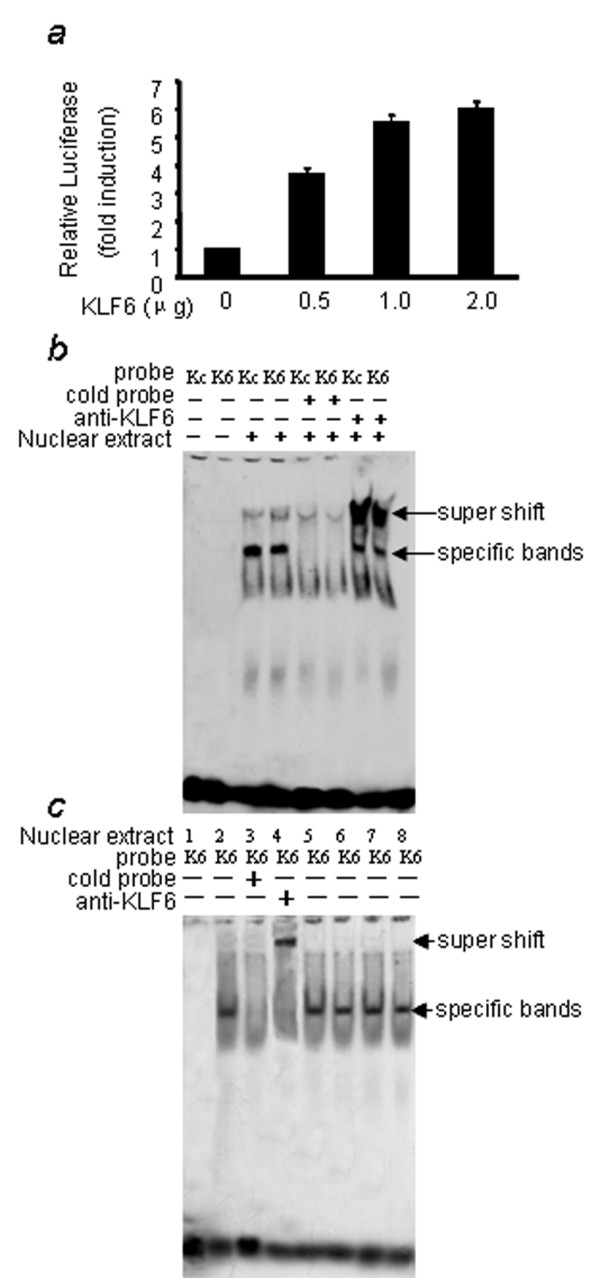
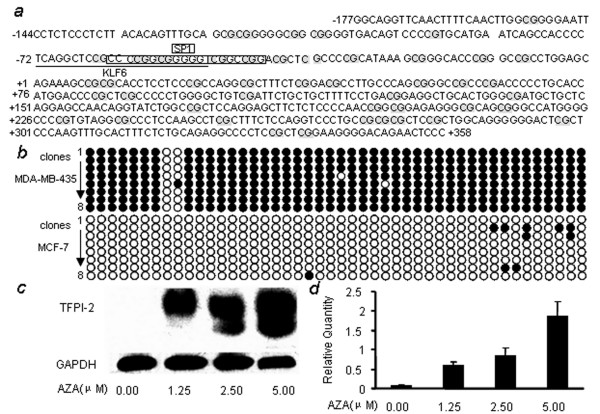
We found that both protein and mRNA of TFPI-2 could not be detected in highly invasive breast cancer cell line MDA-MB-435. To further investigate the mechanism of TFPI-2 repression in breast cancer cells, 1.5 Kb TFPI-2 promoter was cloned, and several genetic variations were detected, but the promoter luciferase activities were not affected by the point mutation in the promoter region and the phenomena was further supported by deleted mutation. Scan mutation and informatics analysis identified a potential KLF6 binding site in TFPI-2 promoter. It was revealed, by bisulfite modified sequence, that the CpG island in TFPI-2 promoter region was hypermethylated in MDA-MB-435. Finally, using EMSA and ChIP assay, we demonstrated that the CpG methylation in the binding site of KLF-6 diminished the binding of KLF6 to TFPI-2 promoter.
In this study, we found that the CpG islands in TFPI-2 promoter was hypermethylated in highly invasive breast cancer cell line, and DNA methylation in the entire promoter region caused TFPI-2 repression by inducing inactive chromatin structure and decreasing KLF6 binding to its DNA binding sequence.
组织因子途径抑制剂-2(TFPI-2)是一种与基质相关的库尼茨抑制剂,可抑制纤溶酶和胰蛋白酶介导的参与肿瘤进展、侵袭和转移的酶原基质金属蛋白酶的激活。在此,我们研究了乳腺癌细胞系中DNA甲基化对TFPI-2抑制的机制。
我们发现,在高侵袭性乳腺癌细胞系MDA-MB-435中无法检测到TFPI-2的蛋白质和mRNA。为了进一步研究乳腺癌细胞中TFPI-2抑制的机制,克隆了1.5 kb的TFPI-2启动子,并检测到几个基因变异,但启动子荧光素酶活性不受启动子区域点突变的影响,缺失突变进一步支持了这一现象。扫描突变和信息学分析确定了TFPI-2启动子中一个潜在的KLF6结合位点。亚硫酸氢盐修饰序列显示,MDA-MB-435中TFPI-2启动子区域的CpG岛高度甲基化。最后,通过电泳迁移率变动分析(EMSA)和染色质免疫沉淀分析(ChIP),我们证明KLF-6结合位点的CpG甲基化减少了KLF6与TFPI-2启动子的结合。
在本研究中,我们发现高侵袭性乳腺癌细胞系中TFPI-2启动子的CpG岛高度甲基化,整个启动子区域的DNA甲基化通过诱导无活性的染色质结构和减少KLF6与其DNA结合序列的结合导致TFPI-2抑制。