Tansila Natta, Tantimongcolwat Tanawut, Isarankura-Na-Ayudhya Chartchalerm, Nantasenamat Chanin, Prachayasittikul Virapong
Department of Clinical Microbiology, Faculty of Medical Technology, Mahidol University, Bangkok 10700, Thailand.
Int J Biol Sci. 2007 Nov 21;3(7):463-70. doi: 10.7150/ijbs.3.463.
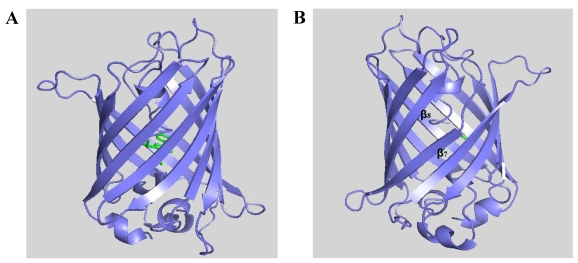
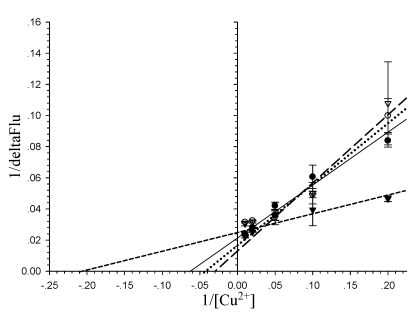
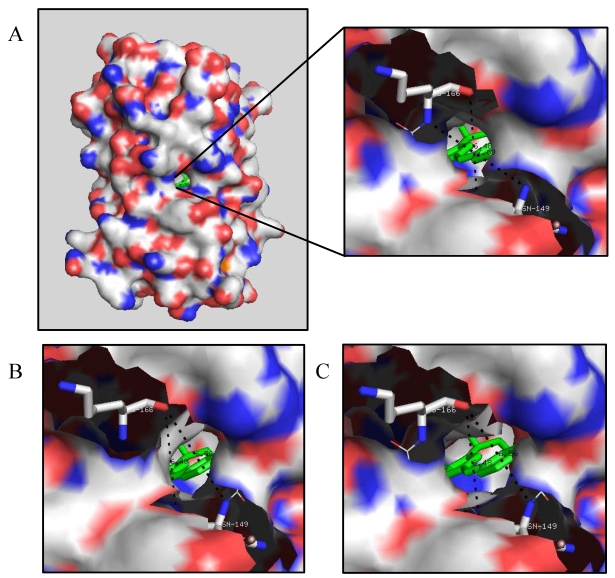
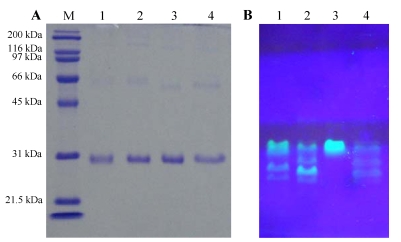
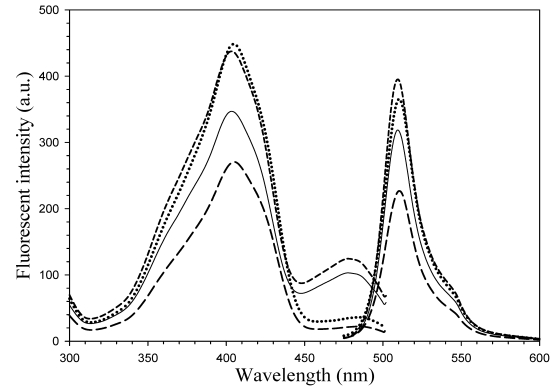
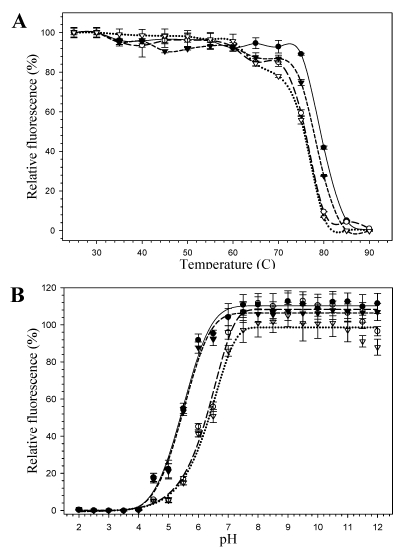
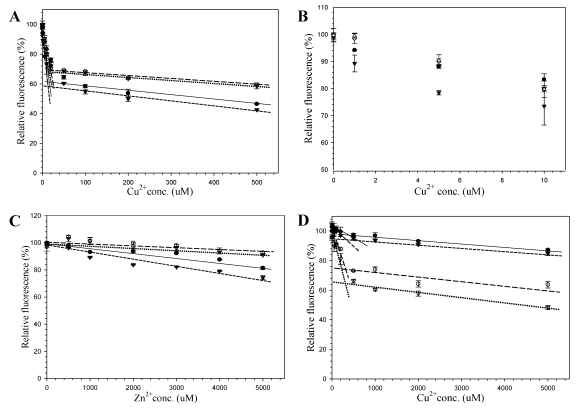
A novel solvent-exposed analyte channel, generated by F165G substitution, on the surface of green fluorescent protein (designated His(6)GFPuv/F165G) was successfully discovered by the aid of molecular modeling software (PyMOL) in conjunction with site-directed mutagenesis. Regarding the high predictive performance of PyMOL, two pore-containing mutants namely His(6)GFPuv/H148G and His(6)GFPuv/H148G/F165G were also revealed. The pore sizes of F165G, H148G, and the double mutant H148G/F165G were in the order of 4, 4.5 and 5.5 A, respectively. These mutants were subjected to further investigation on the effect of small analytes (e.g. metal ions and hydrogen peroxide) as elucidated by fluorescence quenching experiments. Results revealed that the F165G mutant exhibited the highest metal sensitivity at physiological pH. Meanwhile, the other 2 mutants lacking histidine at position 148 had lower sensitivity against Zn(2+) and Cu(2+) than those of the template protein (His(6)GFPuv). Hence, a significant role of this histidine residue in mediating metal transfer toward the GFP chromophore was proposed and evidently demonstrated by testing in acidic condition. Results revealed that at pH 6.5 the order of metal sensitivity was found to be inverted whereby the H148G/F165G became the most sensitive mutant. The dissociation constants (K(d)) to metal ions were in the order of 4.88 x 10(-6) M, 16.67 x 10(-6) M, 25 x 10(-6) M, and 33.33 x 10(-6) M for His(6)GFPuv/F165G, His(6)GFPuv, His(6)GFPuv/H148G/F165G and His(6)GFPuv/H148G, respectively. Sensitivity against hydrogen peroxide was in the order of H148G/F165G > H148G > F165G indicating the crucial role of pore diameters. However, it should be mentioned that H148G substitution caused a markedly decrease in pH- and thermo-stability. Taken together, our findings rendered the novel pore of GFP as formed by F165G substitution to be a high impact channel without adversely affecting the intrinsic fluorescent properties. This opens up a great potential of using F165G mutant in enhancing the sensitivity of GFP in future development of biosensors.
借助分子建模软件(PyMOL)并结合定点诱变技术,成功在绿色荧光蛋白表面发现了一个由F165G取代产生的新型溶剂暴露分析物通道(命名为His(6)GFPuv/F165G)。鉴于PyMOL的高预测性能,还发现了另外两个含孔突变体,即His(6)GFPuv/H148G和His(6)GFPuv/H148G/F165G。F165G、H148G和双突变体H148G/F165G的孔径分别为4 Å、4.5 Å和5.5 Å。通过荧光猝灭实验对这些突变体进行了进一步研究,以阐明小分析物(如金属离子和过氧化氢)的影响。结果表明,F165G突变体在生理pH值下表现出最高的金属敏感性。同时,在148位缺乏组氨酸的另外两个突变体对Zn(2+)和Cu(2+)的敏感性低于模板蛋白(His(6)GFPuv)。因此,提出了该组氨酸残基在介导金属向GFP发色团转移中的重要作用,并通过在酸性条件下的测试得到了明显证实。结果表明,在pH 6.5时,金属敏感性顺序发生反转,H148G/F165G成为最敏感的突变体。His(6)GFPuv/F165G、His(6)GFPuv、His(6)GFPuv/H148G/F165G和His(6)GFPuv/H148G对金属离子的解离常数(K(d))分别为4.88×10(-6) M、16.67×10(-6) M、25×10(-6) M和33.33×10(-6) M。对过氧化氢的敏感性顺序为H148G/F165G > H148G > F165G,表明孔径起关键作用。然而,应该提到的是,H148G取代导致pH稳定性和热稳定性显著下降。综上所述,我们的研究结果表明,由F165G取代形成的GFP新型孔是一个高影响通道,而不会对其固有荧光特性产生不利影响。这为在生物传感器的未来发展中使用F165G突变体提高GFP的敏感性开辟了巨大潜力。