Olepu Srinivas, Suryadevara Praveen Kumar, Rivas Kasey, Yokoyama Kohei, Verlinde Christophe L M J, Chakrabarti Debopam, Van Voorhis Wesley C, Gelb Michael H
Department of Chemistry, University of Washington, Seattle, WA 98195, USA.
Bioorg Med Chem Lett. 2008 Jan 15;18(2):494-7. doi: 10.1016/j.bmcl.2007.11.104. Epub 2007 Dec 3.
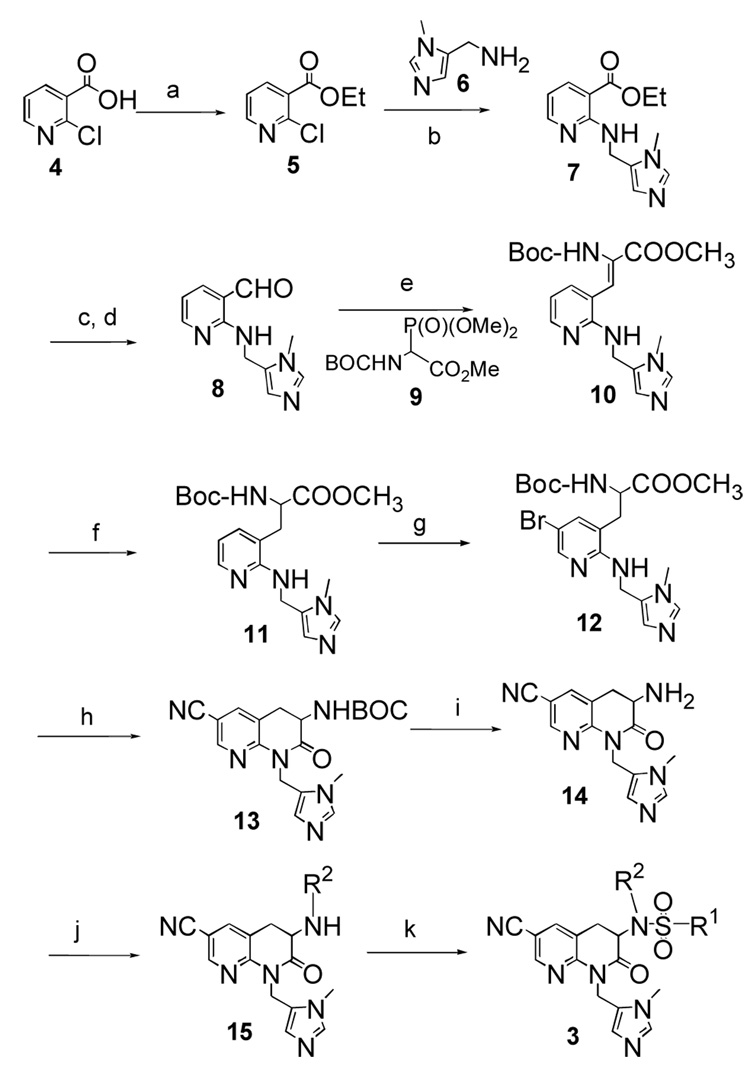
A new class of 2-oxo-tetrahydro-1,8-naphthyridine-based protein farnesyltransferase inhibitors were synthesized and found to inhibit protein farnesyltransferase from the malaria parasite with potencies in the low nanomolar range. The compounds were much less potent on mammalian protein prenyltransferases. Two of the compounds block the growth of malaria in culture with potencies in the sub-micromolar range. Some of the compounds were found to be much more metabolically stable than previously described tetrahydroquinoline-based protein farnesyltransferase inhibitors.
合成了一类新型的基于2-氧代-四氢-1,8-萘啶的蛋白质法尼基转移酶抑制剂,发现它们能抑制疟原虫的蛋白质法尼基转移酶,效力在低纳摩尔范围内。这些化合物对哺乳动物蛋白质异戊二烯基转移酶的效力要低得多。其中两种化合物在亚微摩尔范围内能阻断培养物中疟原虫的生长。发现一些化合物的代谢稳定性比先前描述的基于四氢喹啉的蛋白质法尼基转移酶抑制剂高得多。