Tanofsky-Kraff Marian, Goossens Lien, Eddy Kamryn T, Ringham Rebecca, Goldschmidt Andrea, Yanovski Susan Z, Braet Caroline, Marcus Marsha D, Wilfley Denise E, Olsen Cara, Yanovski Jack A
Unit on Growth and Obesity, Program in Developmental Endocrinology and Genetics, National Institute of Child Health and Human Development, Uniformed Services University of the Health Sciences, Bethesda, MD 20814-4712, USA.
J Consult Clin Psychol. 2007 Dec;75(6):901-13. doi: 10.1037/0022-006X.75.6.901.
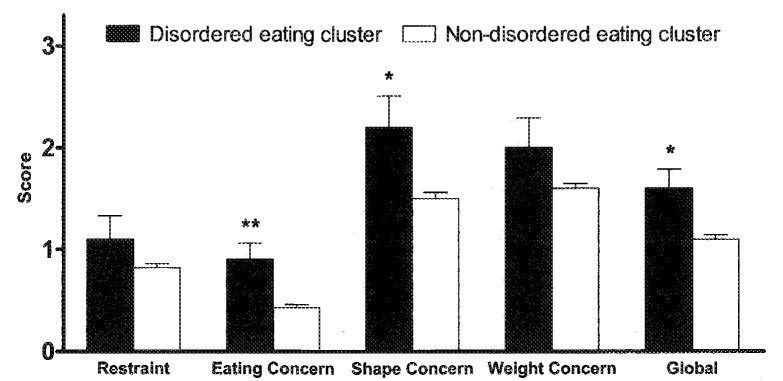
The phenomenology of childhood and adolescent loss of control (LOC) eating is unknown. The authors interviewed 445 youths to assess aspects of aberrant eating. LOC was associated with eating forbidden food before the episode; eating when not hungry; eating alone; and experiencing secrecy, negative emotions, and a sense of "numbing" while eating (ps<.01). Hierarchical cluster analysis revealed a subgroup, most of whom reported LOC eating. Cluster members reported having a trigger initiate episodes, eating while watching television, and having decreased awareness regarding the amount consumed. The authors conclude that aspects of LOC eating during youth are similar to aspects of adult episodes, but a youth-specific presentation may exist. Findings may provide an intervening point to prevent excessive weight gain and eating disorders.
儿童和青少年失控性进食的现象学尚不清楚。作者对445名青少年进行了访谈,以评估异常进食的各个方面。失控性进食与发作前食用禁食、不饿时进食、独自进食以及进食时感到隐秘、负面情绪和“麻木”感有关(p值<0.01)。分层聚类分析揭示了一个亚组,其中大多数人报告有失控性进食。该亚组成员报告称,发作由一个触发因素引发,边看电视边进食,并且对进食量的意识下降。作者得出结论,青少年失控性进食的某些方面与成人发作的某些方面相似,但可能存在特定于青少年的表现形式。这些发现可能为预防体重过度增加和饮食失调提供一个干预点。