Mueller Yvonne M, Do Duc H, Altork Susan R, Artlett Carol M, Gracely Edward J, Katsetos Christos D, Legido Agustin, Villinger Francois, Altman John D, Brown Charles R, Lewis Mark G, Katsikis Peter D
Department of Microbiology and Immunology, and Center for Immunology and Vaccine Science, Drexel University College of Medicine, Philadelphia, PA 19129, USA.
J Immunol. 2008 Jan 1;180(1):350-60. doi: 10.4049/jimmunol.180.1.350.
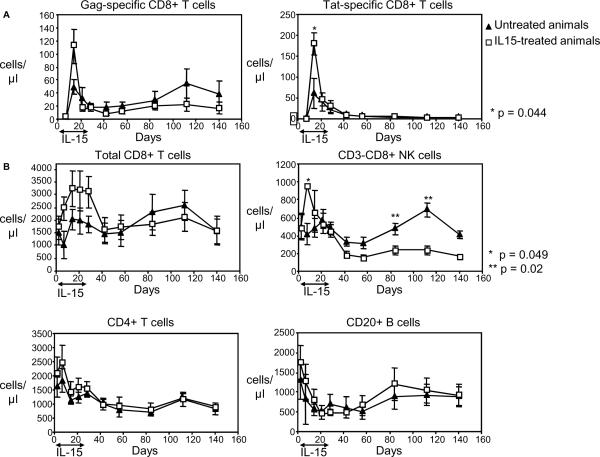
In this study, we examined the effect of in vivo treatment of acutely SIV-infected Mamu-A*01+ rhesus macaques with IL-15. IL-15 treatment during acute infection increased viral set point by 3 logs and accelerated the development of simian AIDS in two of six animals with one developing early minimal lesion SIV meningoencephalitis. Although IL-15 induced a 2- to 3-fold increase in SIV-specific CD8+ T cell and NK cell numbers at peak viremia and reduced lymph node (LN) SIV-infected cells, this had no impact on peak viremia and did not lower viral set point. At viral set point, however, activated SIV-specific CD8+ T cells and NK cells were reduced in the blood of IL-15-treated animals and LN SIV-infected cells were increased. Week 30 LN from IL-15-treated animals had significantly increased Gag-specific CD8+ T cell numbers, whereas total cell, lymphocyte, and CD4+ T cell numbers were reduced. IL-15 treatment significantly reduced anti-SIV Ab concentrations at week 3 and viral set point. IL-15 increased Ki-67+CD4+ T cells at week 1 of treatment and reduced blood CCR5+ and CD45RA-CD62L- CD4+ T cells. The frequency of day 7 Ki-67+CD4+ T cells strongly correlated with viral set point. These findings suggest that CD4+ T cell activation during acute infection determines subsequent viral set point and IL-15 treatment by increasing such activation elevates viral set point. Finally, IL-15-treated acutely SIV-infected primates may serve as a useful model to investigate the poorly understood mechanisms that control viral set point and disease progression in HIV infection.
在本研究中,我们检测了用白细胞介素-15(IL-15)对急性感染猴免疫缺陷病毒(SIV)的Mamu-A*01+恒河猴进行体内治疗的效果。急性感染期间进行IL-15治疗使病毒载量增加了3个对数,并加速了六只动物中两只的猴艾滋病发展,其中一只出现了早期轻微病变的SIV脑膜脑炎。尽管IL-15在病毒血症高峰期使SIV特异性CD8+T细胞和自然杀伤(NK)细胞数量增加了2至3倍,并减少了淋巴结(LN)中被SIV感染的细胞,但这对病毒血症峰值没有影响,也未降低病毒载量。然而,在病毒载量稳定期,接受IL-15治疗的动物血液中活化的SIV特异性CD8+T细胞和NK细胞减少,而LN中被SIV感染的细胞增加。接受IL-15治疗的动物在第30周时,LN中Gag特异性CD8+T细胞数量显著增加,而总细胞、淋巴细胞和CD4+T细胞数量减少。IL-15治疗在第3周和病毒载量稳定期显著降低了抗SIV抗体浓度。IL-15在治疗第1周时增加了Ki-67+CD4+T细胞,并减少了血液中CCR5+以及CD45RA-CD62L-CD4+T细胞。第7天Ki-67+CD4+T细胞的频率与病毒载量密切相关。这些发现表明,急性感染期间CD4+T细胞的活化决定了随后的病毒载量,而IL-15治疗通过增加这种活化提高了病毒载量。最后,经IL-15治疗的急性感染SIV的灵长类动物可能是一个有用的模型,用于研究在HIV感染中控制病毒载量和疾病进展的尚不十分清楚的机制。