Niva Cintia Carla, Lee Jae Min, Myohara Maroko
Invertebrate Gene Function Research Unit, National Institute of Agrobiological Sciences, Tsukuba, Ibaraki, Japan.
Dev Genes Evol. 2008 Jan;218(1):39-46. doi: 10.1007/s00427-007-0198-4. Epub 2008 Jan 9.
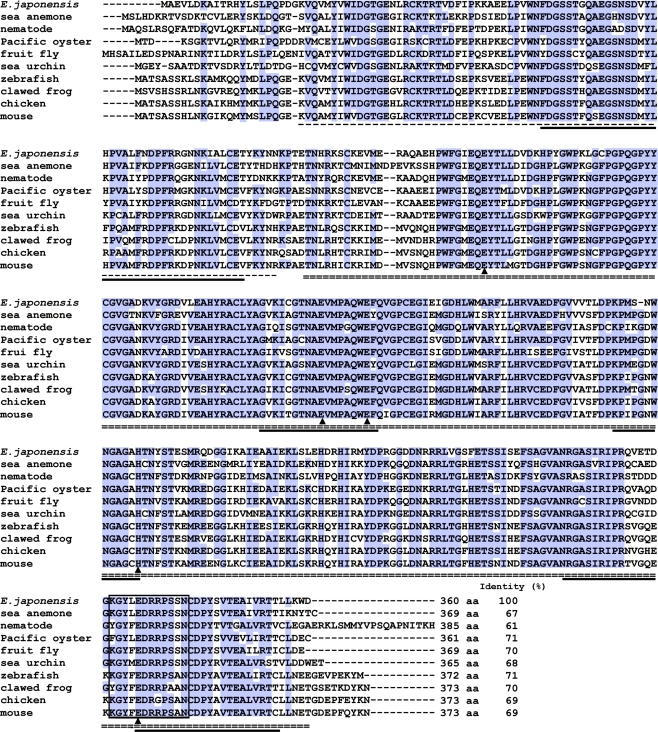
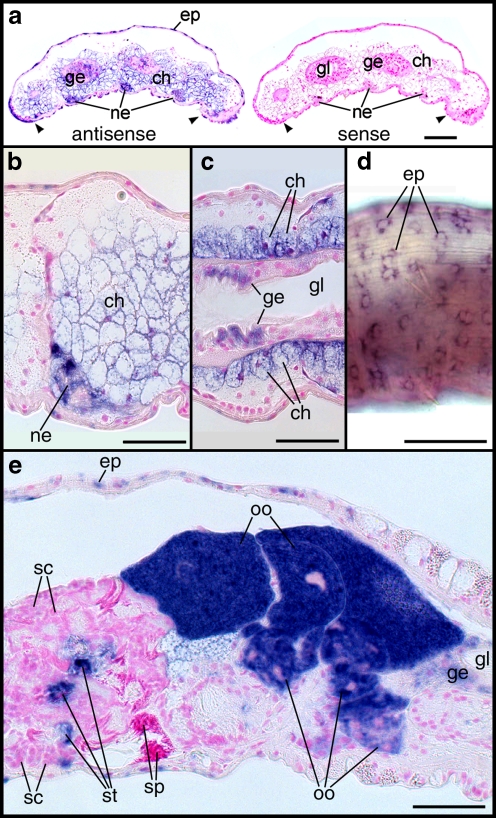
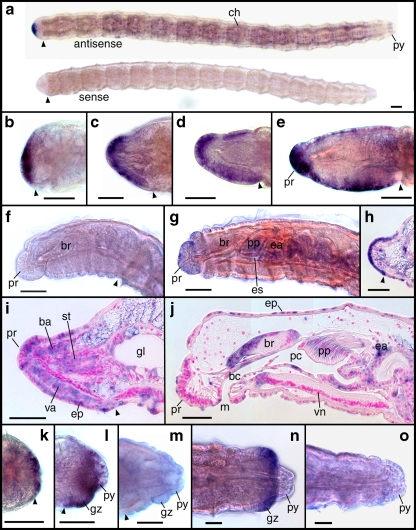
Enchytraeus japonensis is a highly regenerative oligochaete annelid that can regenerate a complete individual from a small body fragment in 4-5 days. In our previous study, we performed complementary deoxyribonucleic acid subtraction cloning to isolate genes that are upregulated during E. japonensis regeneration and identified glutamine synthetase (gs) as one of the most abundantly expressed genes during this process. In the present study, we show that the full-length sequence of E. japonensis glutamine synthetase (EjGS), which is the first reported annelid glutamine synthetase, is highly similar to other known class II glutamine synthetases. EjGS shows a 61-71% overall amino acid sequence identity with its counterparts in various other animal species, including Drosophila and mouse. We performed detailed expression analysis by in situ hybridization and reveal that strong gs expression occurs in the blastemal regions of regenerating E. japonensis soon after amputation. gs expression was detectable at the cell layer covering the wound and was found to persist in the epidermal cells during the formation and elongation of the blastema. Furthermore, in the elongated blastema, gs expression was detectable also in the presumptive regions of the brain, ventral nerve cord, and stomodeum. In the fully formed intact head, gs expression was also evident in the prostomium, brain, the anterior end of the ventral nerve cord, the epithelium of buccal and pharyngeal cavities, the pharyngeal pad, and in the esophageal appendages. In intact E. japonensis tails, gs expression was found in the growth zone in actively growing worms but not in full-grown individuals. In the nonblastemal regions of regenerating fragments and in intact worms, gs expression was also detected in the nephridia, chloragocytes, gut epithelium, epidermis, spermatids, and oocytes. These results suggest that EjGS may play roles in regeneration, nerve function, cell proliferation, nitrogenous waste excretion, macromolecule synthesis, and gametogenesis.
日本带丝蚓是一种具有高度再生能力的寡毛纲环节动物,能够在4 - 5天内从一小段身体碎片再生出一个完整的个体。在我们之前的研究中,我们进行了互补脱氧核糖核酸消减克隆,以分离日本带丝蚓再生过程中上调的基因,并鉴定出谷氨酰胺合成酶(gs)是该过程中表达量最高的基因之一。在本研究中,我们表明,日本带丝蚓谷氨酰胺合成酶(EjGS)的全长序列,这是首次报道的环节动物谷氨酰胺合成酶,与其他已知的II类谷氨酰胺合成酶高度相似。EjGS与其在包括果蝇和小鼠在内的各种其他动物物种中的对应物的总体氨基酸序列同一性为61 - 71%。我们通过原位杂交进行了详细的表达分析,发现截肢后不久,再生的日本带丝蚓的芽基区域有强烈的gs表达。在覆盖伤口的细胞层中可检测到gs表达,并且发现在芽基形成和伸长过程中,表皮细胞中持续存在该表达。此外,在伸长的芽基中,在脑、腹神经索和口道的推定区域也可检测到gs表达。在完全形成的完整头部中,gs表达在口前叶、脑、腹神经索前端、颊腔和咽腔上皮、咽垫以及食管附属物中也很明显。在完整的日本带丝蚓尾部中,在活跃生长的蠕虫的生长区中发现了gs表达,但在成熟个体中未发现。在再生片段的非芽基区域和完整蠕虫中,在肾管、黄色细胞、肠上皮、表皮、精子细胞和卵母细胞中也检测到了gs表达。这些结果表明,EjGS可能在再生、神经功能、细胞增殖、含氮废物排泄、大分子合成和配子发生中发挥作用。