Boyd Lauren Becnel, Atmar Robert L, Randall Graham L, Hamill Richard J, Steffen David, Zechiedrich Lynn
Department of Molecular Virology and Microbiology, Baylor College of Medicine, Houston, TX 77030, USA.
BMC Infect Dis. 2008 Jan 15;8:4. doi: 10.1186/1471-2334-8-4.
Escherichia coli infections are common and often treated with fluoroquinolones. Fluoroquinolone resistance is of worldwide importance and is monitored by national and international surveillance networks. In this study, we analyzed the effects of time, culture site, and patient age, sex, and location on fluoroquinolone resistance in E. coli clinical isolates.
To understand how patient factors and time influenced fluoroquinolone resistance and to determine how well data from surveillance networks predict trends at Ben Taub General Hospital in Houston, TX, we used Perl to parse and MySQL to house data from antibiograms (n congruent with 21,000) for E. coli isolated between 1999 to 2004 using Chi Square, Bonferroni, and Multiple Linear Regression methods.
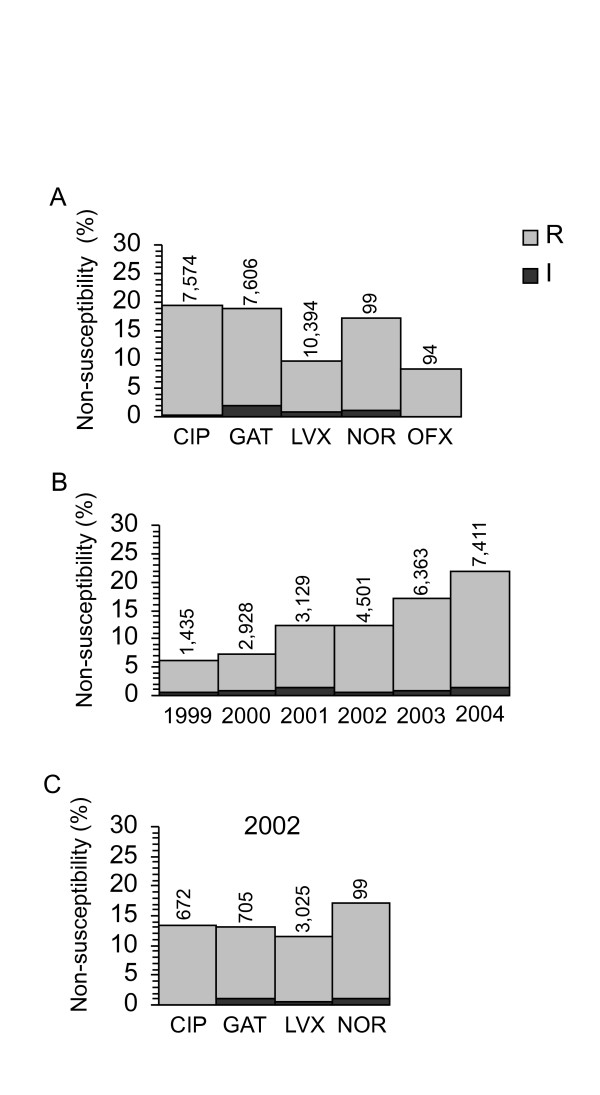
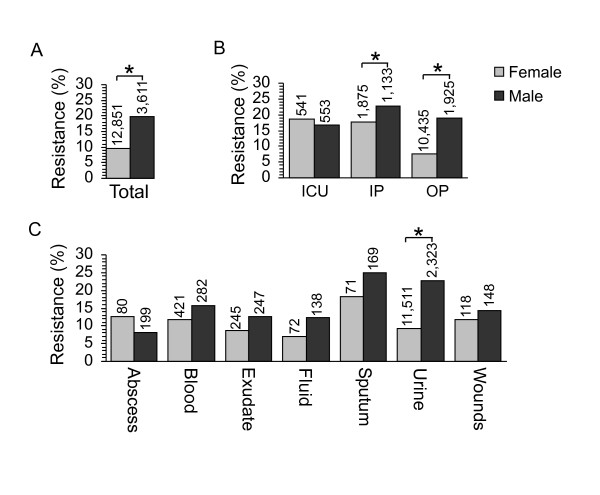
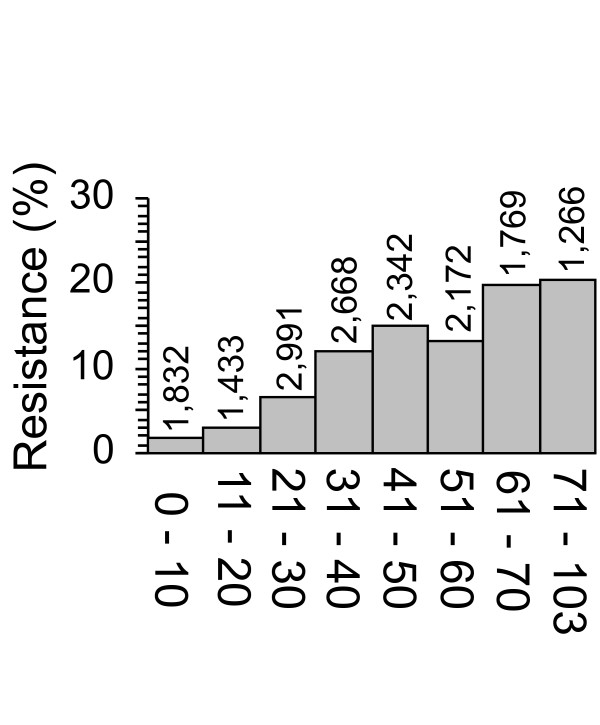
Fluoroquinolone resistance (i) increased with time; (ii) exceeded national averages by 2- to 4-fold; (iii) was higher in males than females, largely because of urinary isolates from male outpatients; (iv) increased with patient age; (v) was 3% in pediatric patients; (vi) was higher in hospitalized patients than outpatients; (vii) was higher in sputum samples, particularly from inpatients, than all other culture sites, including blood and urine, regardless of patient location; and (viii) was lowest in genital isolates than all other culture sites. Additionally, the data suggest that, with regard to susceptibility or resistance by the Dade Behring MicroScan system, a single fluoroquinolone suffices as a "surrogate marker" for all of the fluoroquinolone tested.
Large surveillance programs often did not predict E. coli fluoroquinolone resistance trends at a large, urban hospital with a largely indigent, ethnically diverse patient population or its affiliated community clinics.
大肠杆菌感染很常见,通常用氟喹诺酮类药物治疗。氟喹诺酮耐药性在全球范围内都很重要,由国家和国际监测网络进行监测。在本研究中,我们分析了时间、培养部位以及患者年龄、性别和地理位置对大肠杆菌临床分离株中氟喹诺酮耐药性的影响。
为了解患者因素和时间如何影响氟喹诺酮耐药性,并确定监测网络的数据对德克萨斯州休斯顿市本陶布综合医院的趋势预测效果如何,我们使用Perl进行数据解析,并用MySQL存储1999年至2004年间分离出的大肠杆菌的抗菌谱数据(n = 21,000),采用卡方检验、邦费罗尼校正和多元线性回归方法。
氟喹诺酮耐药性(i)随时间增加;(ii)比全国平均水平高出2至4倍;(iii)男性高于女性,主要是因为男性门诊患者的尿液分离株;(iv)随患者年龄增加;(v)在儿科患者中为3%;(vi)住院患者高于门诊患者;(vii)痰标本中的耐药性高于所有其他培养部位,特别是住院患者的痰标本,无论患者地理位置如何,包括血液和尿液;(viii)生殖器分离株中的耐药性低于所有其他培养部位。此外,数据表明,就达德拜林MicroScan系统的敏感性或耐药性而言,单一氟喹诺酮足以作为所有测试氟喹诺酮的“替代标志物”。
大型监测项目往往无法预测一家大型城市医院及其附属社区诊所中大肠杆菌氟喹诺酮耐药性的趋势,该医院患者大多贫困且种族多样。