Sutton Beth S, Crosslin David R, Shah Svati H, Nelson Sarah C, Bassil Anthony, Hale A Brent, Haynes Carol, Goldschmidt-Clermont Pascal J, Vance Jeffery M, Seo David, Kraus William E, Gregory Simon G, Hauser Elizabeth R
Center for Human Genetics, Duke University Medical Center, Durham, NC 27710, USA.
Hum Mol Genet. 2008 May 1;17(9):1318-28. doi: 10.1093/hmg/ddn020. Epub 2008 Jan 18.
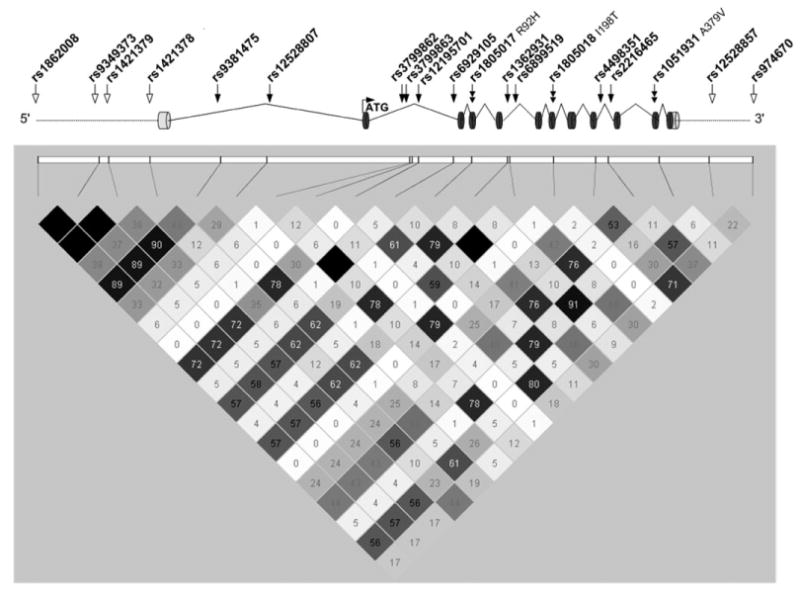
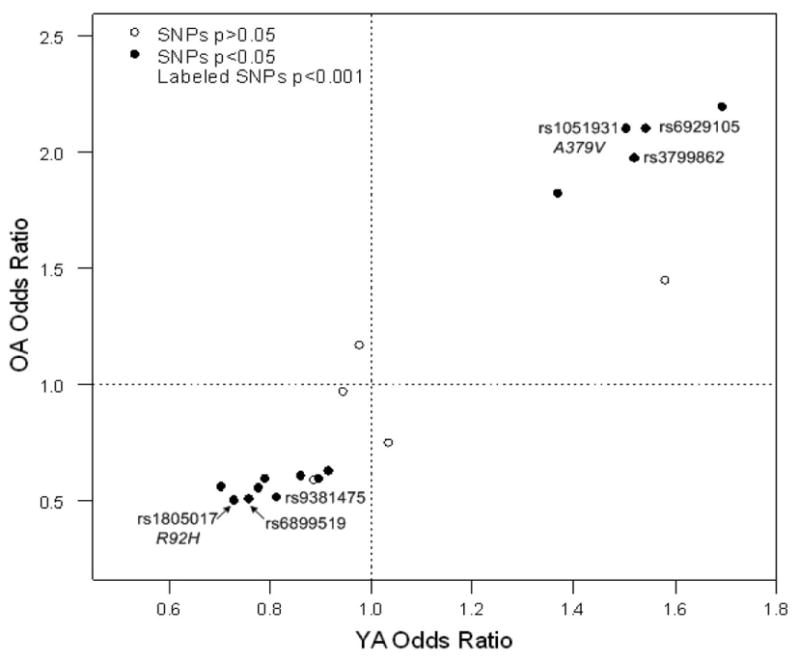
Platelet-activating factor acetylhydrolase (PLA2G7) is a potent pro- and anti-inflammatory molecule that has been implicated in multiple inflammatory disease processes, including cardiovascular disease. The goal of this study was to investigate the genetic effects of PLA2G7 on coronary artery disease (CAD) risk in two large, independent datasets with CAD. Using a haplotype tagging (ht) approach, 19 ht single nucleotide polymorphisms (SNPs) were genotyped in CATHGEN case-control samples (cases = 806 and controls = 267) and in the GENECARD Family Study (n = 1101 families, 2954 individuals). Single SNP analysis using logistic regression revealed nine SNPs with significant association in all CATHGEN subjects (P = 0.0004-0.02). CATHGEN cases were further stratified into subgroups based on age of CAD onset (AOO) and severity of disease; 599 young affecteds (YA, AOO <56) and 207 old affected (OA, AOO >56). Significant genetic effects were observed in both OA and YA (P = 0.0001-0.02). The GENECARD probands demonstrated results similar to those seen in the YA CATHGEN cases (P = 0.002-0.05). Of the 19 SNPs genotyped, 3 SNPs result in nonsynonymous coding changes (I198T, A379V and R92H). Two of the coding SNPs, R92H and A379V, constitute two of the most significantly associated SNPs, even after Bonferroni correction and appear to represent independent associations (r(2) = 0.09). Multiple additional polymorphisms in low linkage disequilibrium with these coding SNPs were also strongly associated. In summary, PLA2G7 represents an important, potentially functional candidate in the pathophysiology of CAD based on replicated associations using two independent datasets and multiple statistical approaches. Further functional studies involving a combination of risk alleles are warranted.
血小板活化因子乙酰水解酶(PLA2G7)是一种强效的促炎和抗炎分子,已被证明与多种炎症性疾病过程有关,包括心血管疾病。本研究的目的是在两个大型独立的冠状动脉疾病(CAD)数据集中,研究PLA2G7对CAD风险的遗传影响。采用单倍型标签(ht)方法,在CATHGEN病例对照样本(病例=806例,对照=267例)和GENECARD家族研究(n = 1101个家庭,2954人)中对19个ht单核苷酸多态性(SNP)进行基因分型。使用逻辑回归进行的单SNP分析显示,在所有CATHGEN受试者中,有9个SNP具有显著相关性(P = 0.0004 - 0.02)。CATHGEN病例根据CAD发病年龄(AOO)和疾病严重程度进一步分层为亚组;599名年轻患者(YA,AOO <56岁)和207名老年患者(OA,AOO>56岁)。在OA和YA中均观察到显著的遗传效应(P = 0.0001 - 0.02)。GENECARD先证者的结果与YA CATHGEN病例中的结果相似(P = 0.002 - 0.05)。在基因分型的19个SNP中,有3个SNP导致非同义编码变化(I198T、A379V和R92H)。其中两个编码SNP,R92H和A379V,即使在Bonferroni校正后,也是最显著相关的两个SNP之一,似乎代表独立的关联(r(2)=0.09)。与这些编码SNP处于低连锁不平衡状态的多个其他多态性也有很强的相关性。总之,基于使用两个独立数据集和多种统计方法的重复关联,PLA2G7代表了CAD病理生理学中一个重要的、潜在功能性的候选基因。有必要进行涉及风险等位基因组合的进一步功能研究。