Mung'ala-Odera V, White S, Meehan R, Otieno G O, Njuguna P, Mturi N, Edwards T, Neville B G, Newton C R J C
Center for Geographic Medicine Research-Coast, Kenya Medical Research Institute, PO Box 428-80108, Bofa Road, Kilifi, Kenya.
Seizure. 2008 Jul;17(5):396-404. doi: 10.1016/j.seizure.2007.11.028. Epub 2008 Jan 14.
There is little data on the burden or causes of epilepsy in developing countries, particularly in children living in sub-Saharan Africa.
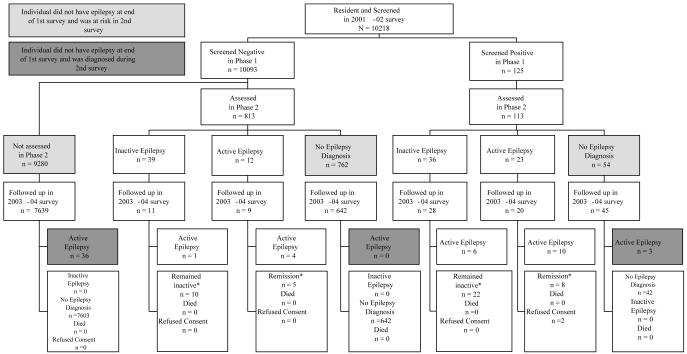
We conducted two surveys to estimate the prevalence, incidence and risk factors of epilepsy in children in a rural district of Kenya. All children born between 1991 and 1995 were screened with a questionnaire in 2001 and 2003, and those with a positive response were then assessed for epilepsy by a clinician. Active epilepsy was defined as two or more unprovoked seizures with one in the last year.
In the first survey 10,218 children were identified from a census, of whom 110 had epilepsy. The adjusted prevalence estimates of lifetime and active epilepsy were 41/1000 (95% CI: 31-51) and 11/1000 (95% CI: 5-15), respectively. Overall two-thirds of children had either generalized tonic-clonic and/or secondary generalized seizures. A positive history of febrile seizures (OR=3.01; 95% CI: 1.50-6.01) and family history of epilepsy (OR=2.55; 95% CI: 1.19-5.46) were important risk factors for active epilepsy. After the second survey, 39 children from the same birth cohort with previously undiagnosed epilepsy were identified, thus the incidence rate of active epilepsy is 187 per 100,000 per year (95% CI: 133-256) in children aged 6-12 years.
There is a considerable burden of epilepsy in older children living in this area of rural Kenya, with a family history of seizures and a history of febrile seizures identified as risk factors for developing epilepsy.
关于发展中国家癫痫负担或病因的数据很少,尤其是撒哈拉以南非洲地区的儿童。
我们进行了两项调查,以估计肯尼亚一个农村地区儿童癫痫的患病率、发病率和风险因素。2001年和2003年,对1991年至1995年出生的所有儿童进行了问卷调查筛查,对回答阳性的儿童,由临床医生评估是否患有癫痫。活动性癫痫定义为两次或更多次无诱因发作,且在过去一年中有一次发作。
在第一次调查中,从人口普查中确定了10218名儿童,其中110名患有癫痫。终生癫痫和活动性癫痫的校正患病率估计分别为41/1000(95%可信区间:31-51)和11/1000(95%可信区间:5-15)。总体而言,三分之二的儿童患有全身性强直阵挛发作和/或继发性全身性发作。热性惊厥阳性病史(比值比=3.01;95%可信区间:1.50-6.01)和癫痫家族史(比值比=2.55;95%可信区间:1.19-5.46)是活动性癫痫的重要危险因素。第二次调查后,在同一出生队列中确定了39名先前未被诊断出癫痫的儿童,因此6至12岁儿童活动性癫痫的发病率为每年187/100000(95%可信区间:133-256)。
生活在肯尼亚农村这一地区的大龄儿童癫痫负担相当重,癫痫发作家族史和热性惊厥病史被确定为患癫痫的危险因素。