Vladimirtsev Vsevolod A, Nikitina Raisa S, Renwick Neil, Ivanova Anastasia A, Danilova Al'bina P, Platonov Fyodor A, Krivoshapkin Vadim G, McLean Catriona A, Masters Colin L, Gajdusek D Carleton, Goldfarb Lev G
Institute of Health-Sakha (Yakut) Republic, Yakutsk, Russian Federation.
Emerg Infect Dis. 2007 Sep;13(9):1321-6. doi: 10.3201/eid1309.061585.
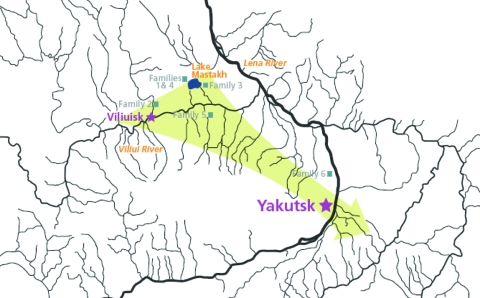
Viliuisk encephalomyelitis is an acute, often fatal, meningoencephalitis that tends to develop into a prolonged chronically progressive panencephalitis. Clinical, neuropathologic, and epidemiologic data argue for an infectious cause, although multiple attempts at pathogen isolation have been unsuccessful. To assess mechanisms of disease transmission and spread, we studied 6 multiplex families. Secondary cases occurred among genetically related and unrelated persons in a setting of prolonged intrahousehold contact with a patient manifesting the disease. Transmission to unrelated persons was documented in a densely populated region around the city of Yakutsk in which Viliuisk encephalomyelitis had not been previously known. Initially identified in a small Yakut-Evenk population on the Viliui River of eastern Siberia, the disease subsequently spread through human contacts to new geographic areas, thus characterizing Viliuisk encephalomyelitis as an emerging infectious disease.
维柳伊斯克脑脊髓炎是一种急性、通常致命的脑膜脑炎,往往会发展为迁延不愈的慢性进行性全脑炎。临床、神经病理学和流行病学数据表明其病因具有传染性,尽管多次尝试分离病原体均未成功。为评估疾病传播和扩散机制,我们研究了6个多成员家庭。在与患病患者长期家庭内接触的情况下,二代病例出现在有血缘关系和无血缘关系的人群中。在雅库茨克市周边人口密集地区记录到了疾病传播给无血缘关系的人,此前该地区并不知晓维柳伊斯克脑脊髓炎。该疾病最初在西伯利亚东部维柳伊河沿岸的一小部分雅库特-埃文克人群中被发现,随后通过人际接触传播到新的地理区域,因此维柳伊斯克脑脊髓炎被认定为一种新发传染病。