Choi Eun Hwa, Kim So Hee, Eun Byung Wook, Kim Sun Jung, Kim Nam Hee, Lee Jina, Lee Hoan Jong
Seoul National University College of Medicine, Seoul, South Korea.
Emerg Infect Dis. 2008 Feb;14(2):275-81. doi: 10.3201/eid1402.070807.
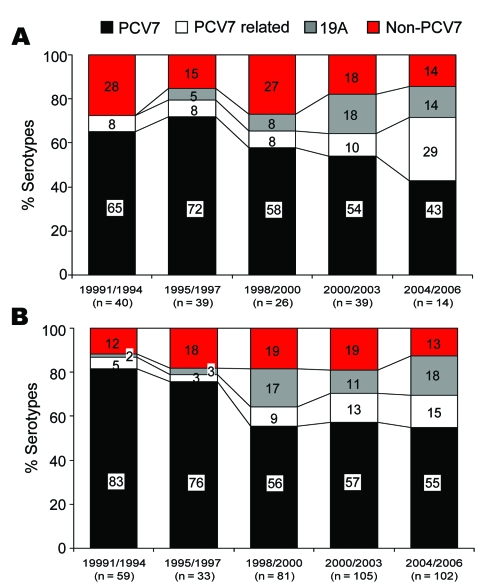
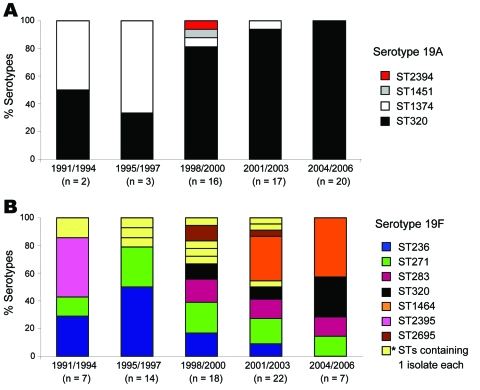
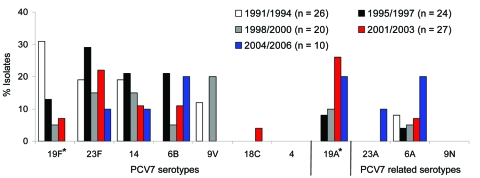
Despite the concern of replacement disease, notably by serotype 19A after 7-valent conjugate vaccine (PCV7) use, serotype 19A was increasingly recognized in Korean children before the introduction of PCV7. To understand the dynamics of serogroup 19 prevalence from 1991-2006, we serotyped 538 pediatric pneumococcal isolates. Serogroup 19 isolates (n = 126) were characterized by antimicrobial drug susceptibility, presence of mefA/ermB, and multilocus sequence typing. Overall, the proportion of serotype 19A isolates increased but serotype 19F decreased. Among children <5 years of age, the proportion of serotype 19A isolates in invasive pneumococcal disease increased from 0% in 1991-1994 to 8%-10% in 1995-2000, reached 26% in 2001-2003, and remained at 20% in 2004-2006 when vaccine coverage did not exceed 25% (p = 0.005 for trend). This study demonstrates that the expansion of multidrug-resistant ST320 was responsible for the increase in serotype 19A before PCV7 use.
尽管存在替代疾病的担忧,尤其是在使用7价结合疫苗(PCV7)后19A血清型引起的担忧,但在引入PCV7之前,19A血清型在韩国儿童中越来越多地被识别出来。为了解1991年至2006年19血清群的流行动态,我们对538株儿童肺炎球菌分离株进行了血清分型。对19血清群分离株(n = 126)进行了抗菌药物敏感性、mefA/ermB的存在情况以及多位点序列分型特征分析。总体而言,19A血清型分离株的比例增加,而19F血清型分离株的比例下降。在5岁以下儿童中,侵袭性肺炎球菌疾病中19A血清型分离株的比例从1991 - 1994年的0%增加到1995 - 2000年的8% - 10%,在2001 - 2003年达到26%,在2004 - 2006年疫苗接种覆盖率不超过25%时保持在20%(趋势p = 0.005)。这项研究表明,多药耐药ST320的扩张是PCV7使用前19A血清型增加的原因。