Mathevon Nicolas, Aubin Thierry, Vielliard Jacques, da Silva Maria-Luisa, Sebe Frédéric, Boscolo Danilo
Equipe Communications Acoustiques Neurobiologie de l'Apprentissage, de la Mémoire et de la Communication (NAMC) Centre National de la Recherche Scientifique (CNRS) UMR8620, Université Paris XI, Orsay, France.
PLoS One. 2008 Feb 13;3(2):e1580. doi: 10.1371/journal.pone.0001580.
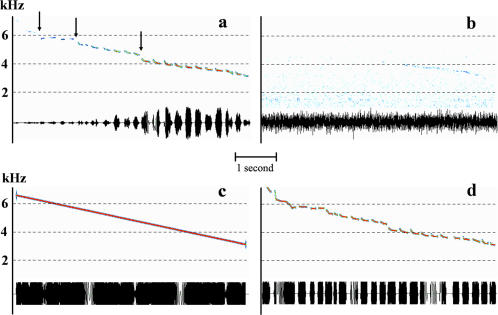
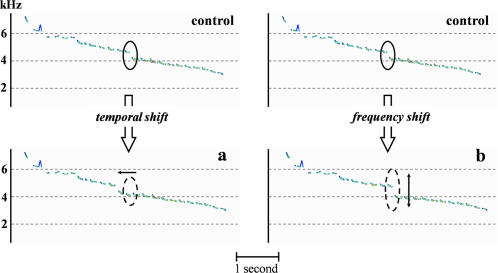
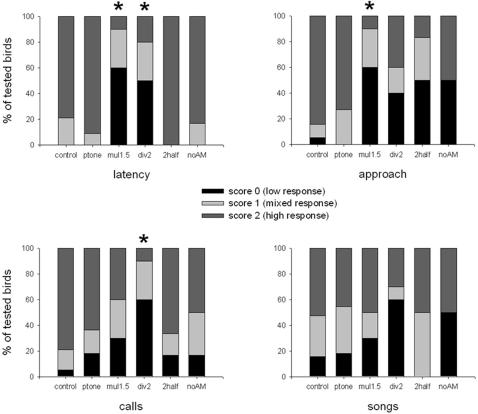
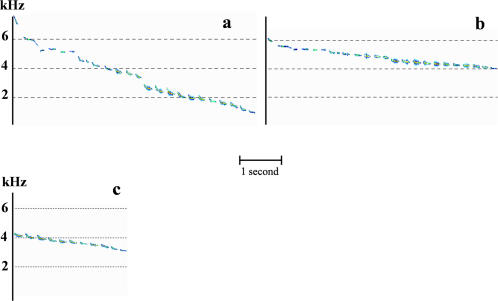
How information transmission processes between individuals are shaped by natural selection is a key question for the understanding of the evolution of acoustic communication systems. Environmental acoustics predict that signal structure will differ depending on general features of the habitat. Social features, like individual spacing and mating behavior, may also be important for the design of communication. Here we present the first experimental study investigating how a tropical rainforest bird, the white-browed warbler Basileuterus leucoblepharus, extracts various information from a received song: species-specific identity, individual identity and location of the sender. Species-specific information is encoded in a resistant acoustic feature and is thus a public signal helping males to reach a wide audience. Conversely, individual identity is supported by song features susceptible to propagation: this private signal is reserved for neighbors. Finally, the receivers can locate the singers by using propagation-induced song modifications. Thus, this communication system is well matched to the acoustic constraints of the rain forest and to the ecological requirements of the species. Our results emphasize that, in a constraining acoustic environment, the efficiency of a sound communication system results from a coding/decoding process particularly well tuned to the acoustic properties of this environment.
个体之间的信息传递过程如何受到自然选择的塑造,是理解声学通信系统进化的关键问题。环境声学预测,信号结构会因栖息地的一般特征而有所不同。社会特征,如个体间距和交配行为,对通信设计也可能很重要。在此,我们展示了第一项实验研究,该研究探究了一种热带雨林鸟类——白眉莺(Basileuterus leucoblepharus)如何从接收到的歌声中提取各种信息:物种特异性身份、个体身份以及发送者的位置。物种特异性信息编码在一种抗性声学特征中,因此是一种公共信号,有助于雄性吸引广泛的受众。相反,个体身份由易受传播影响的歌声特征支持:这种私人信号是留给邻居的。最后,接收者可以通过利用传播引起的歌声变化来定位歌唱者。因此,这种通信系统与雨林的声学限制以及该物种的生态需求非常匹配。我们的结果强调,在具有限制作用的声学环境中,声音通信系统的效率源于一个编码/解码过程,该过程特别适合于这种环境的声学特性。