Lindqvist Lisa, Oberer Monika, Reibarkh Mikhail, Cencic Regina, Bordeleau Marie-Eve, Vogt Emily, Marintchev Assen, Tanaka Junichi, Fagotto Francois, Altmann Michael, Wagner Gerhard, Pelletier Jerry
Department of Biochemistry, McGill University, Montreal, Quebec, Canada.
PLoS One. 2008 Feb 13;3(2):e1583. doi: 10.1371/journal.pone.0001583.
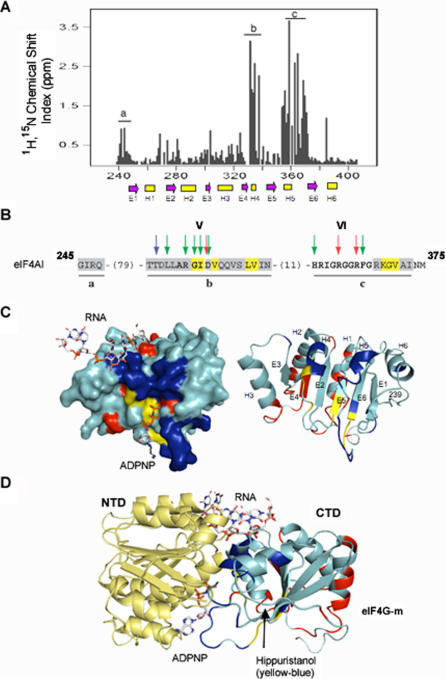
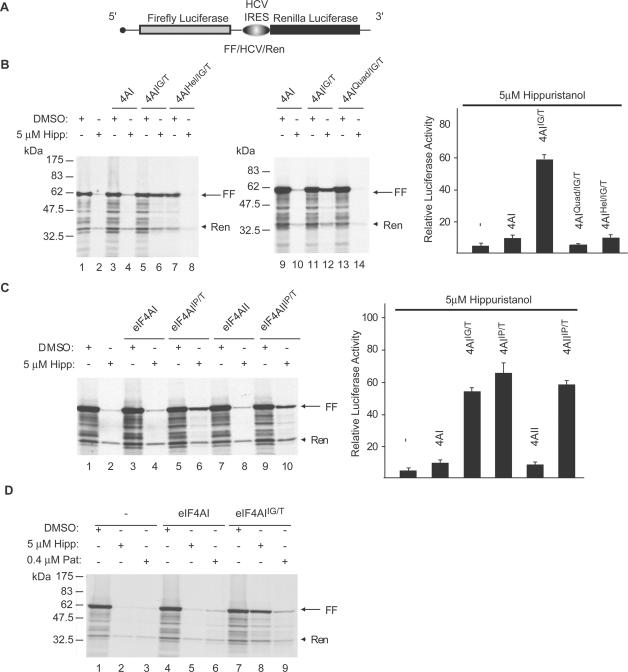
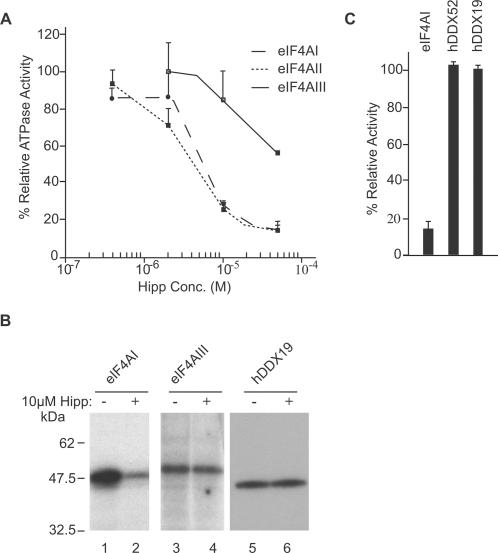
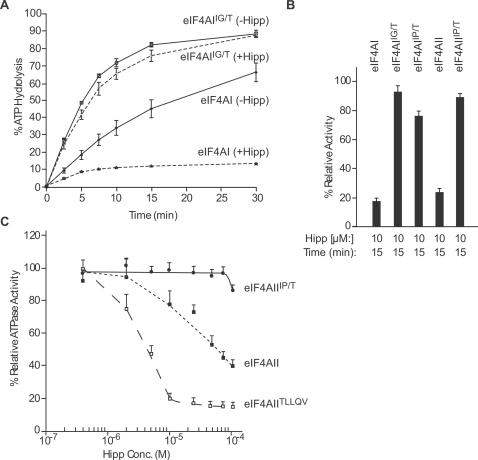
RNA helicases represent a large family of proteins implicated in many biological processes including ribosome biogenesis, splicing, translation and mRNA degradation. However, these proteins have little substrate specificity, making inhibition of selected helicases a challenging problem. The prototypical DEAD box RNA helicase, eIF4A, works in conjunction with other translation factors to prepare mRNA templates for ribosome recruitment during translation initiation. Herein, we provide insight into the selectivity of a small molecule inhibitor of eIF4A, hippuristanol. This coral-derived natural product binds to amino acids adjacent to, and overlapping with, two conserved motifs present in the carboxy-terminal domain of eIF4A. Mutagenesis of amino acids within this region allowed us to alter the hippuristanol-sensitivity of eIF4A and undertake structure/function studies. Our results provide an understanding into how selective targeting of RNA helicases for pharmacological intervention can be achieved.
RNA解旋酶是一大类蛋白质,参与许多生物学过程,包括核糖体生物合成、剪接、翻译和mRNA降解。然而,这些蛋白质的底物特异性很低,使得抑制特定的解旋酶成为一个具有挑战性的问题。典型的DEAD盒RNA解旋酶eIF4A,在翻译起始过程中与其他翻译因子协同作用,为核糖体招募准备mRNA模板。在此,我们深入研究了eIF4A的小分子抑制剂马桑脂醇的选择性。这种源自珊瑚的天然产物与eIF4A羧基末端结构域中存在的两个保守基序相邻且重叠的氨基酸结合。该区域内氨基酸的诱变使我们能够改变eIF4A对马桑脂醇的敏感性,并进行结构/功能研究。我们的结果为如何实现对RNA解旋酶进行选择性靶向以进行药物干预提供了认识。