Davey Jennifer C, Nomikos Athena P, Wungjiranirun Manida, Sherman Jenna R, Ingram Liam, Batki Cavus, Lariviere Jean P, Hamilton Joshua W
Department of Pharmacology & Toxicology, and Center for Environmental Health Sciences, Dartmouth Medical School, Hanover, NH 03755, USA.
Environ Health Perspect. 2008 Feb;116(2):165-72. doi: 10.1289/ehp.10131.
Chronic exposure to excess arsenic in drinking water has been strongly associated with increased risks of multiple cancers, diabetes, heart disease, and reproductive and developmental problems in humans. We previously demonstrated that As, a potent endocrine disruptor at low, environmentally relevant levels, alters steroid signaling at the level of receptor-mediated gene regulation for all five steroid receptors.
The goal of this study was to determine whether As can also disrupt gene regulation via the retinoic acid (RA) receptor (RAR) and/or the thyroid hormone (TH) receptor (TR) and whether these effects are similar to previously observed effects on steroid regulation.
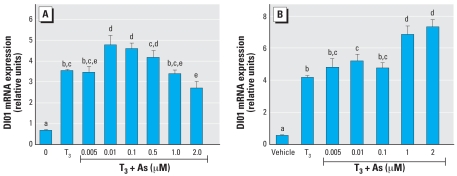
Human embryonic NT2 or rat pituitary GH3 cells were treated with 0.01-5 microM sodium arsenite for 24 hr, with or without RA or TH, respectively, to examine effects of As on receptor-mediated gene transcription. At low, noncytotoxic doses, As significantly altered RAR-dependent gene transcription of a transfected RAR response element-luciferase construct and the native RA-inducible cytochrome P450 CYP26A gene in NT2 cells. Likewise, low-dose As significantly altered expression of a transfected TR response element-luciferase construct and the endogenous TR-regulated type I deiodinase (DIO1) gene in a similar manner in GH3 cells. An amphibian ex vivo tail metamorphosis assay was used to examine whether endocrine disruption by low-dose As could have specific pathophysiologic consequences, because tail metamorphosis is tightly controlled by TH through TR. TH-dependent tail shrinkage was inhibited in a dose-dependent manner by 0.1- 4.0 microM As.
As had similar effects on RAR- and TR-mediated gene regulation as those previously observed for the steroid receptors, suggesting a common mechanism or action. Arsenic also profoundly affected a TR-dependent developmental process in a model animal system at very low concentrations. Because RAR and TH are critical for both normal human development and adult function and their dysregulation is associated with many disease processes, disruption of these hormone receptor-dependent processes by As is also potentially relevant to human developmental problems and disease risk.
长期饮用含过量砷的水与人类患多种癌症、糖尿病、心脏病以及生殖和发育问题的风险增加密切相关。我们之前证明,在低环境相关水平下,砷作为一种有效的内分泌干扰物,会在所有五种类固醇受体的受体介导基因调控水平上改变类固醇信号传导。
本研究的目的是确定砷是否也能通过视黄酸(RA)受体(RAR)和/或甲状腺激素(TH)受体(TR)干扰基因调控,以及这些影响是否与之前观察到的对类固醇调控的影响相似。
分别用0.01 - 5 microM亚砷酸钠处理人胚胎NT2细胞或大鼠垂体GH3细胞24小时,分别添加或不添加RA或TH,以研究砷对受体介导的基因转录的影响。在低非细胞毒性剂量下,砷显著改变了NT2细胞中转染的RAR反应元件 - 荧光素酶构建体和天然RA诱导的细胞色素P450 CYP26A基因的RAR依赖性基因转录。同样,低剂量砷以类似方式显著改变了GH3细胞中转染的TR反应元件 - 荧光素酶构建体的表达以及内源性TR调节的I型脱碘酶(DIO1)基因的表达。使用两栖动物离体尾巴变态试验来研究低剂量砷的内分泌干扰是否会产生特定的病理生理后果,因为尾巴变态受TH通过TR严格控制。0.1 - 4.0 microM的砷以剂量依赖性方式抑制了TH依赖性尾巴收缩。
砷对RAR和TR介导的基因调控的影响与之前观察到的对类固醇受体的影响相似,表明存在共同的机制或作用方式。在非常低的浓度下,砷也在模型动物系统中深刻影响了TR依赖性发育过程。由于RAR和TH对正常人类发育和成人功能都至关重要,并且它们的失调与许多疾病过程相关,因此砷对这些激素受体依赖性过程的干扰也可能与人类发育问题和疾病风险相关。