Sellahewa Chaminda, Nightingale Peter, Carmichael Amtul R
Department of Surgery, Russells Hall Hospital, Dudley, West Midlands, DY1 2HQ, UK.
Int Semin Surg Oncol. 2008 Feb 24;5:2. doi: 10.1186/1477-7800-5-2.
Both obesity and over-expression of HER II are associated with poor prognosis of breast cancer. In vitro experiments suggest that anti-tumour activity of the anti-obesity drug Orlistat is likely to be due to transcriptional suppression of HER II expression. The overexpression of HER II is also positively correlated with other markers of prognosis of breast cancer such as cathepsin expression.
The hypothesis we tested was that the obese women with breast cancer might over-express HER II more often than their lean counterparts to account for the poor prognosis.
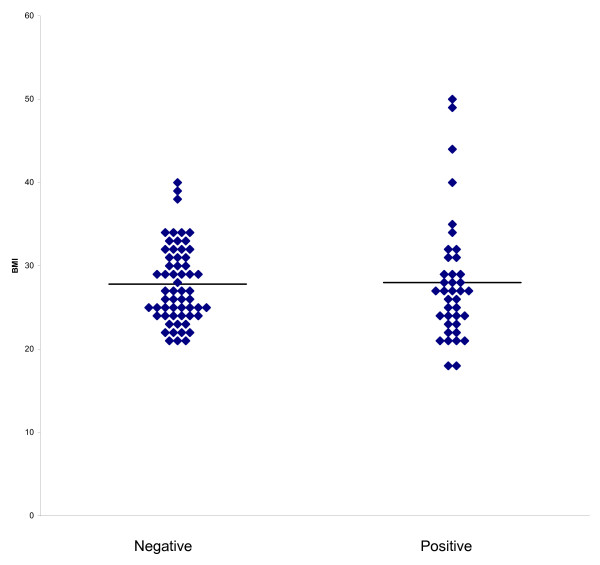
One hundred consecutive patients were included in this study. Their body mass indexes were correlated with overexpression of HER II.
There was also no association between oestrogen or progesterone receptor positivity and obesity or HER II over expression in premenopausal or post-menopausal women with breast cancer.
The present study demonstrated that the poor outcome of breast cancer in obese patients is not due to over expression of HER II.
肥胖和HER II的过表达均与乳腺癌的不良预后相关。体外实验表明,抗肥胖药物奥利司他的抗肿瘤活性可能归因于HER II表达的转录抑制。HER II的过表达也与乳腺癌其他预后标志物如组织蛋白酶的表达呈正相关。
我们所检验的假设是,肥胖乳腺癌女性比瘦的乳腺癌女性更常出现HER II过表达,以解释不良预后。
本研究纳入了100例连续的患者。她们的体重指数与HER II的过表达相关。
在绝经前或绝经后乳腺癌女性中,雌激素或孕激素受体阳性与肥胖或HER II过表达之间也无关联。
本研究表明,肥胖患者乳腺癌预后不良并非由于HER II的过表达。